Pharmaceutical translation is not a simple content task. It is a regulated process that can affect approval timelines, patient safety, and market access.
For procurement managers and regulatory affairs teams at a pharmaceutical company, choosing the right pharmaceutical translation service is not only about price or turnaround time. It is about whether the provider can handle pharmaceutical documents with the right level of accuracy, compliance, and control.
A mistranslated information leaflet, clinical trial document, or regulatory submission can create more than just extra edits. It can lead to questions from regulators, delayed approvals, and serious risk for patients and brands.
What Poorly Translated Pharmaceutical Documents Actually Cost
Poorly translated pharmaceutical documents do not just create rework. They create regulatory risk.
A terminology error in a regulatory submission can trigger questions from the Food and Drug Administration FDA, the European Medicines Agency, or another local authority. That means more review cycles, more internal pressure, and possible delays in approval or launch.
For a launch-stage pharmaceutical product, even a short delay can carry a major commercial cost. The translation fee is usually small compared to the cost of missed market entry, delayed distribution, or repeated regulatory review.
This is why Regulatory Submission Translation should never be treated as a last-minute task. By the time the source files are final, terminology, formatting, and Quality Assurance requirements should already be clear.
Many teams say, “We already work with a translation agency.” But pharmaceutical translation needs more than general language support. It needs expert translators, validated terminology, documented review steps, and a workflow built around regulatory compliance.
The Pharmaceutical Documents Where Translation Failure Has the Highest Stakes
Not all pharmaceutical documents carry the same level of risk. Some documents affect approval. Others affect patient understanding. Some do both.
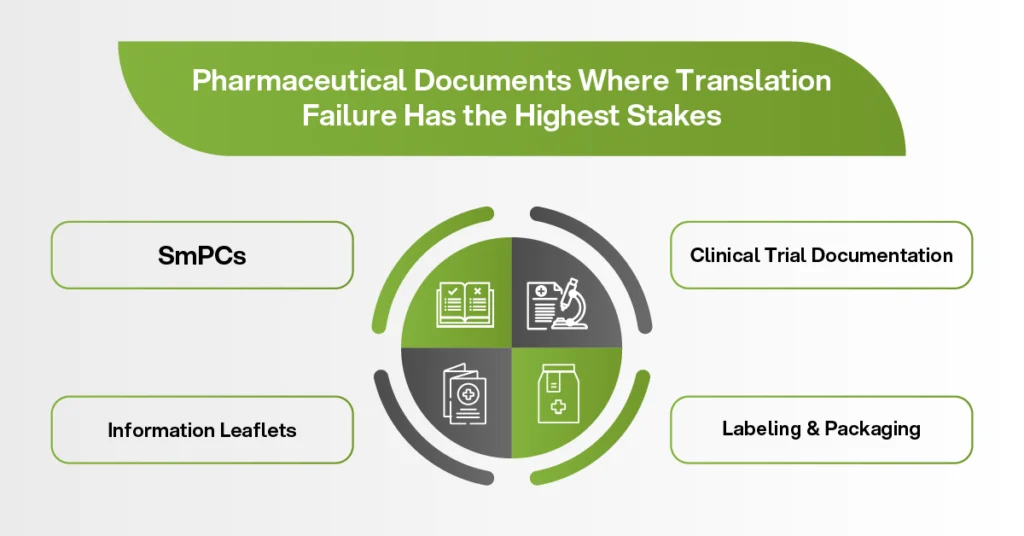
The highest-risk document types usually include:
Summaries of Product Characteristics, or SmPCs. These must follow strict regulatory structure and terminology, especially for European Medicines Agency submissions.
Information leaflets. These are patient-facing documents, so accuracy alone is not enough. The translated documents must be clear, readable, and understandable in the target language.
Clinical trial documentation. Protocols, informed consent forms, case report forms, and patient materials must support accurate participation across multiple languages. This is where Clinical Trial Translation Services become critical.
Labeling and packaging. These documents must fit approved layouts, character limits, local labeling rules, and multilingual packaging requirements.
The specialized part is not only the act of translation. It is the Quality Assurance process applied to each document type.
How Pharmaceutical Translation Differs From General Medical Translation Services
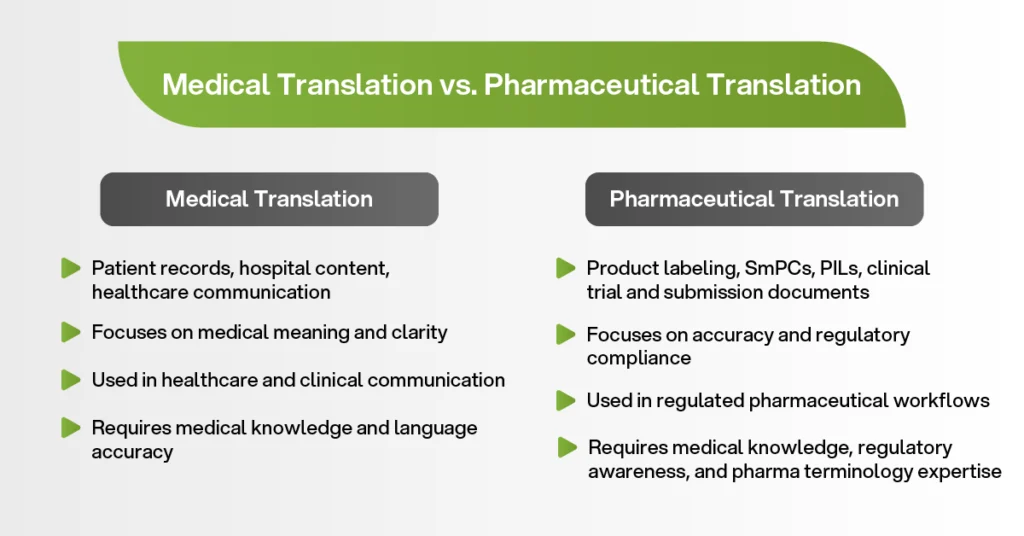
Pharmaceutical translation and medical translation are closely related, but they are not the same service.
Medical Translation Services often cover patient records, healthcare content, hospital materials, and general clinical communication. This work is important, but pharmaceutical translation has a more specific regulatory scope.
Pharmaceutical translation covers regulated dossiers, product labeling, SmPCs, patient information leaflets, clinical trial materials, and submission documents. These documents must align with the rules of the target authority, not only the meaning of the source text.
That means expert translators working on pharmaceutical translation need more than language fluency. They need regulatory awareness, subject-matter knowledge, and experience with pharmaceutical industry terminology.
A general medical translator may understand the clinical meaning of a term. A pharmaceutical translator must understand how that term should appear in a regulatory context.
That difference matters.
The Regulatory Compliance Standards Your Pharmaceutical Translation Must Meet
Every target market has its own expectations for pharmaceutical products, labeling, patient information, and regulatory submissions.
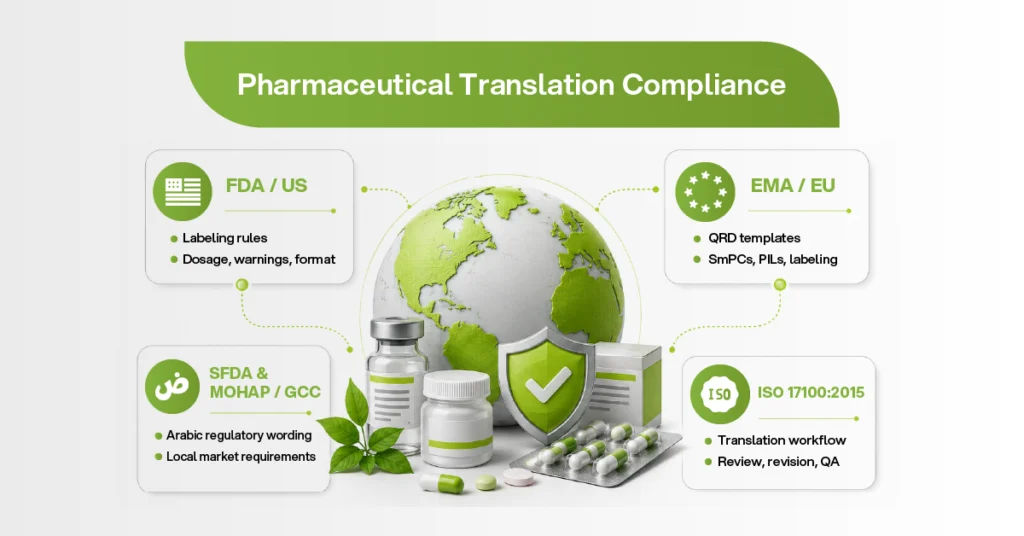
In the US, pharmaceutical labeling must align with FDA requirements under 21 CFR Part 201. This includes rules around content, format, dosage information, warnings, and other labeling elements.
In the EU, the European Medicines Agency uses QRD templates for product information, including SmPCs, labeling, and package leaflets. The translated versions need to follow the same structure and maintain consistent terminology across languages.
In GCC markets, requirements from authorities such as the Saudi Food and Drug Authority and UAE MOHAP add another layer of complexity. Arabic-language pharmaceutical translation cannot rely on general Arabic alone. It must reflect the local regulatory wording, market expectations, and patient communication style.
This is where Life Sciences Translation Services need to be built around separate regulatory glossaries for each market. FDA, EMA, SFDA, and UAE MOHAP terminology do not always match perfectly. A single general glossary is rarely enough.
ISO 17100:2015 is also an important baseline because it defines requirements for professional translation processes, translator qualifications, revision, and project management. For pharmaceutical translation, it should be supported by domain-specific QA, terminology control, and regulatory review.
The Translation Tools and Workflows That Improve Accuracy at Scale
Translation tools can support pharmaceutical translation when they are used correctly. They should not replace expert translators, but they can help control consistency across large projects.
Translation Memory is one of the most valuable tools in pharmaceutical translation. It stores previously approved translations so the same terminology can be reused across updated documents, new submissions, and related product materials.
This is especially useful for pharmaceutical products that go through repeated updates. The same warning, dosage instruction, adverse reaction, or product term should not be translated differently every time.
CAT tools also help translators work with approved terminology, flag inconsistencies, and manage large volumes across multiple languages. They are not the same as machine translation. They are professional translation environments that support human work.
Machine Translation Post-Editing may be suitable for lower-risk pharmaceutical marketing content, depending on the project. But it should not be used carelessly for regulatory submissions, information leaflets, clinical trial consent forms, or safety-critical content.
The key question is not if the provider uses translation tools, but whether those tools include regulatory-specific terminology, controlled access, professionally trained linguists, and a robust Quality Assurance process.
What a Pharmaceutical Translation Program Delivers for a Global Product Launch
For a pharmaceutical company preparing a global launch, translation is not one document. It is a full program.
A launch may require SmPCs, PILs, labeling, packaging, regulatory submissions, website content, patient support materials, and healthcare professional communication across multiple languages. These assets often need to move together under one timeline.
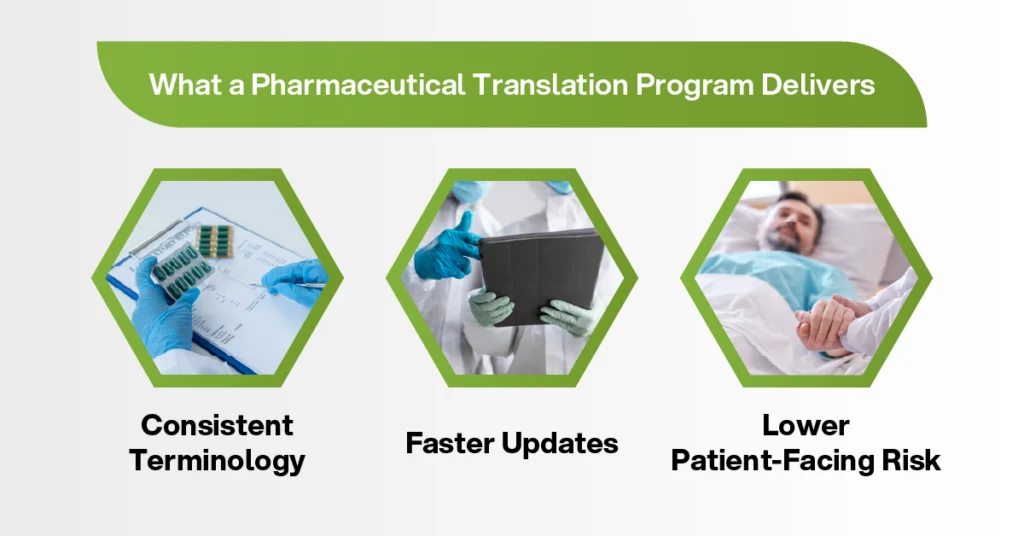
A structured pharmaceutical translation program delivers three practical outcomes.
First, it keeps terminology consistent across all translated documents. This reduces confusion between regulatory, clinical, and patient-facing materials.
Second, it supports faster updates. Once Translation Memory and approved terminology are in place, every future amendment, label update, or new market version becomes easier to manage.
Third, it helps reduce risk in patient-facing content. Cultural nuances, reading habits, and local medical terminology can affect whether patients understand instructions correctly.
For companies running trials and preparing submissions at the same time, connecting Clinical Trial Translation Services with the regulatory translation workflow is especially valuable. It prevents terminology from drifting between trial materials and final submission documents.
Why Cultural Nuances Matter in Pharmaceutical Translation
Accurate translations are not only about correct words. They are about the correct understanding.
An information leaflet translated into Arabic, for example, should not sound like a direct English transfer. It must match the reading patterns, medical wording, and formatting expectations of the target market.
This is not a style issue. It is a patient safety issue.
If a patient misunderstands dosage instructions, storage conditions, side effects, or warning language, the impact can be serious. That is why cultural nuances matter in pharmaceutical translation.
The target language should feel clear and natural to the reader while still staying aligned with the approved source and regulatory requirements.
This balance is where expert translators make a real difference.
Pharmaceutical Translation Checklist Before You Brief Any Provider
Before choosing a pharmaceutical translation service, confirm the following:
- Define the exact document types: SmPCs, PILs, labeling, regulatory submissions, clinical trial documents, or marketing materials.
- List every target language and market.
- Identify the relevant regulatory authorities, such as FDA, EMA, SFDA, UAE MOHAP, or others.
- Confirm the provider has pharmaceutical industry experience, not only general medical experience.
- Ask whether expert translators are qualified by language pair, subject area, and regulatory domain.
- Check whether Translation Memory and approved glossaries will be created or updated.
- Define the Quality Assurance workflow for each document type.
- Confirm whether back-translation is needed for clinical trial or patient-facing materials.
- Share formatting, layout, and submission requirements early.
- Brief the provider before the source files are final, not after.
Launch Your Pharmaceutical Translation Program with bayantech
Pharmaceutical translation needs accuracy, regulatory awareness, and a workflow built to protect timelines.
bayantech supports pharmaceutical companies, CROs, and life sciences teams with specialized pharmaceutical translation services across regulatory, clinical, medical, and patient-facing content.
Share your document types, language pairs, target regulatory authorities, and submission deadline. Our team will help you scope the project clearly, identify QA requirements, and prepare accurate translations built for regulatory confidence.