














Professional eLearning Translation Services

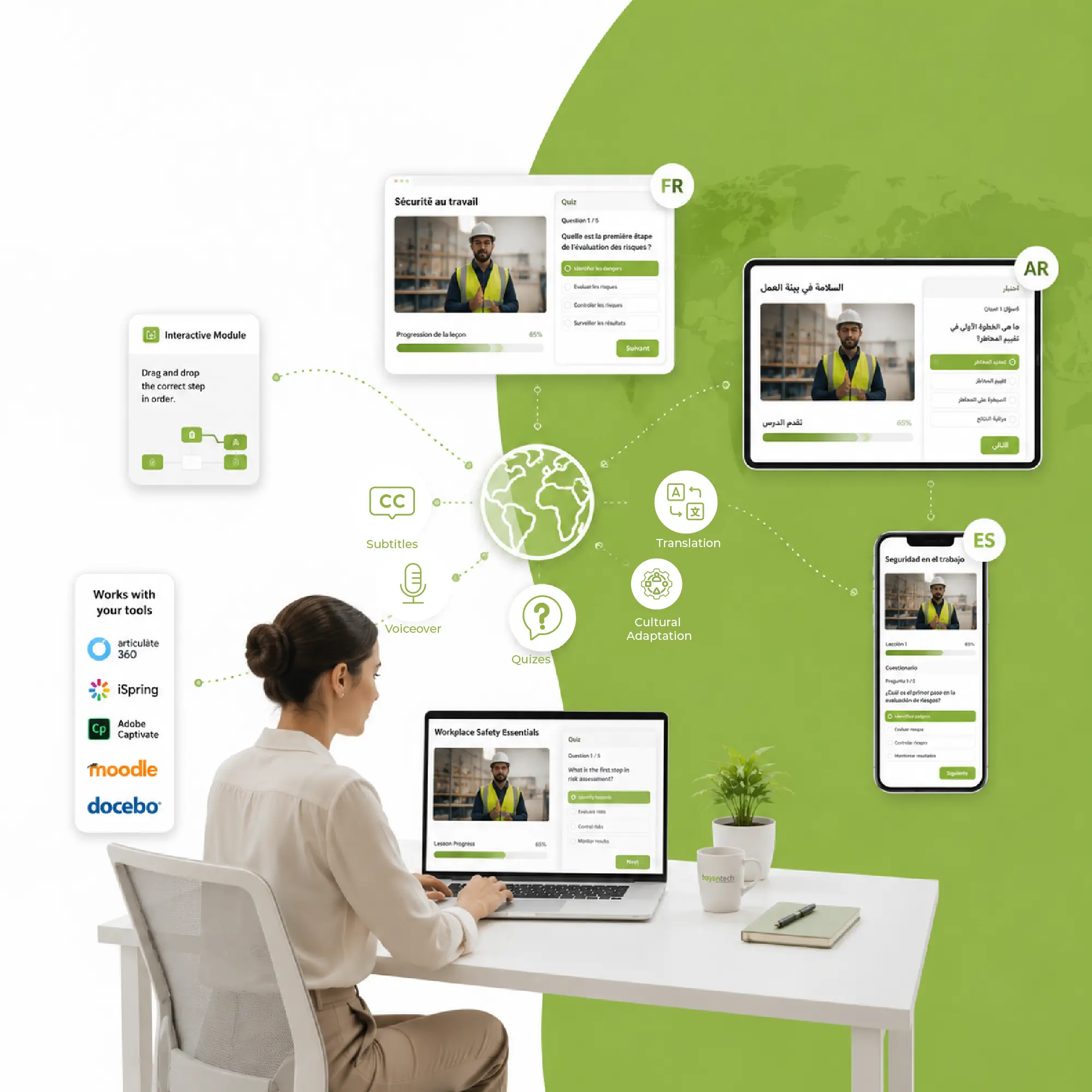
Launch multilingual eLearning courses without rebuilding courses from scratch. bayantech translates and localizes training materials, content, quizzes, and interactive modules to match how people learn in each market, while maintaining consistency across authoring tools, eLearning platforms, and every learning environment.

Our eLearning translation services help you launch translated and localized eLearning courses with ease. We adapt learning to ensure learners understand clearly, stay engaged, and complete training confidently, regardless of their language.

Our eLearning Translation Services

elearning translation services
1 1

What Are eLearning Translation Services?

eLearning translation services convert your course into a new target language. Localization services go a step further, making the course feel natural in the learner’s native language and culture. 

That means adapting more than lesson text; UI labels, quizzes, navigation, and interactive modules are also translated and localized so the full course functions smoothly inside the same learning environment.

  • Translation vs. localization: Translation converts the language accurately. Localization adapts the course so it feels natural, with tone, terminology, UI labels, and examples included.
  • Why “translation-only” often underperforms: Even if the text is correct, learners can struggle with confusing navigation, awkward phrasing, and unclear instructions, leading to lower engagement and completion rates.
  • What “fully translated and localized” means: Every learner-facing element is aligned to each market, including course content, assessments, UI, and interactive behaviors (prompts, feedback, and scoring).

Why Translate eLearning Courses for Global Teams?

Learners understand and retain training content better in their native language, especially when examples are culturally relevant and aligned with local learning styles. 

Translating eLearning courses into multiple languages improves engagement, reduces misunderstandings, and supports stronger assessment performance.

For global businesses, multilingual eLearning also helps standardize training across regions, so every team follows the same policies, skills, and quality expectations, no matter where they work.

With Professional eLearning Translation and Localization, You Get 

  • Faster onboarding and fewer support issues

  • Better engagement and completion rates

  • Consistent policies and skill standards worldwide

  • Scalable growth with multilingual eLearning
2 1

What Makes bayantech Different?

Group 2949 1

Professional Services

Group 2073

+15 Years of Experience

Group 2068

Flexible Turnarounds Timely Delivery

certified quality assurance

Certified Quality Assurance

Group 2076

24/7
Support

Group 2069

100% Quality Guarantee

Group 2070

Affordable
Rates

Group 2071

Complete
Security

Group 27382

Customer Satisfaction

Group 2951 1

Technological Advantage

Group 3520
Group 3519
1 1

What Parts of eLearning Courses Do You Translate and Localize?

We translate and localize every element learners interact with: learning content, navigation, quizzes, downloadable training materials, and interactive modules. 

The goal is one clear, consistent learning experience in each target language, with culturally relevant phrasing and examples that support real understanding. 

This reduces learner confusion, protects training intent, and helps your teams complete training with confidence, regardless of language or region.

We Translate and Localize

  • Course scripts and on-screen training content

  • Assessments, quizzes, and question banks

  • UI labels, buttons, menus, and navigation

  • PDFs, workbooks, and supporting training materials

  • Examples, scenarios, and visuals to be culturally relevant

  • Interactive module checks (click paths, scoring, and feedback)

Can You Work With Our Authoring Tools and eLearning Platforms?

Yes. We support popular authoring tools and eLearning platforms used for corporate training. 

We keep your course structure intact and return localized files that are ready to upload so the course runs smoothly in the same learning environment, just in a new target language. 

This helps you launch multilingual training faster without rebuilding modules or reformatting content.

  • We work from your source files and exports from your authoring tools.
  • You receive a localized course package plus updated assets (text, UI, and media as needed).
  • Delivered in the format your platform expects, so your team can upload and publish with minimal effort.
2 1
1 1

How Do You Ensure Learning Content Stays Clear Across Multiple Languages?

Multilingual training fails when content is technically accurate but unclear, inconsistent, or hard to follow. 

We prevent that by combining specialized linguists with structured QA and review checks that protect meaning, tone, and usability. 

The result is learning content that reads naturally in each native language, while staying aligned across multiple languages for consistent training outcomes.

We achieve this with a QA workflow designed specifically for multilingual eLearning, including:

  • Clarity and instructional tone checks to keep guidance easy to follow
  • Consistent terminology across training materials and course versions
  • Validation of interactive modules (labels, feedback, and quiz logic)
  • Cultural review for learning styles and culturally relevant examples

Which Industries Use eLearning Translation Services Most?

Industries with distributed teams and standardized training benefit most from multilingual eLearning, especially when training content must be consistent across locations. 

Common sectors include manufacturing, healthcare, technology, finance, retail, and other compliance-driven environments. 

When courses are delivered in the learner’s native language and adapted to the local learning environment, teams make fewer mistakes, follow policies more consistently, and perform better on the job.

What Is Your Translation Process for eLearning Courses?

Our translation process is built to achieve learning goals. We start by scoping your course, then prepare all assets so nothing gets missed. 

Here’s how our process works:

Audit and Scope the Course

We review your eLearning course to confirm languages, file formats, learning goals, and any platform requirements so scope and turnaround times are clear from day one.

Group 2691

Translate and Localize the Learning Content

Specialized linguists translate the course for each target language and localize tone, terminology, and examples so the content feels natural and instructionally clear.

Group 2690

Deliver Publish-Ready Files and Support Rollout

You receive localized packages ready to upload, along with support for publishing, updates, and ongoing maintenance as your training content evolves.

Group 2712
Group 2689

Prepare All Course Assets

We extract and organize on-screen text, UI labels, assessments, interactive elements, media references, and training materials to ensure nothing is missed.

Group 2692

Validate Interactive Modules in the Learning Environment

We verify that navigation, buttons, feedback messages, scoring, and quiz logic work correctly after localization inside the same learning environment.

Group 2690

What Turnaround Times Should We Expect?

Turnaround times depend on 

  • Course size
  • Number of languages
  • Media requirements
  • The level of interactivity in your modules 

Your dedicated project managers confirm timelines upfront, align each language track, and keep the rollout on schedule so your multilingual eLearning launch stays predictable. 

If you’re working toward a fixed deadline, we can prioritize critical modules first and deliver in phases to help you go live sooner.

Timelines are shaped by word count, media handling, and interactive modules, and phased delivery options are available (for example, a pilot module first). For change requests, version updates, and ongoing maintenance, immediate support is provided. 

3 1

Professional Translation at Your Deadline.

Languages we translate into

We help you expand your business with our professional language translation service,
supporting the most challenging languages.

elearning translation services

Frequently Asked Questions

Here are the most common questions teams ask before adopting machine translation at scale:

Can you deliver courses fully translated and localized for multiple languages?

Yes. We translate and localize the full course experience—content, UI, quizzes, and interactive modules—so each version is ready to publish and consistent with the original.

Yes. We can pilot one language or one module first to confirm quality, workflow, and turnaround times before scaling to additional languages.

Share your source course files (from your authoring tools), any exports, and all supporting training materials, plus your target languages, platform details, and deadline.

We work with common authoring tools like Articulate 360 (Storyline/Rise), Adobe Captivate, Lectora, iSpring Suite, Camtasia, and Elucidat, and eLearning platforms/LMSs like Moodle, Cornerstone, SAP SuccessFactors, Docebo, TalentLMS, and Litmos.

Yes. Dedicated project managers coordinate schedules, languages, and updates for clear communication.

Ready to Launch Multilingual eLearning Courses That Learners Complete?

Share your course format, authoring tools, eLearning platforms, target languages, and deadline. 

We’ll confirm turnaround times, assign dedicated project managers, and deliver translated and localized training that fits each target language and learning culture, so your teams can learn clearly, stay engaged, and complete training with confidence.

Our Achievements Languages

Group 1056
Words
1 M
An icon that represents the languages we translate into
Projects
1000
Group 1059
clients
100
An icon that represents the languages we translate into
Languages
1

Ready to Get Started?

*to apply for freelance translator and vendor opportunities, please click here.
Subscribe to our newsletter and see the latest
industry news and statistics