








1. Content Review and Planning
We assess content types, target markets, formats, and deadlines to apply the right level of localization to each asset.
Accurate translation is only the first step. If the tone, measurements, dates, currencies, or cultural references still reflect the source market, your content will feel like an afterthought.
bayantech provides professional content localization services that adapt language, formatting, and cultural context for every target market. From websites and product pages to technical documents and eLearning courses, we help you deliver clear, relevant, and consistent content at any scale.


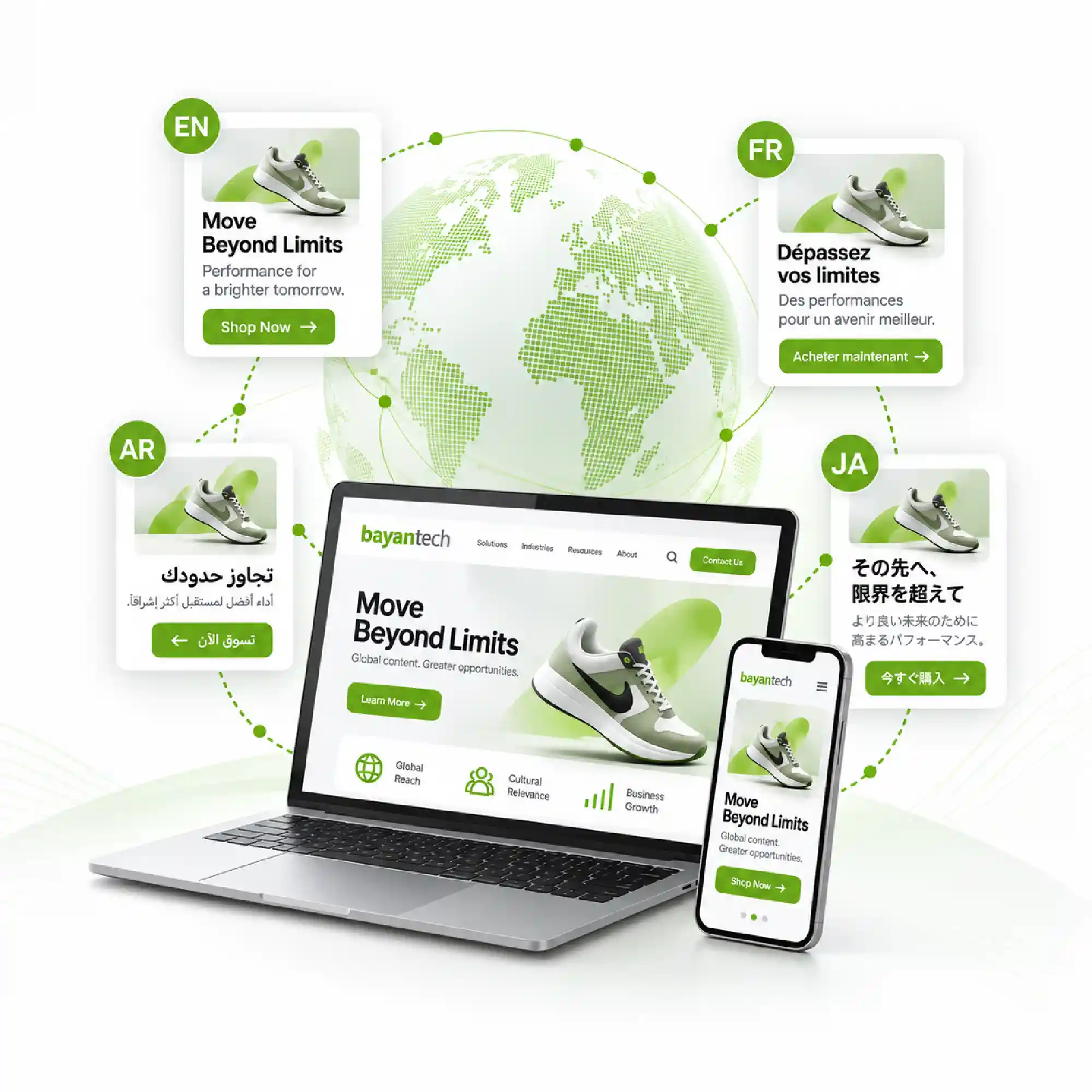

Accurate translation is important, but accuracy alone does not guarantee that the content will work in another market.
A product page may use the wrong currency or measurement units. A website may show unfamiliar date formats. An image may not suit the local audience. Even the tone may feel too direct, too formal, or inconsistent with the brand.
These gaps can reduce trust, create confusion, increase support requests, and weaken the return on your content investment.
A translation vendor may confirm that the words are correct, but global content adaptation also requires cultural, visual, technical, and market-level review.
At bayantech, we look beyond the text. Our localized content solutions consider the audience, platform, purpose, format, and customer journey so every piece of content feels natural in its intended market.
The same issue can affect paid campaigns. Translated ad copy may underperform when the currency, offer, or message framing does not match the local audience, which is why localization is also essential for Multilingual PPC.

Multilingual content simply means information is available in multiple languages.
Content localization means each version is actively adapted for the market where it will be used.
Publishing a website in ten languages won’t drive results if those versions ignore local terminology, search behavior, or audience expectations. A localization agency ensures each language version thrives in its own market. For example, a localized product page adapts:
Creative campaign assets may need a different approach. Content that depends on emotion, wordplay, or humor often requires Transcreation Services rather than standard localization.
Not every content type carries the same level of risk or business value.
Content that supports a transaction, product decision, customer request, or training outcome should usually receive priority over content that is purely informational.

We localize landing pages, service pages, navigation, banners, forms, CTAs, and supporting website content.
Our team adapts the language and formatting while ensuring the localized copy fits the design, supports the user journey, and remains consistent with your brand.
Product content localization covers descriptions, features, specifications, categories, catalogs, and marketplace listings.
Consistent terminology is especially important. Different translations of the same product feature can confuse customers, sales teams, and support teams across markets.
Directly translating an article does not always make it relevant to local readers or search engines.
We adapt examples, references, terminology, headings, and search terms so the content matches the market where it will be published.
Blog and article localization works closely with Multilingual SEO Services, helping localized content remain both natural to readers and visible in local search results.
We localize user manuals, installation guides, product documentation, help centers, FAQs, and support materials.
Our terminology management process helps keep product names, features, commands, and technical instructions consistent across documents and languages.
eLearning content localization can include course modules, assessments, presentations, voice-over scripts, subtitles, interfaces, and downloadable resources.
We adapt the learning experience for the language, culture, knowledge level, and technical environment of each audience.
We also adapt campaign pages, email content, downloadable resources, case studies, and other customer-facing materials.
Wider campaign coordination across advertisements, social media, email, and multimedia can be managed through our Marketing Localization Services.
We assess content types, target markets, formats, and deadlines to apply the right level of localization to each asset.
We leverage existing translation memories, glossaries, and style guides to reuse approved language and maintain consistency.
Native linguists adapt the content for language, tone, terminology, and cultural relevance based on your industry.
A secondary review checks linguistic accuracy, formatting, and market suitability, including in-context reviews within your platform or document.
We deliver final files in your required format and update language assets to make future revisions faster and more cost-effective.

Technology makes high-volume localization scalable, but it shouldn’t be applied blindly.
AI-powered localization and Machine Translation Post-Editing (MTPE) are ideal for large volumes of lower-risk content, such as product catalogs, internal knowledge bases, and repetitive support articles. In MTPE, professional linguists review and correct machine-translated output to meet agreed quality standards.
However, customer-facing marketing copy, sensitive technical materials, and content requiring a strong brand voice still need full human translation or creative adaptation. bayantech evaluates content risk and purpose to recommend the right workflow, giving you scalability without sacrificing human judgment where it matters most.

As content volumes grow, terminology drift is a real risk. One regional team might translate a product feature differently than another, causing confusion across your website, support center, and sales materials.
bayantech prevents this through global content governance. We create and maintain shared language assets, including:
These resources give every linguist and regional team a single source of truth. This doesn’t slow production; it reduces rework, speeds up publishing, and improves your localization ROI.
The right partner should be able to support both your current project and your future content growth.
When comparing providers, ask whether they can provide:
A commitment to maintaining glossaries and translation memories across all projects.

bayantech supports both common and rare languages, with native linguists assigned to every language pair to ensure natural flow and the right tone for your audience.
We also handle regional variants, such as country-specific Arabic, French, or Spanish terminology, so the final translation feels local, not generic.
Whether you’re translating for internal teams, external stakeholders, or official submission, we help you choose the right language variant for the market you’re targeting.

A certified translation is a translation delivered with a signed statement confirming the translation is accurate and complete.
In practical terms, the difference is simple: standard translation is for everyday business use, while certified translation is prepared for situations where an authority needs formal confirmation for review and acceptance.
The signed statement typically includes:
Certified translation is commonly requested for immigration files, court and legal matters, university admissions, and government submissions, especially when documents are reviewed by authorities, courts, or law firms.
If your submission requires additional authentication, we can also support add-ons such as notarization or sworn translation, where applicable.
bayantech supports industries where documentation needs to be accurate, consistent, and ready for use.
We work with legal, medical, finance, technology, manufacturing, and education teams, translating everything from contracts and reports to technical manuals and regulated content.
Clients choose us for terminology consistency across large document sets, secure handling for sensitive files, and dependable turnaround times that keep approvals, submissions, and operations moving without delays.
Your all-in-one trusted partner for enterprise localization, multilingual marketing, and AI — governed by ISO-driven quality across every market.
Governed quality management across every project
Trusted by regulated and global brands since day one
Speed-to-market without sacrificing accuracy
Localization, marketing & AI under one roof
Deep experience in Life Sciences, Legal & ICT/SaaS
SLA-backed response time, no waiting on launch
In-market teams across your priority growth regions
Subject-matter experts, not just translators
Data governance built for regulated content
24/7 support with a single point of accountability

Content localization for SaaS is rarely a one-time project.
Product teams may release new interface strings, feature pages, emails, release notes, help articles, and onboarding content every few weeks.
A content localization agency supporting SaaS should be able to work around recurring release cycles, maintain terminology across the product and knowledge base, and manage small updates without restarting the complete process each time.
bayantech supports scalable SaaS localization through controlled language assets, repeatable workflows, technology integration, and agreed delivery schedules.
This helps product, marketing, and support content remain aligned as the platform grows.
Your global content shouldn’t feel copied. It should feel clear, useful, and relevant to the people it serves.
Tell us about your content types, target languages, and update frequency. Our team will recommend the right mix of human localization, MTPE, and terminology management for your project.