
A translated Arabic website and a search-ready Arabic website are not the same.
Just because a brand translates everything on its website and changes the site’s format to a left-to-right one, does not mean that it will be visible locally. Why? Because the key to a successful Arabic SEO strategy is based on how people search, site structure, and the suitability of the content for every individual market, not just the language used.
At the end of 2025, Saudi Arabia and the UAE had internet penetration of about 99%, while Egypt had 98.2 million internet users. Yet these audiences do not behave as one market.
So, let’s see what it takes for Arabic SEO services to be successful.
Reasons Why Your Website Does Not Rank after Translation
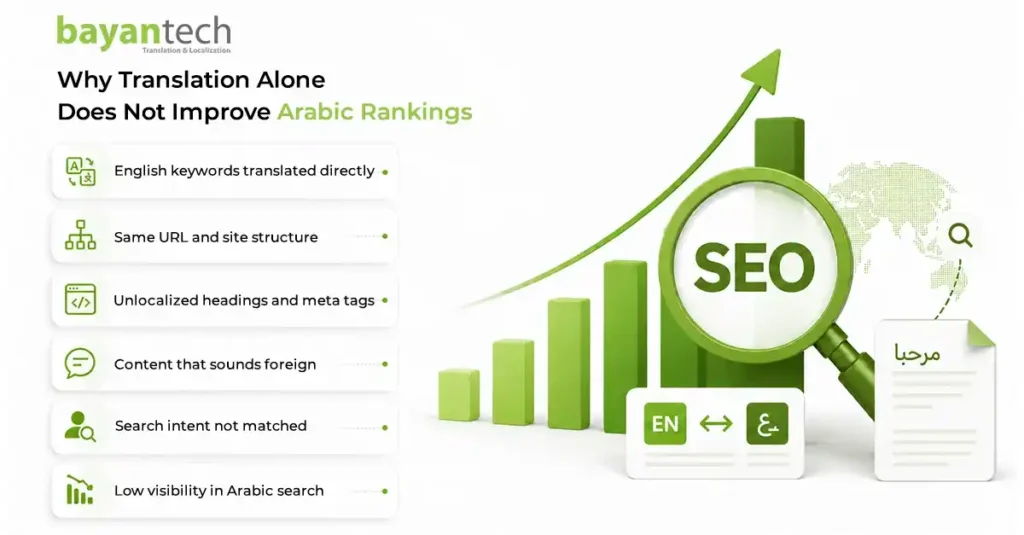
The method used by many companies to market their services in Arabic is copying their websites and translating their content. This way, they will have an easily readable website but not a competitive website in terms of search presence.
The keyword list used for English content might not resonate with Arabic audiences. It could feel foreign and out of place. While the URL structure, headings, internal links, and snippets can remain the same as the original website, even the best translation won’t fix localization issues.
That is why the role of Arabic Localization Services comes into play.
This is where Arabic Localization Services become important. Localization aligns the experience with local language, cultural expectations, user journeys, and technical requirements instead of treating Arabic as a final publishing layer.
Yes, you may translate the language well, but that is not how your audience searches for the service you offer.
The Hidden Technical Debt Behind RTL Websites
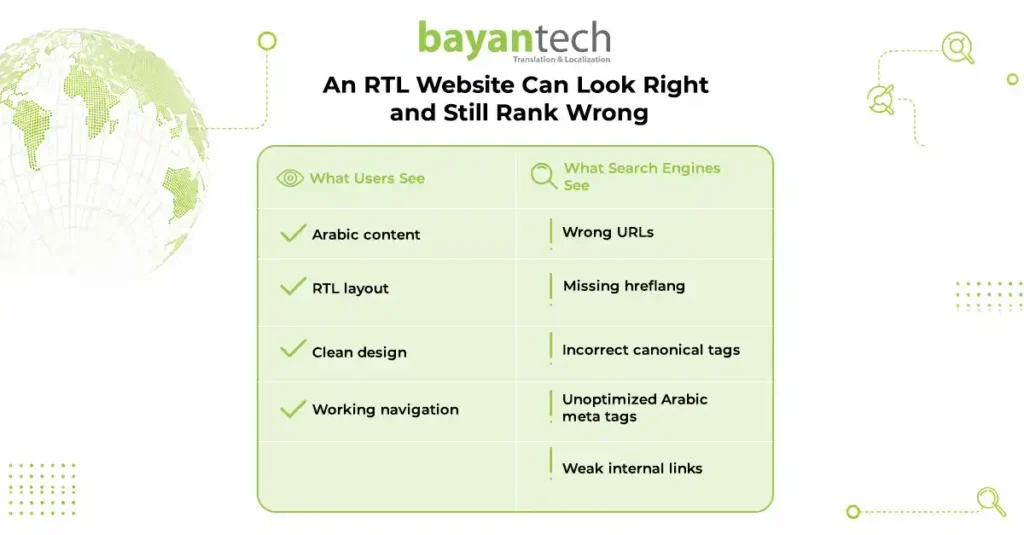
A developer flips the template, and everything looks good. This does not guarantee the Arabic version is ready to be found.
RTL website optimization begins underneath the design. The audit has to verify language-specific URLs, self-referential canonicals, reciprocal hreflangs, indexable navigation, and internal linking to the right regional version.
Google states the use of unique URLs for language versions and hreflang for the connection between localized versions. The search engine also states that automatic changes in the website content based on location and browser language prevent some versions from crawling and indexing.
Arabic meta tags optimization requires the same attention. A directly translated title can sound unnatural or miss the point. Google makes title links and snippets from several page signals, so the title, description, header, and text have to support the same goal.
Arabic website structure cannot be just a replica of English architecture with mirrored style. Each page should have a purpose, target market, and internal linking strategy.
Why Generic Arabic Content Fails to Build Authority
It is usually easy for the Arabic audience to spot the Arabic pages translated without taking into account the way they speak and make comparisons and choices. Even though the grammatical correctness may be maintained in such cases, it fails to provide the necessary emotional engagement, making Arabic content optimization impossible.
A high-quality page would demand Arabic copywriting for creating original content, Arabic content localization for adapting existing content, and Arabic transcreation where emotions are much more important than mere linguistic accuracy.
The search engine keeps on focusing on the quality, authority, and user-oriented content. Creation of Arabic pages that are near-identical in their structure is likely to lead to search engine optimization content rather than an informative one.
The mass Arabic backlink building will not help with creating the Arabic domain authority as well. Directory links, which are irrelevant for the business, do not contribute to its Arabic domain authority. Backlinks should be created by appropriate publishers, organizations, and partners in the relevant field. Google classifies links created mainly to manipulate rankings as link spam.
One Strategy Does Not Fit Saudi Arabia, the UAE, and Egypt
Modern Standard Arabic offers broad reach but does not erase regional differences. Research datasets identify country-level Arabic varieties across 18 MENA markets, demonstrating how written language varies by location.
A saudi arabia seo plan may need local terminology, commercial modifiers, city pages, and trust signals. A UAE digital marketing strategy may need to serve a multilingual population and mixed English-Arabic journeys. Egypt may offer greater volume for some topics, but with different pricing expectations and conversational wording.
That is why MENA search optimization should separate markets before combining them. Brands entering several Gulf countries may also need GCC Market Entry Localization to decide which content can remain regional and which pages need country-specific positioning.
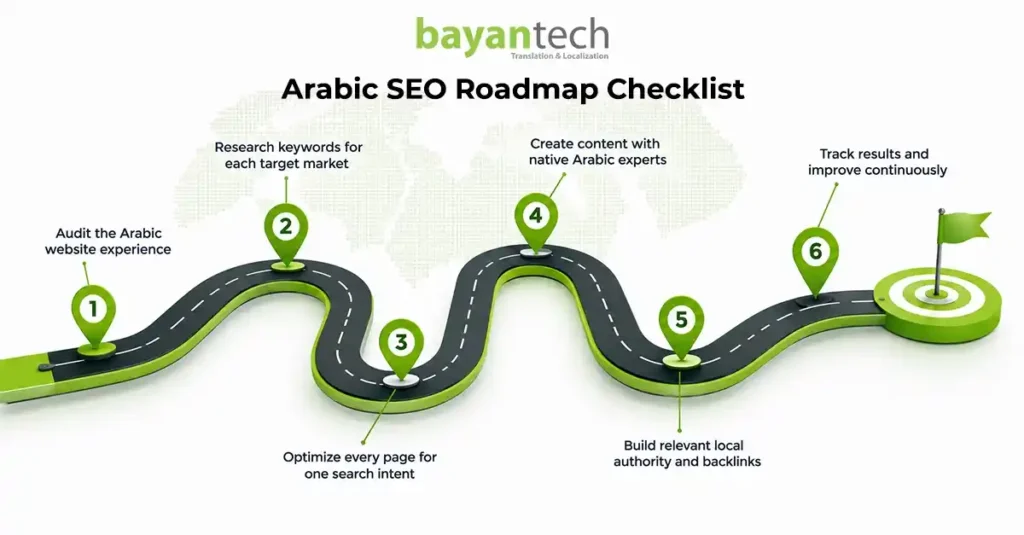
The Arabic SEO Roadmap: Six Steps That Build on One Another
1. Diagnose the Arabic Experience First
Begin with an Arabic SEO audit covering crawlability, indexation, rendering, URL patterns, canonicals, hreflang, sitemaps, internal links, structured data, and rankings. Review desktop and mobile because a page can look correct while navigation, forms, breadcrumbs, or filters still fail in RTL.
Prioritize fixes by impact and dependency. Correcting indexation after publishing 100 pages wastes budget.
2. Research Demand Independently by Market
Run Arabic keyword research from the ground up rather than translating English terms. Compare Modern Standard Arabic, regional wording, mixed Arabic-English queries, spelling variants, questions, and commercial modifiers. Group them by informational, comparison, transactional, local, and branded intent.
Search Console, sales calls, customer service logs, and local competitor pages often reveal vocabulary that tools miss. Data from Multilingual PPC Management Services can show which wording attracts clicks and conversions, not merely estimated volume.
3. Rebuild Each Page Around One Search Purpose
Apply Arabic on-page SEO to the title, description, H1, subheadings, copy, images, schema, internal anchors, and calls to action. Do not force every term onto one page. Match one primary intent to the best URL and support it with related questions.
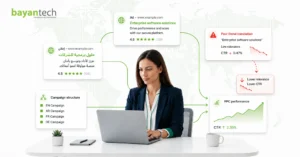
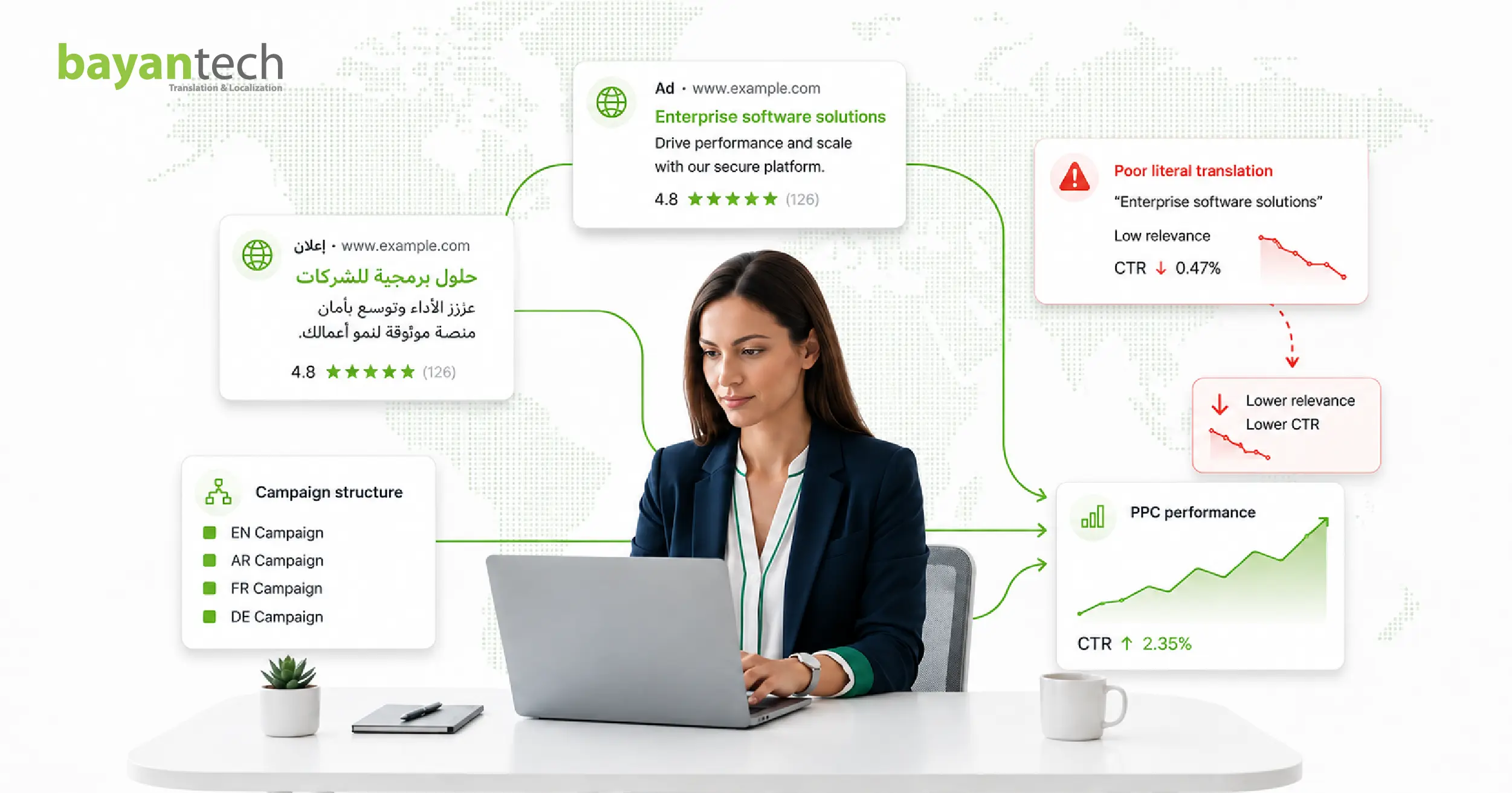
Then improve Arabic CTR optimization by testing titles and descriptions around concerns such as price, speed, compliance, expertise, or risk. A ranking matters only when the result earns the click and the page continues the promise.
4. Create Content With Native Market Expertise
Assign native Arabic content writers who understand the audience, industry, and required formality. A software page for Saudi procurement teams should not sound like a lifestyle campaign for Egyptian consumers.
For regulated material, connect the workflow with ISO-Certified Translation Services so terminology, reviews, and quality controls remain consistent. When several languages are involved, Multilingual SEO Services can coordinate keyword mapping and content governance without forcing every locale into one template.
5. Build Relevant Authority
Earn coverage through expert contributions, original research, local partnerships, useful tools, strong industry directories, and digital PR. For GCC SEO services, geographic relevance matters alongside topical relevance. A respected Saudi business publication may be more useful for a Saudi page than a higher-metric website with no regional connection.
6. Measure by Market and Improve Continuously
Track rankings, clicks, qualified sessions, leads, assisted conversions, and revenue separately by country and landing page. Review queries with impressions but weak clicks, pages attracting traffic without leads, and content appearing in the wrong market.
Re-audit quarterly, update declining pages, improve internal links, and use conversion data to refine the Arabic-first digital strategy.
Build an Arabic Search Strategy Around Your Market
Tell bayantech which Arabic-speaking markets you are targeting and how your website is structured. Our team can identify the highest-priority gaps and develop a practical roadmap for stronger visibility, qualified traffic, and sustainable regional growth.