
A board resolution translated by a non-registered translator can be rejected by UAE banks, free zone authorities, and government entities—regardless of how accurate the translation is. In the United Arab Emirates, compliance is not only about translation quality; it is also about meeting the correct legal requirements.
If your company is preparing to open a corporate bank account, amend a license, update authorized signatories, or submit corporate documents to a UAE authority, understanding the translation requirements upfront can save weeks of delays.
This guide explains what UAE authorities expect and how to avoid common mistakes when arranging a board resolution translation UAE project.
Why Board Resolution Translation UAE Submissions Get Rejected
One of the most common reasons board resolutions in the UAE are rejected is the use of the wrong type of translation.
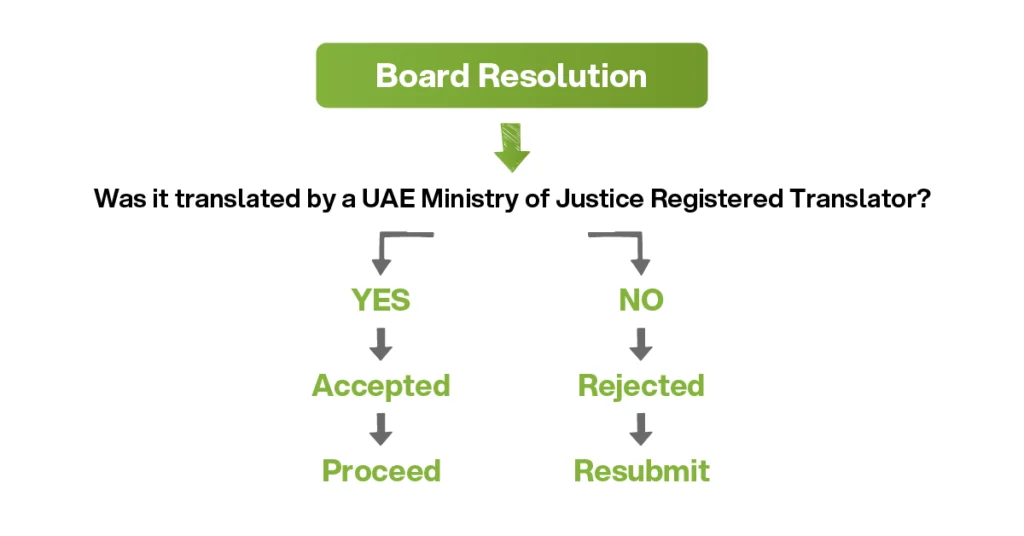
Many organizations assume that any professional translation will be accepted. In reality, UAE authorities often require translations completed by a translator registered with the UAE Ministry of Justice. This requirement is based on legal status, not translation quality.
Another common misunderstanding involves notarization. A notarized translation UAE process authenticates signatures, but notarization alone does not replace the requirement for a Ministry of Justice-registered translator. These are two separate steps that serve different purposes.
As a result, companies that submit translations prepared outside the approved framework may face rejection, resubmission requests, and delays to important business activities.
For organizations unfamiliar with UAE regulations, understanding the difference between Certified vs Sworn Translations is often the first step toward selecting the correct service.
What UAE Laws Actually Require for Board Resolution Translation
A board resolution is an official record of decisions made by a company’s board of directors. These decisions may authorize corporate actions such as opening bank accounts, appointing signatories, approving investments, or making ownership-related changes.
In mainland UAE, corporate governance activities are governed by applicable UAE laws, including the Commercial Companies Law framework. When board resolutions are issued in a foreign language and submitted to UAE authorities, they generally require translation by a Ministry of Justice-registered translator.
However, requirements can vary depending on the jurisdiction. Mainland authorities, free zones, and financial jurisdictions may not follow identical procedures. DIFC and ADGM, for example, operate under separate legal frameworks and may accept different translation credentials depending on the submission type.
This is why companies using Legal Translation Services should always identify the receiving authority before commissioning a translation project.
The UAE Authorities and Free Zones That Require Board Resolution Translation
The specific authority reviewing your document determines which translation standard is required.
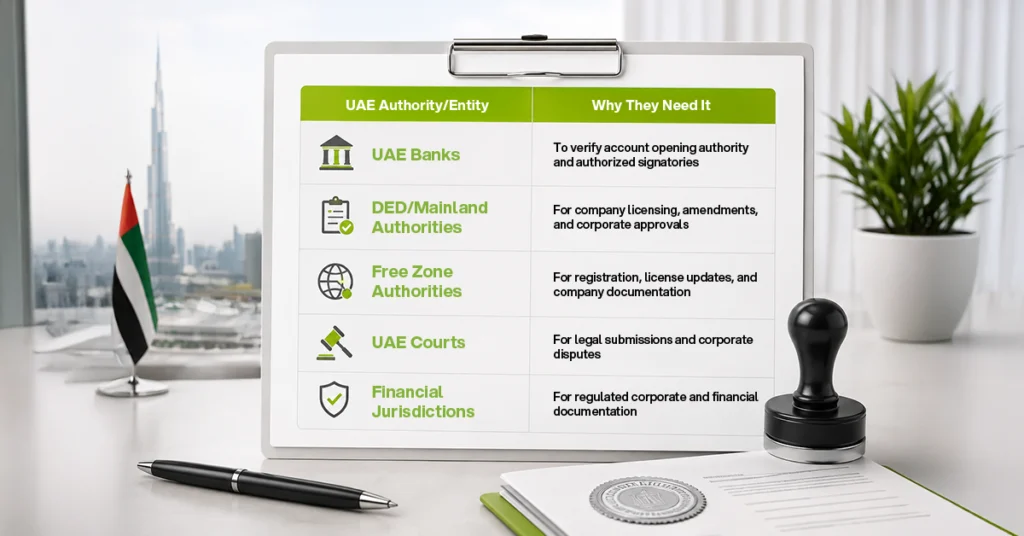
For corporate bank accounts, UAE banks typically require translated board resolutions as part of their KYC and compliance procedures. Whether you are applying with Emirates NBD, ADCB, Mashreq, ADIB, or another institution, a translated board resolution is often required to confirm authorized signatories and account-opening authority.
The same applies to many licensing and registration procedures handled by mainland authorities such as the Department of Economic Development.
For UAE free zone companies, requirements vary by authority. Free zones such as JAFZA, Meydan, and Dubai Airport Free Zone commonly require translated corporate documentation, although exact requirements should always be confirmed directly with the relevant authority.
Court submissions and legal proceedings also require strict compliance with translation regulations.
For businesses expanding into the UAE, translation for UAE bank requirements is often one of the first compliance challenges encountered. Getting the translation right from the beginning helps keep business operations moving without unnecessary delays.
Organizations managing regional banking relationships often combine these requirements with Financial Translation Services to ensure consistency across multiple jurisdictions.
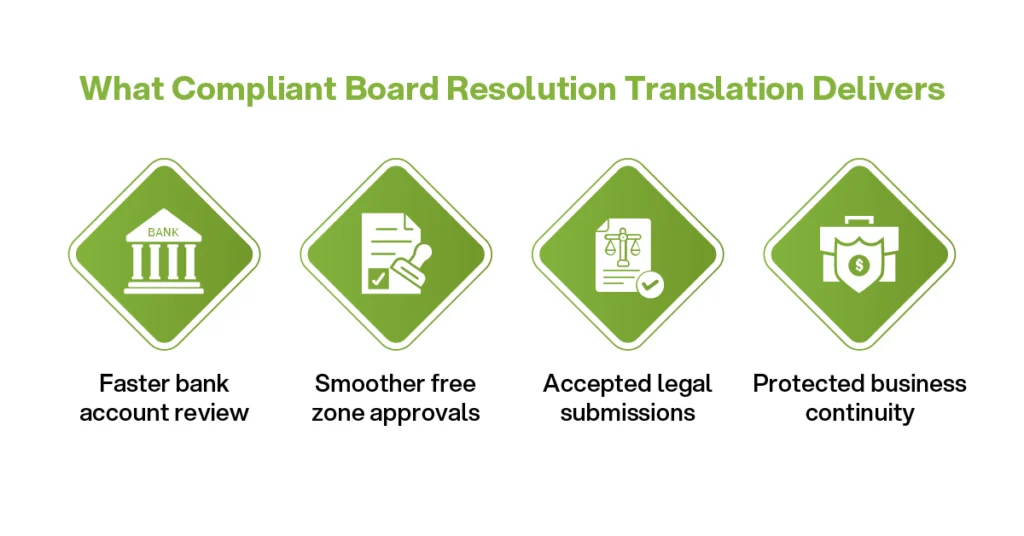
What Compliant Board Resolution Translation Delivers
The value of compliant translation goes far beyond the translated document itself.
First, it helps corporate bank account applications move through compliance review without avoidable objections. A missing credential or incorrect translation format can trigger additional requests that delay account activation.
Second, compliant translation supports smoother free zone registration processes, license amendments, and shareholder updates. When authorities receive documents in the format they expect, approvals are generally faster and more predictable.
Third, board resolutions intended for legal proceedings or regulatory submissions can proceed without procedural issues related to document acceptance.
In short, certified board resolution translation is not simply a language service—it is a risk-reduction tool that supports corporate governance and business continuity.
The Board Resolution Translation Process for UAE Submissions
The process is straightforward when planned correctly.
Step 1: Prepare the source document.
Ensure the board resolution is signed, dated, and issued on company letterhead where applicable.
Step 2: Identify the receiving authority.
Requirements differ between mainland authorities, banks, courts, and free zones.
Step 3: Engage a qualified translation provider.
Confirm that the translator meets the requirements of the receiving authority and jurisdiction.
Step 4: Complete attestation if required.
Some submissions require additional authentication after translation.
Step 5: Complete notarization if required.
Certain authorities or banks may request notarization as an additional verification step.
Depending on the document and authority, the full process may take several business days. Planning ahead is especially important when board meetings and corporate deadlines are tied to regulatory approvals.
Organizations that regularly handle corporate governance documentation often benefit from establishing ongoing Document Translation Services support rather than sourcing a provider for each individual project.
Board Resolution Translation UAE Checklist Before You Commission
Before requesting a translation, confirm the following:
- Identify the receiving authority.
- Confirm the jurisdiction (mainland, free zone, DIFC, or ADGM).
- Verify whether Ministry of Justice registration is required.
- Check whether attestation is needed.
- Determine whether notarization is required.
- Prepare the signed and dated source document.
- Confirm your submission deadline.
- Verify any authority-specific requirements before work begins.
A few minutes spent validating these points can prevent costly delays later.
Commission Your Board Resolution Translation for UAE Submission
Board resolution translation is not just about converting text from one language to another. It is about meeting the exact requirements of the authority reviewing the document.
At bayantech, we help organizations navigate corporate document translation UAE requirements for banks, government entities, courts, and free zones across the United Arab Emirates. If you are unsure which translation standard applies to your board resolution, our team can help identify the correct workflow before the project begins.
To learn more about our experience supporting regulated business documentation across the GCC, visit our About Us / Our Story page or contact our team for guidance on your upcoming submission.