

Global Content Marketing in 2026: The Governance Model Most Strategies Skip
Most global content marketing strategies start with the same questions: which channels to use, and whether to create blogs, videos, social posts, or email campaigns. Fewer teams address the decision that affects everything else: who owns content decisions across markets.
Without a clear governance model, every new market raises fresh questions about approvals, messaging, terminology, and adaptation. A global content marketing strategy needs more than translated content. It needs clear ownership, defined workflows, and a system that balances consistency with local relevance.
This article covers how to build a scalable international content marketing plan: governance, style guides, approval workflows, content adaptation, and performance measurement.
Centralized vs. Local Content Strategy: Choosing the Right Governance Model
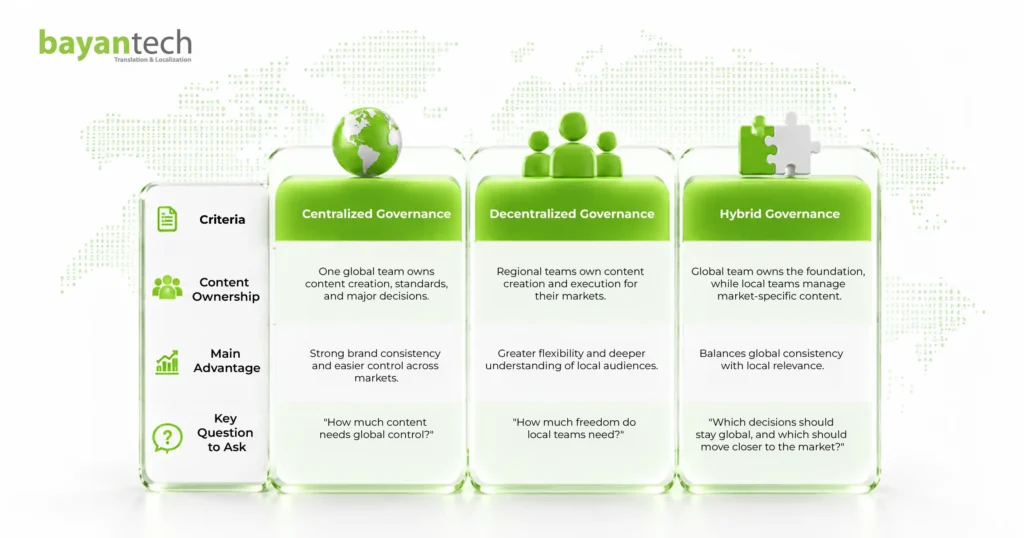
A successful global program starts by deciding who controls content decisions. The main options are centralized, decentralized, or hybrid governance.
A centralized model gives one global team responsibility for creating core content, maintaining brand standards, and managing major approvals, while local teams adapt that content to market needs.
A decentralized model shifts more control to regional teams, who create content independently within shared brand guidelines.
A hybrid model splits the difference: the central team builds the foundation, and local teams handle market-specific execution.
The right choice depends on how much your markets differ. Centralization improves consistency but can struggle when local audiences need highly specific messaging. Decentralization gives markets more flexibility but risks inconsistent brand experiences without shared guidelines.
A documented governance model removes uncertainty by defining who creates content, who reviews it, and who approves final changes.
This becomes especially important when companies face International Marketing Challenges during expansion, as different markets bring different customer expectations, regulations, and communication styles.
With clear ownership in place, teams spend less time debating decisions and can scale into new markets using an established process instead of rebuilding the workflow each time.
A Real Example: Governance in Practice
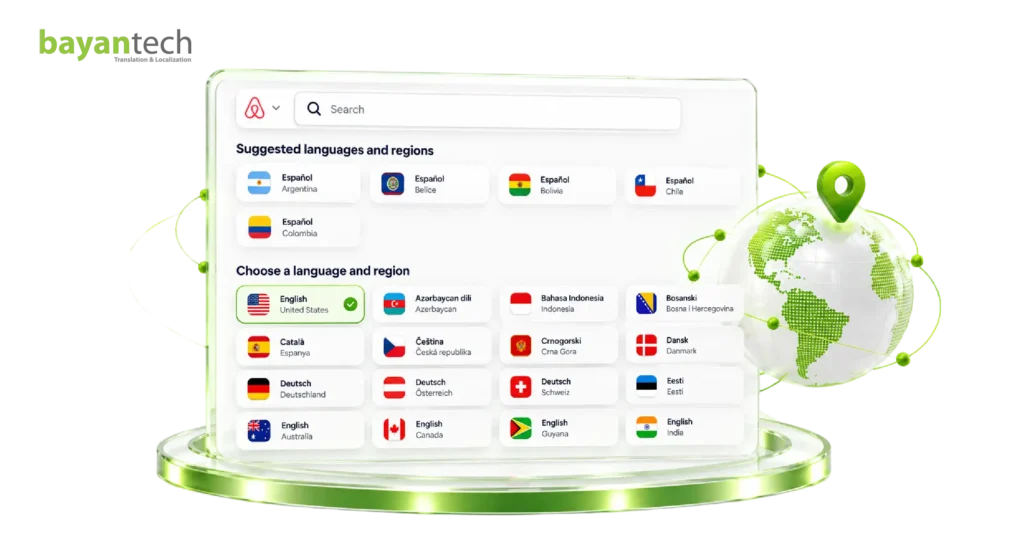
Airbnb’s platform runs in 62 languages, a scale it reached by pairing its design team with its globalization team from the start rather than treating translation as a step tacked on after launch. Airbnb scaled to 62 languages by putting design and globalization teams in the same room.
That’s a hybrid model in action: a central team owns the design system and technical standards that let content scale across languages, while local execution stays close to each market.
The failure mode looks different but traces back to the same root cause. In cases like HSBC’s rebrand, the decision was made after launch instead of before it — localization got treated as a fix rather than a founding decision, and the brand paid for it in market confusion.
The lesson isn’t “localize everything” or “centralize everything.” It’s that the governance model has to exist before content starts shipping, not get invented in response to the first market that pushes back.
What Actually Belongs in a Global Content Style Guide
Many companies think a style guide only defines tone of voice. For global content marketing, that’s not enough a working style guide should also spell out what stays consistent and what can change by market.
The guide should include:
- Brand tone and messaging principles.
- Approved terminology and product names.
- Words or claims that cannot be changed.
- Content elements that can be adapted locally.
- Rules for cultural references, examples, and visuals.
- Escalation steps for unclear cases.
A company might decide, for example, that product names and technical terms must stay identical across all markets, while examples, customer stories, humor, and references get market-specific adaptation.
That distinction prevents two common problems: local teams changing brand terms to make content feel more natural, or translating too literally and stripping out the local context that made the original effective.
With clear boundaries in place, teams know which decisions they can make on their own and which need approval, so local teams can adapt content confidently instead of asking the central team for guidance on every call, while the brand stays consistent across markets.

Building a Multi-Market Content Approval Workflow That Does Not Slow Teams Down
Approval processes often become a bottleneck as companies expand. Some teams route every piece of content through a central team and create delays, while others hand markets complete control and risk inconsistent messaging.
A scalable approval workflow needs different levels for different types of content. A practical structure uses two gates:
Global approval gate:
Used for content that affects the entire brand, such as major campaigns, legal statements, product messaging, or regulated information.
Local approval gate:
Used for market-specific changes, including translated copy, local examples, cultural adjustments, and channel preferences.
This doesn’t add steps so much as put each decision with the person who has the right context. A global campaign gets central approval once, then local teams review only the changes that affect their own audience, avoiding a single approval bottleneck while keeping brand controls in place and delivering content faster without losing quality or compliance.
Standardize or Localize? Making the Right Decision for Global Expansion
One of the biggest decisions in global content marketing is knowing what should stay the same and what should change. Standardizing everything and localizing everything both fail somewhere. The better approach is to evaluate each market on its own.
A content strategy for global expansion should consider:
- How similar customer buying behavior is compared with the home market.
- Whether competitors communicate differently.
- Whether cultural expectations affect purchasing decisions.
- Whether regulations influence messaging.
A software company entering a market with similar customer needs may only require accurate translation and minor adjustments; a consumer brand entering a market with different buying habits may need much deeper adaptation.
This is what a global content localization strategy is really about not just changing words, but adapting content to reflect each audience’s expectations, preferences, and context.
Evaluating markets individually means localization resources go where they create the most impact, instead of overspending on unnecessary adaptation in some markets or underinvesting in others that need deeper localization.
Companies that need support with this process often use Marketing Localization Services to adapt campaigns, websites, and content assets while maintaining brand consistency.
Why Blog, Video, Social, and Email Need Different Global Strategies
A common mistake in cross-border content marketing is treating all content formats the same way. A global content calendar may organize production, but blog, video, social, and email each need their own strategy.
A global blog content strategy often focuses on search behavior, local keywords, and educational content. A blog that performs well in one country may need a different structure or topic focus in another market.
A global video content strategy requires decisions about subtitles, voice-over, visual references, and storytelling style. Video preferences can vary significantly between audiences.
A global social content strategy depends on platform usage, audience behavior, and local engagement patterns. The best channel in one market may not be the best option elsewhere.
A global email content strategy requires more than translated messages. Subject lines, timing, offers, and calls to action may need adjustment based on local expectations.
The advantage of treating formats separately is that each content type receives the planning it needs instead of following one global template.
The benefit is stronger performance across markets because each channel works according to local audience behavior.
Measuring Global Content Marketing ROI Across Markets
Many companies measure global content performance using total traffic, total leads, or total conversions. These numbers are useful, but they do not always show the full picture.
A larger market will naturally produce bigger numbers. That does not always mean the content performs better.
To understand global content marketing ROI, companies should compare performance fairly across markets.
Useful global content marketing metrics include:
- Engagement rate by market.
- Conversion rate by market.
- Content-assisted leads.
- Cost per acquisition.
- Content performance compared with market size.
For example, a smaller market may generate fewer leads but have a higher conversion rate. Looking only at total numbers could hide this opportunity. Cross-market content performance should be measured using normalized data instead of only aggregate results.
This approach helps teams understand where content supports growth and where improvements are needed.
The advantage is clearer decision-making. Teams can identify which markets need more investment and which strategies need adjustment.
The benefit is a stronger business case for content marketing for global growth because results can be evaluated market by market.
Pre-Launch Checklist for Your Global Content Marketing Strategy
Before launching a global program, confirm that you have:
- Defined your centralized, decentralized, or hybrid governance model.
- Created a global content style guide with clear rules for fixed and adaptable elements.
- Built a tiered approval workflow with global and local review points.
- Decided what to standardize and what to localize in each market.
- Planned separate strategies for blog, video, social, and email content.
- Defined performance metrics that compare markets fairly.
A global content strategy scales through the system behind it: the decisions, workflows, and metrics that let teams work faster as they add markets, not through publishing more content on its own.
Build a Global Content Strategy That Scales
Expanding into new markets takes more than translating existing content — it takes clear ownership, practical workflows, and a strategy that connects global goals with local audience needs.
bayantech helps organizations build multilingual content programs that scale, combining structured workflows with hands-on localization expertise.
Tell us about your target markets and current content approach, and our team can help you plan the next stage of your global content expansion.