
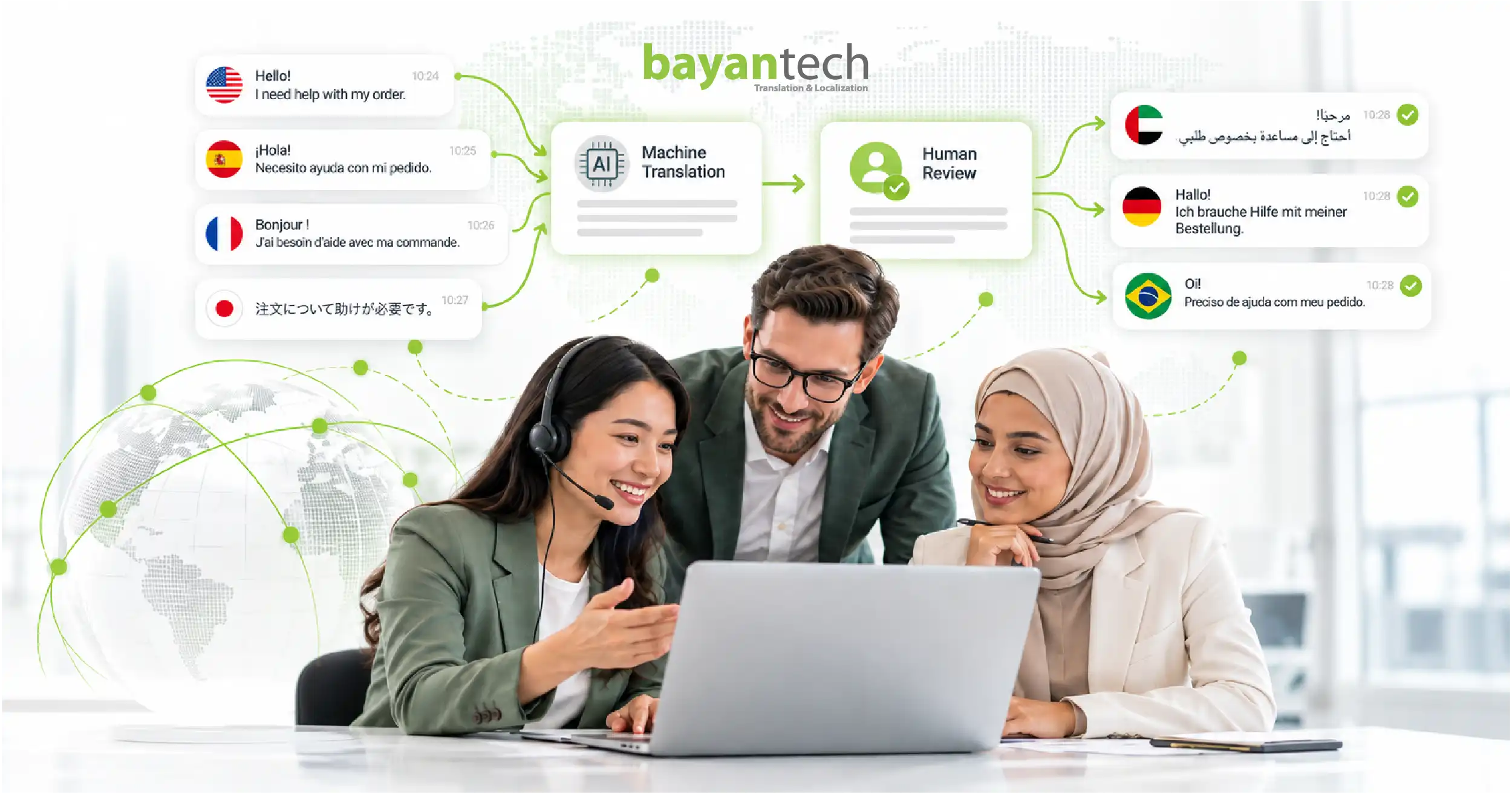
Many global customers have experienced the frustration of trying to get help from a company in another country, especially when language makes an already difficult situation harder to resolve. A simple question can quickly become a poor customer experience when instructions are unclear, terminology changes between channels, or the customer cannot fully explain the problem.
In fact, 67% of customers are willing to switch brands because of a poor customer experience. For global businesses, this makes the quality of multilingual support especially important.
Effective multilingual customer support requires more than simply offering help in several languages. It depends on consistent terminology, the right translation approach for different types of support content, and clear rules for when machine translation is enough and when human review is needed.
The real challenge is making sure customers receive the same clear, reliable support experience in every language. So, what usually goes wrong, and how can companies build a multilingual support process that works as they grow?
The Hidden Cost of Untranslated Macros and Canned Responses
Support teams rely heavily on repeated content. Refund instructions, password-reset steps, cancellation policies, delivery updates, and common troubleshooting answers are often stored as macros or canned responses so agents can reply faster.
Because these messages are short, they are easy to overlook during localization. One agent may translate a reply when it is first needed, while another creates a slightly different version later.
Imagine three agents translating the same refund phrase in different ways. The basic meaning may be similar, but one version sounds definite, another sounds conditional, and a third uses different terminology from the policy page. To the company, these may look like small wording differences. To the customer, they can sound like different policies.
The problem becomes more visible across multilingual ticketing system content, automated emails, FAQs, and chat responses, where customers may see different terms for the same thing.
That is why multilingual support macros need approved terminology, clear tone guidance, and a simple update process whenever the source version changes. Without that control, consistency depends too much on which agent happens to answer.
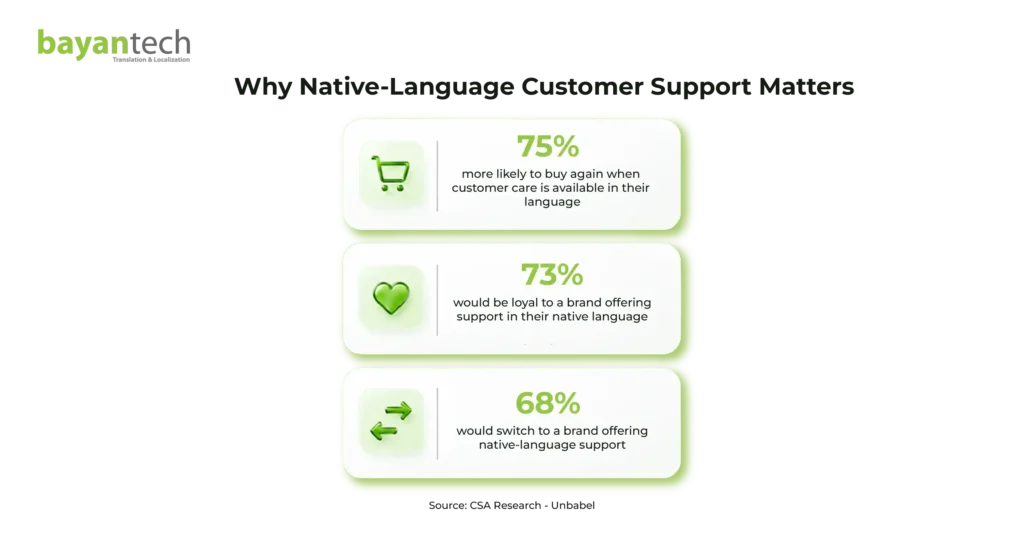
As technology evolves, machine translation and AI can be integrated into multilingual customer support solutions. However, there are limitations. Let’s explore!
Where Machine Translation Alone Breaks Down in Live Support
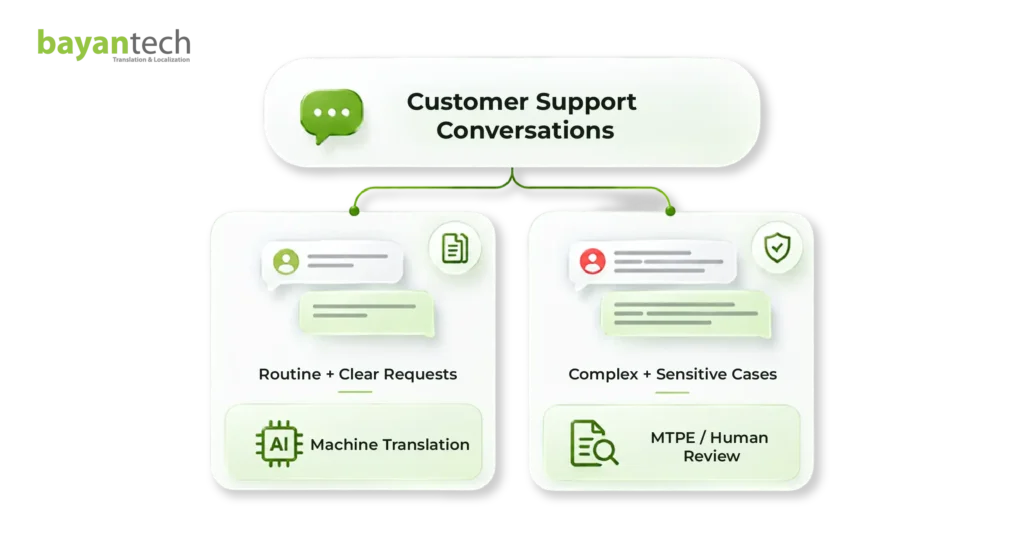
Machine translation can be very useful in customer service. Routine questions about order status, account access, product instructions, or basic troubleshooting can often move through machine translation for customer support quickly.
The difficulty appears when conversations become less predictable. Customers use slang, abbreviations, sarcasm, product nicknames, and emotional language, all of which can change how a message should be understood.
In multilingual live chat translation, the translated message may reach the agent or customer immediately, before anyone can check whether the meaning, tone, or urgency was understood correctly.
Consider a customer using an idiom to show serious frustration. A literal translation could make the complaint sound much milder than intended, leading the agent to respond casually when the customer expects immediate attention.
This does not mean companies should avoid AI-powered support translation. It means different conversations need different levels of review. Routine, low-risk exchanges can use real-time support translation for speed, while escalated complaints, payment disputes, sensitive issues, or high-value accounts can follow a more controlled path.
This is where MTPE Services can support the workflow. Machine translation post-editing combines machine-generated translation with human review and correction, making it useful for conversations where unclear wording or the wrong tone could have a larger impact.
Why Help Center and Chatbot Localization Need Different Approaches
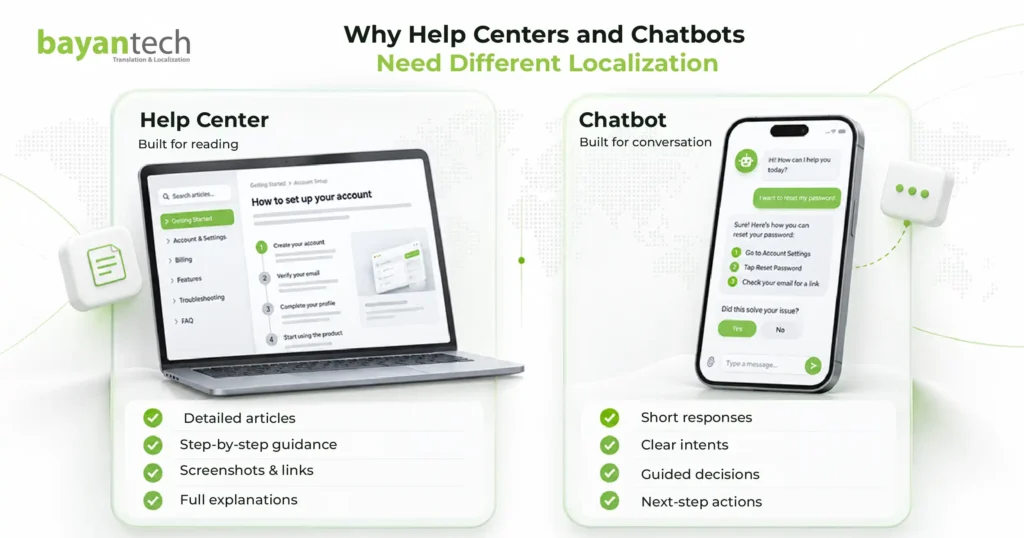
A help center and a chatbot may draw from the same product knowledge, but customers use them differently. Treating them as one localization task can create problems even when the translation itself is accurate.
With help center localization, teams usually work with longer, stable articles. Customers can follow detailed instructions, review screenshots, and move between related pages, giving localization teams room for terminology, formatting, and linguistic checks.
The same approach works well for knowledge base translation, FAQ translation services, and broader support documentation localization.
Chatbots need content that works in much smaller pieces. A response has to match a clear intent, fit naturally inside a conversation, and often guide the customer toward the next question or action.
For example, a troubleshooting article may list five reasons a customer cannot log in. A chatbot has to decide which question to ask first, which response fits the answer, and when the issue should move to a human agent.
Good chatbot response translation depends on source content that is short, direct, and tied to specific intents. In multilingual chatbot localization, terminology should match the help center, while sentence structure and response length may differ.
A Step-by-Step Process for Multilingual Customer Support That Scales
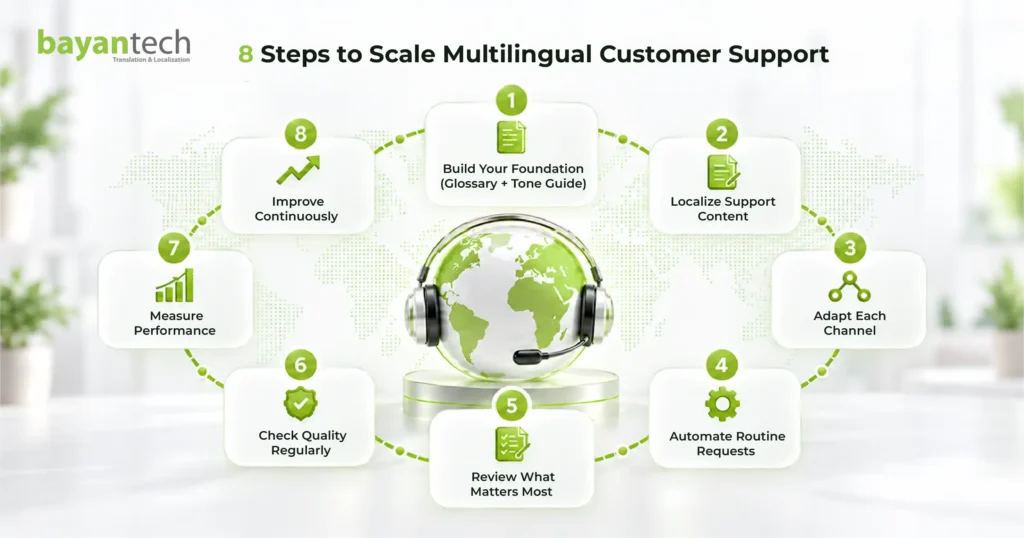
A scalable process starts by deciding how language will be controlled across customer support.
1. Build a Shared Glossary and Tone Guide
Start with the words customers and agents see most often. Create one shared reference for product names, features, technical terms, brand language, and policy wording, with approved translations for key terms.
Some wording should stay fixed, especially around refunds, cancellations, legal notices, security, and account policies. The tone guide should also explain whether support should sound formal, friendly, reassuring, or direct.
A shared reference helps multilingual customer service sound consistent instead of allowing each team or agent to make language decisions independently.
2. Translate and Review Your Macros Before Agents Use Them
Collect the canned responses your team already uses and prioritize the ones that appear most often. Translate them against the glossary and tone guide, then review them as a set rather than as isolated sentences.
Store approved translations centrally and connect them to the correct source versions. If a refund policy or account process changes, the related translations should enter the same update cycle so outdated wording does not remain active.
3. Prepare Help Center and Chatbot Content Separately
Use the same approved terminology across both channels, but prepare each one for how customers actually use it.
Help center articles can remain detailed because customers visit them for explanation. Chatbot content should be broken into shorter units, with one clear purpose for each response and a defined next step where needed.
At this stage, large-scale help center and knowledge base translation often fit more naturally within Content Localization Services than being managed article by article inside a support platform.
4. Use Machine Translation for Routine Conversations
Not every interaction needs the same level of linguistic review. Routine questions can move through multilingual email support translation, live chat translation, or other automated workflows when the meaning is clear and the risk is low.
This helps teams maintain response times as ticket volume and language coverage grow, especially for multilingual support for global SaaS products expanding into several markets at once.
5. Add Human Review for Higher-Risk Conversations
Define clear situations where automated translation should not be the final step. These may include escalated complaints, payment disputes, cancellations, technical incidents, regulatory questions, important accounts, or customers already at risk of leaving.
These conversations can move into an MTPE or human-reviewed workflow. The level of review should reflect the risk of misunderstanding rather than simply the language involved.
6. Run Native-Speaker Spot Checks Regularly
Quality control should continue after launch. Review samples of tickets, emails, chats, macros, and chatbot responses in each language for terminology, clarity, tone, and fit.
Look for patterns. If the same term causes confusion repeatedly, update the glossary. If agents keep rewriting one macro, check whether the approved version sounds natural. If chatbot responses repeatedly fail in one area, the source content may need to be restructured.
7. Track Results by Language and Market
A single global satisfaction score can hide problems in individual markets. Track multilingual customer satisfaction by language or region when you have enough data to make the comparison meaningful.
Compare the measures your support team already follows, such as satisfaction, repeat contacts, escalation rates, resolution time, and retention, by language or market.
This also makes customer support localization ROI easier to evaluate. Instead of looking only at translation cost, teams can examine whether localized support is reducing repeat contacts, improving satisfaction, or helping customers remain with the product.
8. Feed What You Learn Back Into the Process
Support language changes with the product. New features introduce terminology, agents uncover unanswered questions, and chatbot logs reveal wording customers misunderstand.
Use those findings to update the glossary, macros, source content, and review rules. A support process becomes more reliable when customer conversations actively improve the content future customers receive.
This feedback loop turns individual translation tasks into a maintained multilingual support localization system rather than a collection of one-off translations.
Quick Recap: Before You Trust Your Multilingual Support Setup
Before expanding your multilingual customer support, check the content customers see most often.
Macros should use approved terminology. Higher-risk live conversations should have a human-review option. Help center and chatbot content should be structured for their own channels, even when they use the same product information.
Then measure performance by language or market instead of relying only on global averages.
Machine translation can provide speed. The process around it determines whether that speed still produces clear, consistent customer support.
Build Multilingual Customer Support Around the Way Customers Actually Ask for Help
Customers move between help articles, chatbots, email, tickets, and live agents. Their language experience should stay consistent across those touchpoints.
bayantech can help you build a multilingual customer support workflow that combines localization, machine translation, human review, terminology control, and ongoing QA.
Tell us about your support channels and current translation setup, and our team can help you identify the right workflow for your content, languages, and customer conversations.