

Imagine investing in audience research and dedicated localization teams to craft spot-on content only for customers never to find your website.
Often, the missing link is one simple step: SEO translation. Remember who “reads” your translated pages: people and search engines.
Google needs to understand and index your content, which happens when you use the right local keywords and localize your SEO.
So, keep on reading as we explain what SEO translation and localization involve, what goes wrong when you skip them, and how to turn your website into a conversion engine.
What Goes Wrong When You Don’t Implement SEO Translation
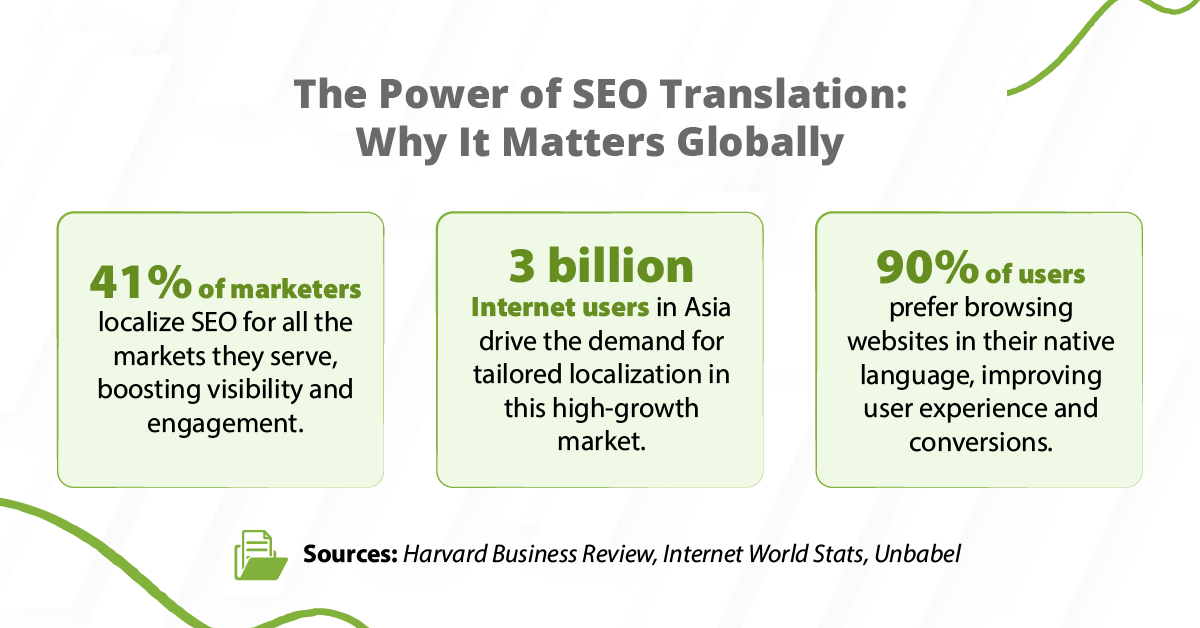
As one would expect, users in Sydney use keywords that are far from the keywords users in Texas use to search for the same products; even though both users speak English, they have different dialects and cultures that make this search process different.
Now, let’s explore the disadvantages of skipping SEO localization altogether:
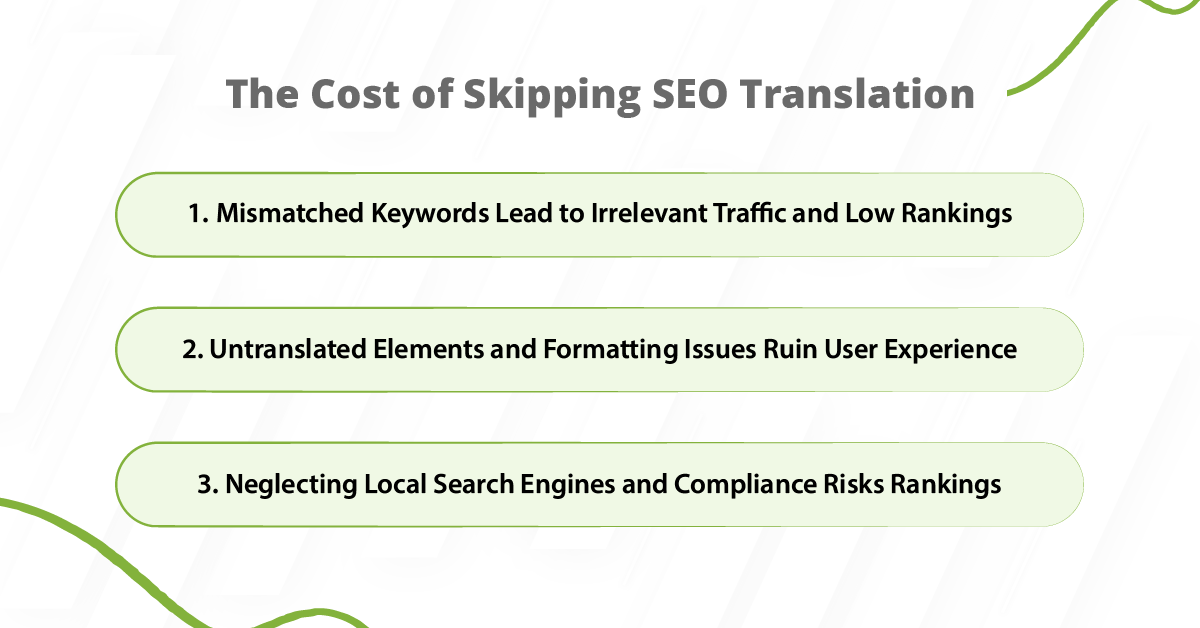
- First, mismatched keywords will make your website and snippets show up in irrelevant searches; the clicks on your website will bounce, and eventually the search engine will downrank your page.
- Untranslated titles, mixed currencies, and wrong date formats ruin the UX and user experience. Even worse, when they make it to the checkout page and feel confused, they will dismiss the whole website, probably for a long time.
- The local search engine you’re tailoring your content for is not always Google. It’s Baidu in China, Yandex in Russia, and Naver in South Korea, and Seznam in the Czech Republic.
On top of that, SEO translation is important for compliance. Missing hreflang tags, duplicate content, or wrong meta language would jeopardize compliance.
Your Guide to Build a Successful Multilingual SEO Strategy
Step 1: Build an Intent-First Multilingual SEO Strategy
Before diving into keyword research or translations, start with strategy. Look at the markets where your website already attracts organic impressions.
Next, focus on converting those impressions into clicks by aligning every piece of localized content with local search intent.
Go beyond analytics. Interview your sales and customer support teams to profile each market’s audience. They’re the ones who know what your customers ask, complain about, and expect.
Once you understand your audience, map their search behavior across the buyer journey — from “problem” to “compare” to “buy.” This helps you identify what types of content are needed in each stage, and which pages to localize or create from scratch.
Finally, prioritize markets and pages based on opportunity and resources. Choose your website structure carefully:
- Subfolders (example.com/fr) are great for centralized SEO management.
- Subdomains (fr.example.com) suit multilingual projects with separate teams or hosting needs.
- ccTLDs (example.fr) signal strong local relevance but require higher maintenance.
Step 2: Research Target Keywords per Target Language (Not Translations)
This is where a Multilingual SEO team comes in. Translating keywords literally is one of the biggest mistakes in SEO translation.
Instead, professional native linguists should lead the process, supported by local keyword tools to uncover what real users are searching for — including synonyms, idioms, slang, and measurement units that reflect the local culture.
Once you gather data, cluster keywords by intent — informational, navigational, or transactional — to understand how users move from awareness to conversion. This ensures your translated content matches user intent, not just language.
Next, build a keyword map or master sheet that includes:
- Primary and secondary keywords per page
- Localized title and meta description samples
- Internal linking targets and anchor text recommendations
Step 3: Create & Localize Copy That Matches the Query
Turn searches into sessions with copy that mirrors local intent and culture.
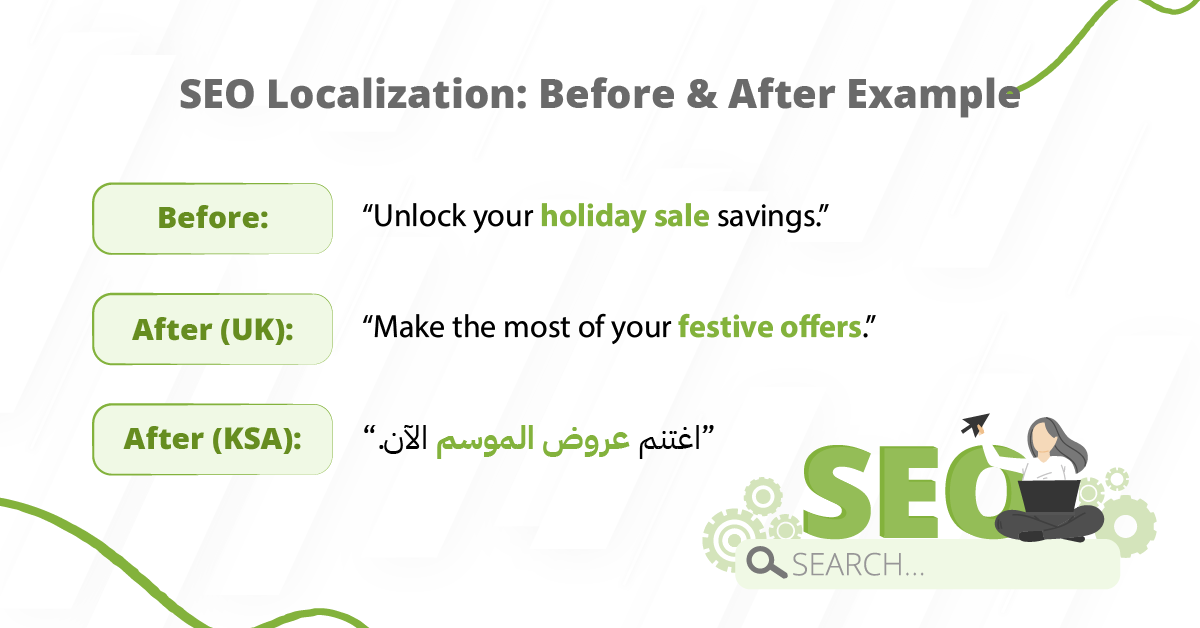
- Use Transcreation where messaging needs creativity; keep meaning, adapt tone.
- Rewrite headings, intros, and CTAs with local idioms and proof points.
- Localize prices, units, testimonials, and regulatory notes; add country-specific FAQs.
- Run an on-page SEO check: titles 55–60 chars, meta descriptions ≤155, clear H1/H2 hierarchy, relevant internal links, descriptive image alts.
- Avoid calques and awkward phrasing.
Step 4: Technical Setup for International SEO
Once your content and keywords are localized, it’s time to make sure search engines can read, index, and rank them correctly.
This is where your technical SEO foundation comes in, the setup that connects every localized page to its right audience.
- Implement hreflang for all language–country pairs, including self-referencing and x-default.
- Localize URL slugs where it helps relevance; avoid parameter-based language switches.
- Provide localized XML sitemaps; ensure HTML lang attributes and server headers match each locale.
- Validate indexing and coverage in Search Console per market; monitor logs for crawl and hreflang errors.
Step 5: UX for Local Trust
Traffic means little without trust. After users land on your localized pages, your goal is to make every interaction feel local, from how they navigate to how they pay.
That’s where UX and conversion optimization tailored to each market come in.
- Adapt navigation labels to local wording; simplify flows per market.
- Ensure forms/checkout handle local addresses, taxes/VAT, and payment methods (cards, wallets, cash-on-delivery where relevant).
- Localize trust signals: certifications/badges, phone numbers, service hours, delivery windows, and return policies.
- Improve speed by market: image compression, font subsets, lazy loading, and CDN routing by country.
- Align microcopy (errors, hints, success states) with local tone and reading patterns.
Step 6: Measure What Matters & Iterate
Multilingual SEO isn’t a one-off project; it’s a cycle of testing, measuring, and improving. With clear KPIs per locale, you can see what works, fix what doesn’t, and keep each market’s growth compounding quarter after quarter.
- Use International SEO Services for ongoing audits, fixes, and roadmap per locale.
- Track per-locale KPIs: impressions, CTR, average position (target keywords), bounce rate, conversion rate, revenue/lead quality.
- Maintain a change logbook (on-page edits, technical updates); A/B test titles and metas by market.
- Build a quarterly review: highlight winners, diagnose laggards, size new opportunities (keywords, pages, SERP features).
- Close the loop: feed insights back to keyword maps, copy, and tech setup to keep each locale compounding.
Common SEO Translation Mistakes (and How We Avoid Them)
Even the most experienced teams slip on SEO translation when content and technical work aren’t aligned. Here are the top pitfalls, and how we tackle them.
- Mistake 1: Literal keyword swaps
Translating keywords word-for-word ignores intent and local phrasing.
Fix: Conduct intent research and rewrite content to match how each market searches.
- Mistake 2: One template for all markets
A single structure or CTA rarely fits all audiences.
Fix: Add localized proof points, examples, and social proof that reflect regional values.
- Mistake 3: Missing hreflang or wrong canonicals
This confuses search engines and splits ranking signals.
Fix: Use a technical SEO checklist to ensure proper hreflang, canonical logic, and crawl parity.
- Mistake 4: Tracking all countries in one view
Combining data hides performance gaps between markets.
Fix: Build per-locale dashboards to measure impressions, CTR, and conversions by language and region.
Mini Case Study: Netflix’s SEO Translation Approach
Netflix is a powerful example of how multilingual SEO and localization go hand-in-hand. Here’s how they do it, and what you can draw from their approach.
Key Elements of Their Approach
- Netflix uses a URL structure that allows geo-targeting, for example, using www.netflix.com/es/ for the Spanish market. This structure helps search engines and users clearly identify the language/market version of the site.
- They optimize content by answering locally relevant queries, like “how to watch Netflix in [country]”, “Netflix subscription cost in [region]”, or “Netflix catalogue in [country]”. This aligns their pages with query intent rather than just translating generic copy.
- Netflix supports a huge number of markets with localized content, dubbing/subtitles, UI, and marketing assets in many languages. For example, they’ve supported over 60 languages and localised for markets in Europe, Asia, and Latin America.

Ready to Make SEO Translation Your Growth Channel?
Turn multilingual traffic into revenue with native linguists, market-led keyword research, and airtight technical SEO.
bayantech’s ISO 9001 & 17100 translation processes align copy, structure, and crawlability, so each locale ranks, converts, and scales without rework.
If you’re launching or rebuilding your online presence, we handle end-to-end rollout: translation strategy, transcreation, implementation, and QA.
Contact us to get started today!