
If your business regularly translates websites, manuals, software, product content, or marketing materials, you will probably see the same sentences appear more than once.
So why translate them from scratch every time?
That is where translation memory helps.
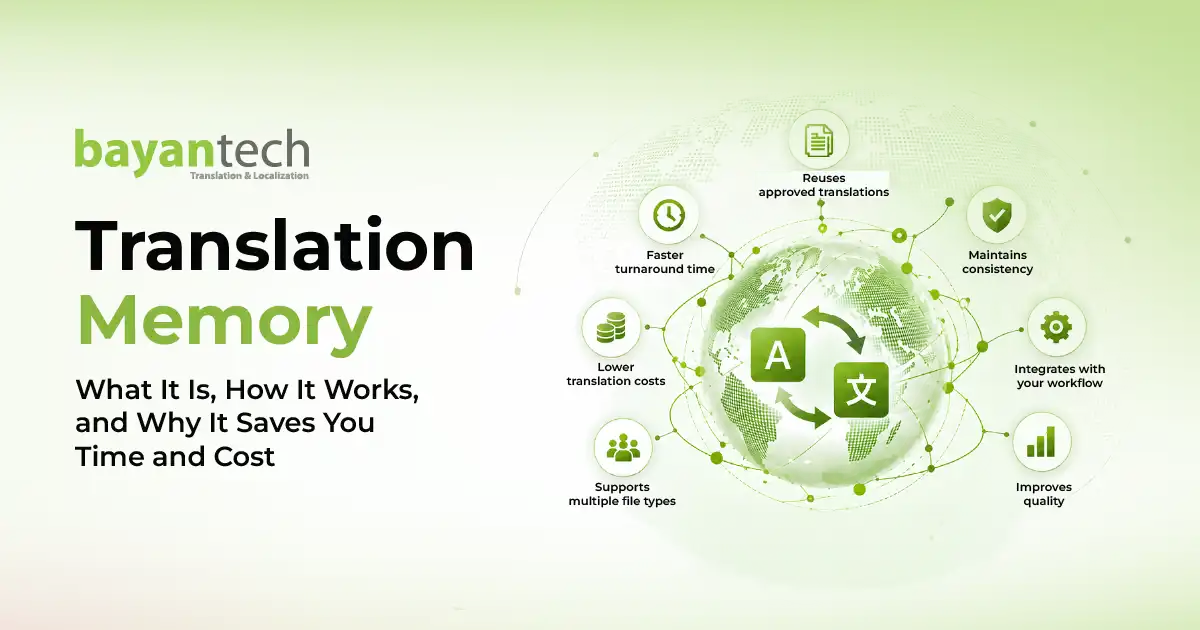
Translation memory stores translations that have already been completed and approved, then suggests them when the same or similar content appears again. This helps translation teams work faster, maintain consistency, and reduce unnecessary translation costs.
In fact, 86% of respondents in CSA Research data cited by Phrase said translation memory leads to faster delivery.
This guide explains what translation memory is, how it works, how it differs from machine translation, and how businesses can get more value from it.
What Is Translation Memory?
Translation memory (TM) is a bilingual database that stores previously translated sentences, phrases, or clauses together with their approved translations.
Each source-and-target pair is called a translation unit.
When a translator works on new content, translation memory software searches the database for identical or similar text. The translator can then accept the suggested translation, edit it, or create a new one.
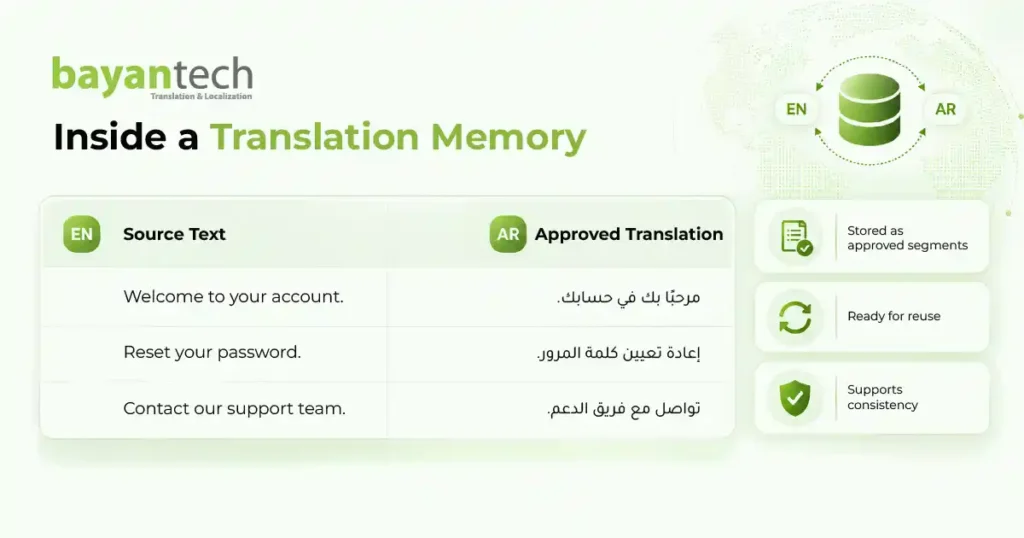
This means a TM becomes more useful with every project. A translation memory built while translating a technical manual today can reduce the work required when that manual is updated next year.
TM is different from a terminology database. A TM stores complete segments, while a term base stores individual terms and their approved equivalents.
Translation memories can also be exchanged through the TMX file format, helping organizations move their translation data between compatible CAT tools and translation management systems.
A Brief History of Translation Memory
The idea behind translation memory has existed for decades.
In 1980, computational linguist Martin Kay discussed how technology could support human translators by helping them reuse language and work more efficiently.
Commercial CAT tools later turned that idea into practical translation workflows. Trados became one of the best-known early platforms, followed by tools such as memoQ.
As cloud technology developed, translation memories became easier to share across global teams.
Today, CAT tools translation memory technology works alongside machine translation, AI, automated quality checks, and translation management systems.
How Does Translation Memory Work?
Translation memory normally works within a computer-assisted translation (CAT) tool.
The process has three main stages.
1. Segmentation
The CAT tool divides the source content into smaller segments, usually sentences or short phrases.
2. Automatic Matching
The system compares each new segment with content already stored in the translation memory database.
In professional localization services workflows, these matches appear automatically while translators work.
3. Reuse and Review
When the TM finds a match, the translator reviews the previous translation and decides whether it can be reused.
Not all matches are equal.
Translation Memory Match Types
| Match Type | What It Means | Typical Action |
| Context Match / 101% Match | The sentence and its surrounding context match previous content. | Usually requires minimal review. |
| 100% Match | The source sentence exactly matches something in the TM. | Review and reuse if appropriate. |
| Fuzzy Match | The new text is similar but not identical to a stored segment. | Edit the existing translation to fit the new content. |
| No Match | No useful previous translation exists. | Translate from scratch. |
Match types also influence cost.
Many language service providers use tiered pricing, where exact and high-percentage matches cost less than completely new content. Fuzzy matches may receive partial discounts depending on how much editing is required.
This is one of the main ways leveraging translation memory can reduce the cost of large, repetitive projects.
Translation Memory vs. Machine Translation
Translation memory and machine translation are often used together, but they are not the same.
Translation memory reuses existing translations.
Machine translation creates new translations automatically.
A TM searches a database of previously translated and approved content. Machine translation uses AI or neural models to generate new target-language text.
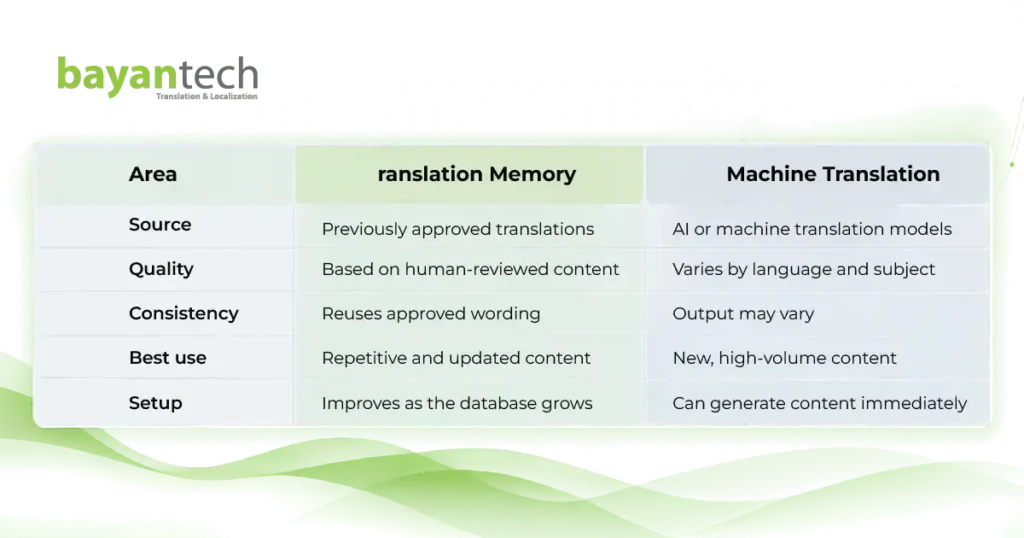
The key point in translation memory vs machine translation is that businesses do not necessarily need to choose between them.
In modern workflows, MT can create a first draft, TM can provide approved language from previous projects, and human linguists can review the result.
AI and Translation Memory Integration
AI can produce fluent translations quickly, but it does not automatically know how your organization prefers to communicate.
It may not know your approved product names, preferred terminology, brand tone, or previous editorial decisions.
This is where AI and translation memory integration becomes important.
Before AI translates new content, relevant translations from your TM can be provided as context. In simple terms, the system can see how your company translated similar content before and use that information when producing new text.
Translation memory helps AI follow:
- Approved terminology
- Product and feature names
- Brand tone
- Previous editorial decisions
- Technical and legal wording
This makes AI output more consistent with your existing multilingual content.
However, human review is still essential for translation memory quality. Poor or unreviewed AI output should not automatically enter the master TM because incorrect translations could then be reused in future projects.
That is where MTPE services play an important role. Machine translation produces the first draft, professional linguists review and improve it, and approved translations can then be added to the TM for future use.
Translation Memory Management: How to Get the Most From Your TM
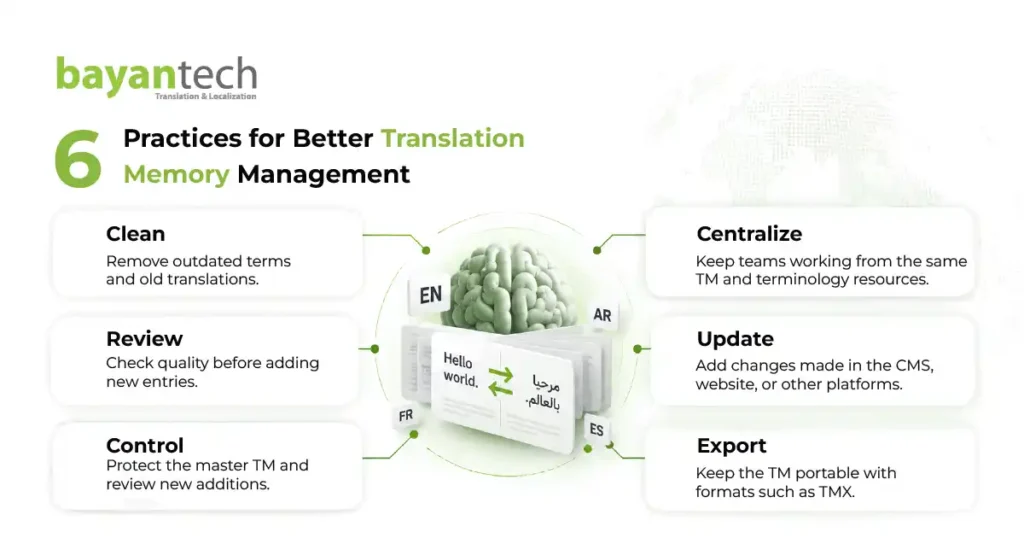
A translation memory only remains valuable if it is properly managed.
Good translation memory management prevents outdated or incorrect translations from being reused.
- Keep the TM Clean
Regularly remove outdated product names, old terminology, and superseded language.
- Check Quality Before Adding Entries
Translations should be reviewed for spelling, terminology, numbers, and formatting before they enter the master database.
- Control Master TM Access
For larger programs, teams can work with a separate working TM. New entries are reviewed before being added to the approved master TM.
- Keep Translation Resources Centralized
Everyone working on the same project should use the same TM and terminology resources.
A centralized localization workflow reduces the risk of different teams using conflicting translations.
- Capture Changes Made Elsewhere
If someone updates translated content directly in a CMS or website, that change should also be added to the TM.
Otherwise, the old translation may appear again later.
- Keep the TM Portable
Using formats such as TMX makes it easier to move translation memory data between compatible tools.
For translation memory for enterprise programs, this matters because the TM becomes a long-term business asset rather than something tied to one project.
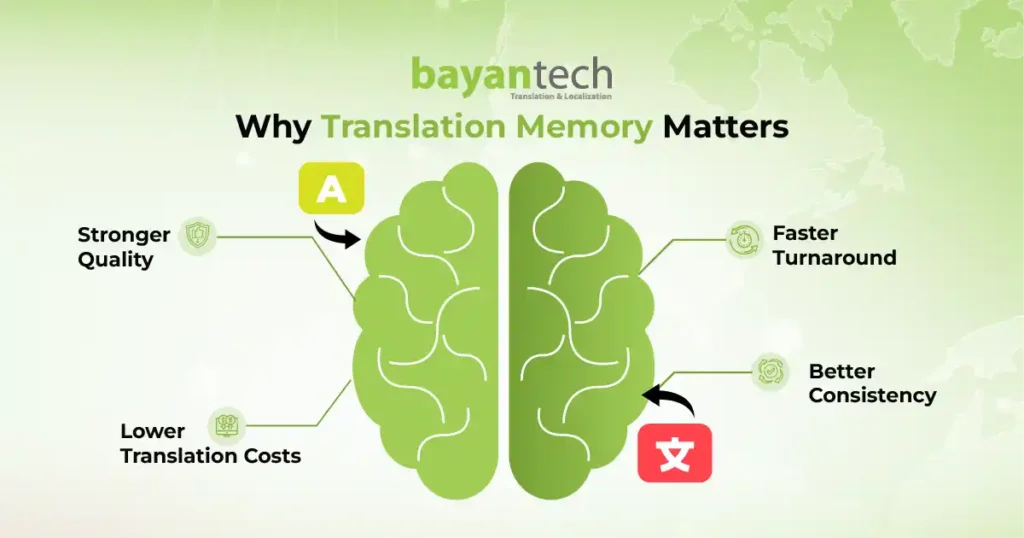
4 Benefits of Translation Memory
Faster Turnaround
Previously translated content does not need to be recreated every time.
The more repetition a project contains, the more time translators can save. CSA Research data cited by Phrase found that 86% of respondents linked TM with faster delivery.
Better Consistency
Without a centralized TM, different teams may translate the same product name, feature, or message differently.
Translation memory consistency helps ensure that approved wording is reused across projects and markets.
Lower Translation Costs
Professional translation services providers often charge less for content that already exists in the TM.
Context matches and exact matches generally require less work, while new content is translated at the full rate.
For organizations handling repetitive content, this can create meaningful translation memory cost savings over time.
Stronger Quality
TM suggestions come from content that has already been translated and approved by professionals.
This gives translators a stronger starting point than producing every sentence from scratch.
What Content Benefits Most From Translation Memory?
Translation memory works best when content repeats or changes gradually.
It is especially useful for:
- Technical documentation: Updated manuals often reuse large sections from earlier versions.
- Legal and financial content: Contracts and reports frequently contain recurring structures.
- Software and UI strings: Buttons, menus, and messages need consistent wording.
- Product catalogs: Large catalogs often repeat features, specifications, and descriptions.
- Knowledge bases: Teams can translate only the sections that changed.
This makes TM particularly valuable for translation memory for large projects and ongoing enterprise localization programs.
Highly creative advertising or campaign copy may benefit less because the goal is often to recreate the message for each market rather than reuse identical wording.
Frequently Asked Questions
What is translation memory?
Translation memory is a bilingual database that stores previously translated text with its approved translation so it can be reused later.
Is translation memory the same as machine translation?
No. TM reuses existing human-approved translations, while machine translation automatically generates new translations.
Do I need translation memory if I use AI?
Yes. TM gives AI access to your approved terminology, brand language, and previous translation decisions.
What is a fuzzy match?
A fuzzy match is a sentence that partially matches content already stored in the TM. The translator edits the existing translation instead of starting from zero.
How does translation memory reduce translation cost?
Previously translated matches generally require less work, so many providers apply lower rates to exact and fuzzy matches than to completely new content.
Make Every Translation Project More Valuable
Translation memory does more than make one project faster. Every approved translation can make future projects easier, more consistent, and more cost-effective.
At bayantech, we combine professional linguists, translation technology, and quality-controlled workflows to help businesses manage multilingual content efficiently.
With +120 languages supported and more than 20 years of localization experience, we help organizations build translation resources that grow in value over time.
Get a Free Quote and see how translation memory can support your next project.