
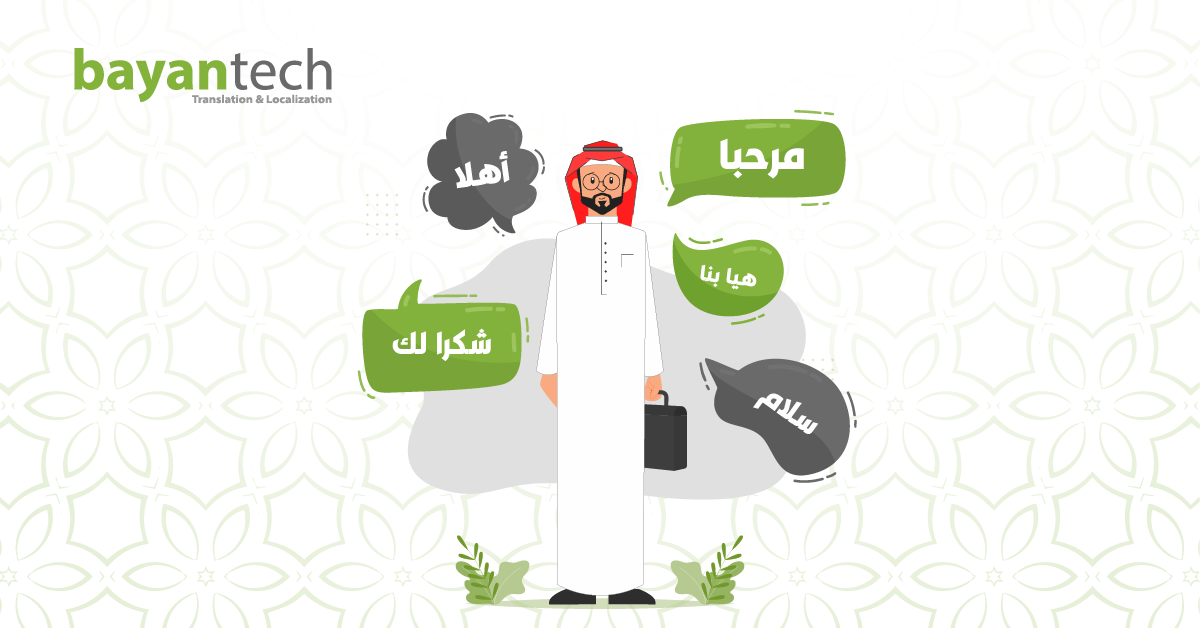
Does your business operate in the Middle East? Are the world’s 400 million Arabic speakers part of your target audience?
If so, you probably already know Arabic is a rich language, with dialects that can differ so much they’re sometimes treated as distinct languages.
For marketing, product, support, and compliance teams, spoken Arabic often becomes part of day-to-day work, especially in direct customer touchpoints.
In this blog, we break down the difference between Modern Standard Arabic and regional dialects, and how to choose the right form of Arabic to support clear communication and strong customer satisfaction.
Arabic as a Diglossic Language: Formal vs. Informal Tones
One reason many teams struggle to choose the right form of Arabic is that Arabic is a diglossic language.
In diglossia, a language has two varieties: one is formal and used in official contexts, and the other is a vernacular used in informal settings and everyday conversation.
In Arabic, the “high” (formal) variety is Modern Standard Arabic (MSA). The conversational (informal) variety depends on the regional dialect.
A common mistake teams make is choosing the wrong variety or using MSA for all Arabic content, regardless of audience or context.
The problem is that it can sound unnatural in many cases. It’s like using Old English in an ad for a new app: it might go viral, but for the wrong reasons.
Then, there are differences across regional variants. Key Arabic dialect groups include:
- Maghrebi Arabic (Moroccan, Algerian, Tunisian)
- Libyan Arabic
- Egyptian Arabic
- Sudanese Arabic
- Levantine Arabic (Lebanese, Syrian, Palestinian, Jordanian)
- Gulf Arabic (Kuwaiti, Emirati, Qatari, Bahraini, Omani, Saudi, Iraqi Gulf varieties)
- Iraqi Arabic
Keep in mind that dialects within the same group—such as Maghrebi or Levantine—can still vary significantly.
The 3 Layers of Arabic You’ll Encounter
- Classical Arabic
Classical Arabic is the original form of Arabic. It’s the language of religious texts, heritage contexts, and classical literature.
It can work in specific brand moments (e.g., heritage campaigns or formal cultural messaging), but it’s rarely the right tone for customer support or modern product communication.
- Modern Standard Arabic (MSA)/Formal Arabic
Modern Standard Arabic evolved from Classical Arabic and is used today in formal settings. It’s widely understood by Arabic speakers across regions.
You’ll see it in policies, contracts, corporate pages, press releases, and regulated industries.
MSA is widely readable across the Arab world—especially in writing—and it helps keep tone consistent when authority and clarity matter most.
- Spoken Arabic (Everyday Dialects)
This is the Arabic people speak day to day. It performs best in social content, video scripts, chat/support, onboarding nudges, community management, and influencer campaigns.
Dialects are learned natively at home, while MSA is typically learned in school—so dialects tend to feel more natural in fast, conversational touchpoints.
A Breakdown of the 4 Major Arabic Dialects
Across Arabic-speaking countries, there isn’t one version of spoken Arabic that fits every market.
Discover the major regional Arabic dialects that your Arabic content will fall into:
- Egyptian Arabic
Thanks to decades of film, TV, and pop culture, Egyptian Arabic is widely recognized across the Arab world. It is often easy to follow even for audiences outside Egypt.
This dialect works well for Egypt-first campaigns, social content, customer support, and pan-Arab conversational messaging when the brand tone is warm and informal.
- Levantine Arabic (Levantine dialects)
Levantine Arabic refers to Levantine dialects commonly used across Lebanon, Syria, Jordan, and Palestine.
It’s frequently recommended for broad reach because it’s familiar, widely consumed in media, and fits naturally in dialogue-style content.
It’s a strong choice for Levant-targeted campaigns, regional brands, UI/UX microcopy, chatbots, and conversational product experiences where tone matters.
- Arabian Peninsula dialects (Gulf and neighbors)
Spoken varieties across the Arabian Peninsula, including Gulf dialects and neighboring regional speech, carry strong local identity and can signal “this is for you” in market-facing communication.
Dialect choice here can directly impact trust, especially in high-consideration sectors.
This approach is ideal for Saudi/UAE/Qatar/Kuwait/Oman/Yemen audience-facing ads, retail campaigns, and fintech messaging where credibility and familiarity are key.
- Moroccan Arabic (Maghrebi region)
Moroccan Arabic (Darija), within the broader Maghrebi region, is highly distinctive in vocabulary, pronunciation, and speed.
When localized properly, though, it’s a major advantage for Morocco-focused performance and brand connection.
Arabic Localization Tips to Outstand in Arabic-Speaking Markets
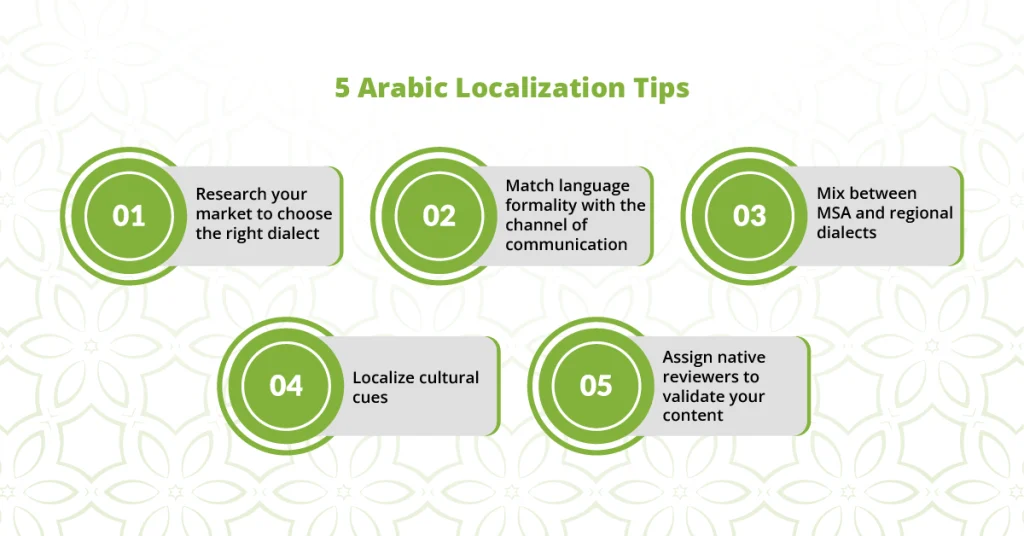
- Choose dialect by market, not by preference. Localize to the country you’re selling in (e.g., Egyptian Arabic for Egypt, Levantine Arabic for the Levant, Gulf for the Arabian Peninsula, Moroccan Arabic for Morocco).
- Match the language level to the channel. Use MSA for legal, compliance, and formal website pages; use the local dialect for ads, social, and conversational UX (chat, prompts, notifications).
- Create a “core MSA” + “dialect layer” workflow. Keep brand terminology and key claims consistent in MSA, then adapt tone and phrasing per dialect to avoid rewrites and mixed messaging.
If your customer journey is digital, align dialect decisions with Website Localization Services so UI strings, CTAs, and help content feel natural in each market.
- Localize cultural cues, not just words. Adjust greetings, humor, urgency, and politeness levels—what feels friendly in one market can feel too casual (or too stiff) in another.
- Test with native reviewers from the target country. Validate tone, slang risk, and clarity before launch—especially for fintech, healthcare, and high-trust messages.
| Tip for business leaders: For high-stakes content (legal, fintech, healthcare, brand claims), Arabic Translation Services help ensure accurate rendering of meaning, tone, and terminology—so messaging stays clear, consistent, and safe across markets. |
Benefits of Arabic Localization Services
Done well, Arabic dialect localization is more than swapping words—it’s dialect-aware translation that produces culturally adapted Arabic content using clear target-market Arabic dialect selection. The result is messaging that feels written for the audience, not “translated for them.”
Key benefits:
- Higher ad relevance because the copy sounds native and reduces the “this was translated” feeling.
- Better support resolution since customers describe issues in the spoken language they actually use.
- Stronger brand trust when tone, politeness, and phrasing match local expectations.
- Fewer misunderstandings in product UX because prompts and instructions align with how users interpret everyday language.
For growth teams, dialect-aware landing pages also support Multilingual SEO, helping each market rank for the terms customers actually search.
Order bayantech’s Arabic Localization Services Today
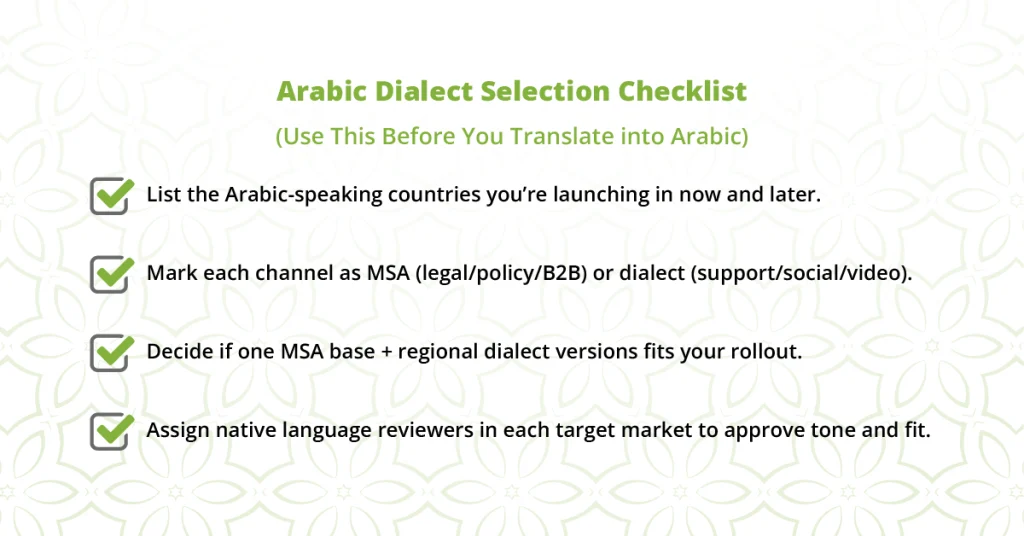
Want the fastest path to the right Arabic variation? bayantech can map your markets, channels, and content types, then recommend the best mix of MSA and dialect localization for conversion—without overcomplicating your workflow.
Before publishing, add a final review pass with Proofreading & Editing Services to confirm tone, terminology, and formatting.
Contact the team today to communicate with Arabic-speaking audiences confidently.