


Global expansion creates a difficult decision: should your brand look exactly the same everywhere, or should every market receive a customized experience?
The problem is that this is not a choice between two extremes. Successful global brands decide which elements create value through consistency and which require local adaptation.
A global standardization strategy can help brands reduce costs, maintain consistency, and expand faster. However, applying the same approach everywhere can create problems when customer expectations, regulations, or cultural preferences differ.
This guide explains how companies can approach standardization vs localization, build a practical global-local balance, and decide which parts of their marketing strategy should remain global and which should adapt locally.
What Global Standardization Actually Means and Where It Breaks
A global standardization strategy means using the same product, messaging, processes, or marketing assets across multiple markets with limited changes. The main idea is simple: instead of creating a completely different approach for every country, companies build a shared foundation that can scale.
For example, a company may use the same brand identity, product positioning, and campaign structure across markets while reducing duplicated work. The advantage is efficiency.
Standardized content, processes, and assets allow teams to enter markets faster without rebuilding everything from the beginning. However, standardization has limits.
A message that works well in one market may not have the same impact somewhere else. Customer expectations, cultural references, buying behavior, and regulations can change how audiences respond.
This is where the risks of over-standardization appear. A company may save time in production but lose relevance if customers feel the message was created for another market.
For example, a global campaign built around a specific cultural reference may perform well in the original market but fail to connect with audiences who do not share the same context.
The goal is not to avoid standardization. The goal is to know where it creates value and where it creates friction.
A strong strategy considers the trade-off between standardization cost savings vs localization ROI. The savings from using the same assets everywhere should be compared with the potential impact of adapting content for specific audiences.
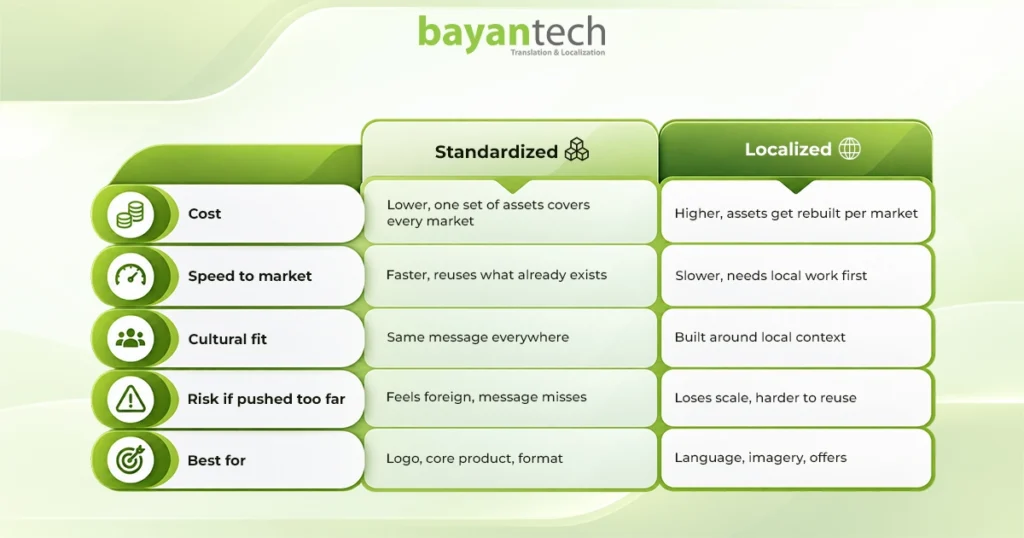
The difference becomes clearer when comparing what standardization and localization optimize for:
Glocalization and the Global-Local Balance: The Hybrid Model Most Brands Use
Few brands run pure standardization or pure localization. Most run something in between, often called glocalization: specific elements stay locked globally (the logo, the core product, the positioning), while others open up to local teams (language, imagery, specific offerings).
This isn’t indecision dressed up as strategy. A hybrid model still requires an explicit decision about which elements are locked and which are open. That decision just happens at a more granular level than “standardize” or “localize” as a blanket choice.
The advantage over picking one extreme is that a brand keeps the cost efficiency of shared assets while still adapting the pieces that actually drive local relevance, instead of forcing every market to work with assets that only fit the home market.
McDonald’s is a familiar version of this. The golden arches, the drive-through format, and the core menu structure stay consistent worldwide. The specific items on the menu don’t. India’s McSpicy Paneer replaces beef with a spiced paneer patty for a market where most people limit or avoid meat, and Japan’s Teriyaki burger reflects a flavor profile the American menu never touches. The format is standardized. The menu is localized.
Documenting that split, in writing, so every market executes against the same rule instead of guessing case by case, is what separates a deliberate hybrid model from an accidental one.

A Decision Framework for When to Standardize vs. Localize
The biggest challenge is not understanding standardization and localization. It is knowing when to standardize vs localize.
Many companies make these decisions based on assumptions. A market looks similar, so they use the same content. A market looks different, so they localize everything.
A better approach is to evaluate each element using clear criteria. A global brand strategy decision framework should consider three factors:
- Buying behavior: Do customers make decisions in a similar way across markets?
- Regulatory requirements: Are there legal or compliance differences that require adaptation?
- Cultural relevance: Does the message depend on local habits, values, or references?
Companies can then score each element as low, medium, or high for adaptation needs. For example:
| Element | Standardize When | Localize When |
| Product information | Features are the same everywhere | Requirements differ by market |
| Messaging | Customer needs are similar | Motivations differ significantly |
| Pricing | Pricing model is consistent | Currency and purchasing power affect decisions |
| Visuals | Images represent global audiences | Cultural expectations differ |
| Customer support | Process is similar | Language and communication preferences vary |
The advantage of using a framework is that decisions become repeatable. Teams no longer debate every market separately without clear criteria. The benefit is faster expansion because every new market can be evaluated using the same process.
This approach also helps companies avoid many International Marketing Challenges that appear after launching content that does not match local expectations.
Standardization in SaaS and Retail Expansion: Why the Right Balance Differs by Industry
The right level of standardization depends heavily on the industry. A SaaS company and a retail brand may both expand globally, but the elements that need adaptation are very different.
Standardization in SaaS Expansion
SaaS companies can often standardize their core product experience. The software interface, technical features, and product positioning may remain consistent across markets.
However, some elements usually require adaptation:
- User onboarding language.
- Payment methods.
- Compliance requirements.
- Customer support content.
A customer in a new market may understand the product, but still expect local payment options or support in their preferred language.
Standardization in Retail Expansion
Retail brands often standardize their brand identity, supply chain, and store experience. However, they usually need more market adaptation for:
- Product assortment.
- Seasonal campaigns.
- Local buying habits.
- Promotional messaging.
A product that sells well in one country may need different positioning or packaging in another.
The advantage of an industry-specific approach is that companies focus localization resources where they create the most impact.
The benefit is avoiding both extremes: spending too much on unnecessary adaptation or failing to adapt areas that directly influence customer decisions.
Brands managing large content programs often support this approach through Multilingual Content Marketing, where content creation and adaptation are planned across markets instead of handled as separate translation tasks.
Standardization Cost Savings vs. Localization ROI: Finding the Right Investment
Global brands often look at standardization because it reduces production costs.
Using the same campaign assets, messaging framework, and processes across markets can save time and resources. However, cost savings alone do not show the full picture.
The question is whether the savings are greater than the value created by adapting content for local audiences. Many global brands that appear highly standardized actually use a selective approach.
For example, a global brand may keep its logo, visual identity, and core positioning consistent everywhere. At the same time, it may adapt campaigns, products, or messaging based on regional preferences.
The real question is not whether localization is necessary, but where it creates measurable business value. Brands that separate standardized assets from market-specific elements can invest resources where adaptation has the strongest impact.
The advantage of separating these decisions is that companies can protect their global identity while investing in localization where it affects customer behavior.

The benefit is a stronger return from international expansion because resources go toward changes that can improve market performance.
According to CSA Research, 76% of consumers prefer products with information in their own language, showing why local adaptation can influence purchasing decisions.
Companies that need support adapting campaigns, websites, and marketing assets can use Marketing Localization Services to maintain brand consistency while creating market-specific experiences.
Pre-Decision Checklist for Your Global Standardization Strategy
Before choosing what to standardize and what to localize, ask:
- Which brand elements must remain consistent across all markets?
- Which elements depend on cultural, regulatory, or customer differences?
- Have we evaluated each market using the same decision criteria?
- Are we measuring the cost of localization against the potential business impact?
- Do our teams have clear guidelines for global and local decisions?
A strong strategy is not about choosing standardization over localization. It is about knowing where each approach creates the most value.
Get the Right Standardization-to-Localization Balance for Your Brand
Expanding globally requires more than choosing between one global message or multiple local versions. Companies need a structured approach that defines what stays consistent, what changes, and why.
bayantech helps organizations build scalable international marketing strategies through localization expertise, structured workflows, and multilingual content solutions.
Whether you are entering new markets or improving an existing global program, the right balance can help your brand stay consistent while connecting with local audiences.