
When organizations submit legal and official documents across borders, accuracy is only part of the equation. Even a perfectly translated document can be rejected if the wrong type of translation was commissioned in the first place.
This is where the debate around certified vs sworn translations becomes important. The distinction is not about quality, language expertise, or pricing. Instead, it is about compliance with the requirements of the receiving authority.
Whether your documents are being submitted to a court, government agency, immigration authority, university, or regulatory body, the translation type required is determined by that institution, not by the translation provider.
For procurement managers, legal affairs teams, HR departments, and operations leaders, understanding this distinction before requesting a quote can prevent costly delays, rejected submissions, and unnecessary rework.
What Certified Translations Are And What the Signed Statement Actually Certifies
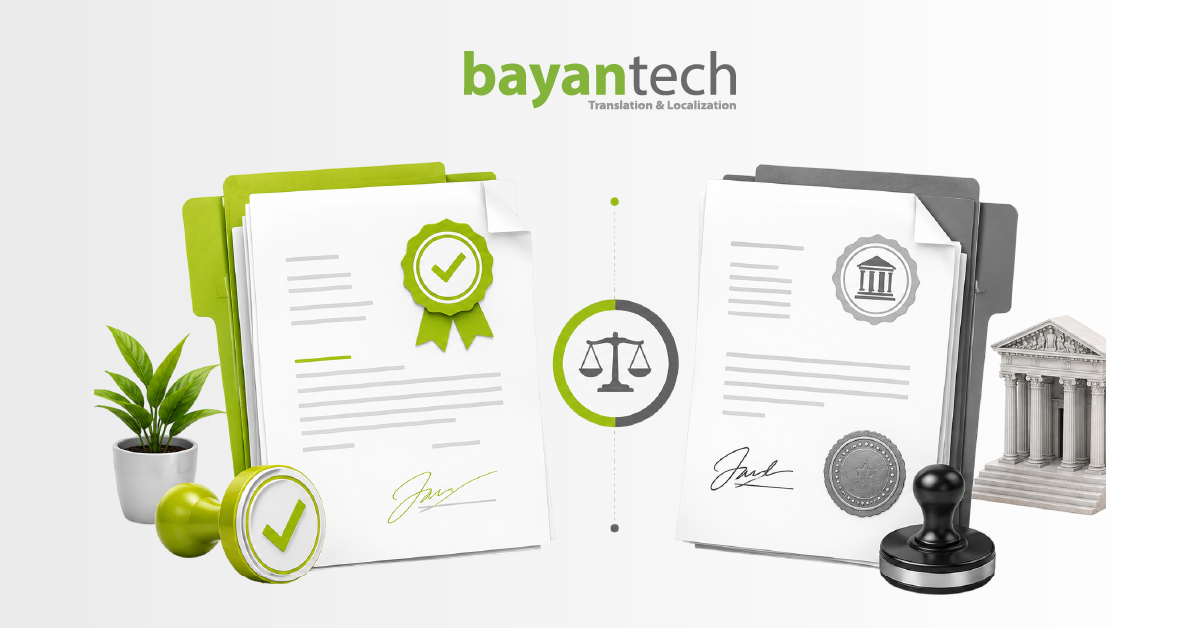
A certified translation is an official translation accompanied by a signed statement from the translator or translation agency confirming that the translation is complete and accurate.
This statement—often called a certificate of accuracy—serves as a written attestation that the translated content is a true representation of the original document. The certificate is typically signed, dated, and includes confirmation that the translator is competent in both languages.
The key feature of certified translations is that the legal validity comes from the signed statement attached to the translation, not from a government appointment or court-issued credential.
This approach is widely accepted in the United States and many other common law jurisdictions. Government agencies, courts, universities, and immigration authorities regularly accept certified translations for documents such as birth certificates, marriage certificates, diplomas, contracts, and other official documents.
For example, if an HR team is supporting international employee immigration filings in the United States, certified translations are typically the required format for foreign-language supporting documents.
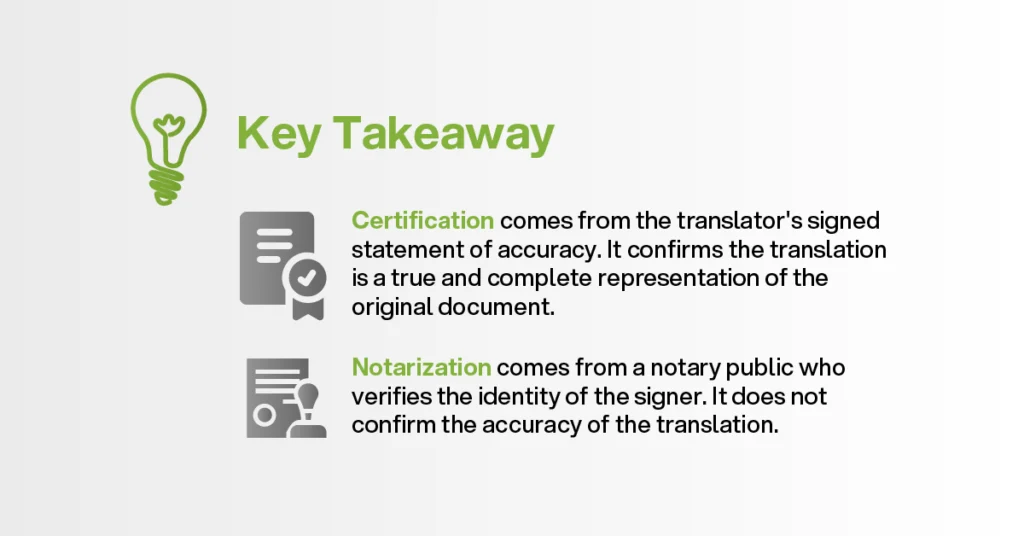
It is also important to clarify a common misconception. A certified translation is not the same as a notarized translation. Certification comes from the translator or agency’s signed statement. Notarization is a separate process involving a notary public who verifies the identity of the signer.
For businesses managing recurring Document Translation Services across multiple jurisdictions, understanding these distinctions helps prevent administrative delays caused by submitting the wrong translation type.
What Sworn Translations Are And Why Officially Authorized Status Changes the Legal Standing
Unlike certified translations, sworn translations derive their legal validity from the translator’s official status.
A sworn translator is a language professional who has been officially authorized by a court, ministry, or competent government authority to produce translations with legal standing in a specific jurisdiction.
The most important difference is that the credential belongs to the translator rather than the document.
In countries such as Spain, France, Germany, Italy, Brazil, and many GCC markets, sworn translators hold regulated credentials that allow their translations to be accepted by courts, government registries, and public authorities.
Because of this official appointment, sworn translations are often required in legal proceedings and government submissions.
This distinction matters because no amount of accuracy can replace the required credential. A certified translation may be flawless, but if a sworn translation is required, the document can still be rejected immediately.
The UAE provides a good example. Documents submitted to courts, government ministries, and notary authorities often require translation by translators registered under the Ministry of Justice framework. A standard certified translation would not satisfy those requirements.
Organizations purchasing Legal Translation Services for submissions in civil law jurisdictions should therefore verify whether the receiving authority requires a sworn translator rather than simply a certificate of accuracy.
The Practical Difference Between Certified and Sworn Translations for Official Documents
At first glance, certified and sworn translations may appear similar. Both involve professional translation, quality review, and official use. However, the source of their legal recognition is completely different.
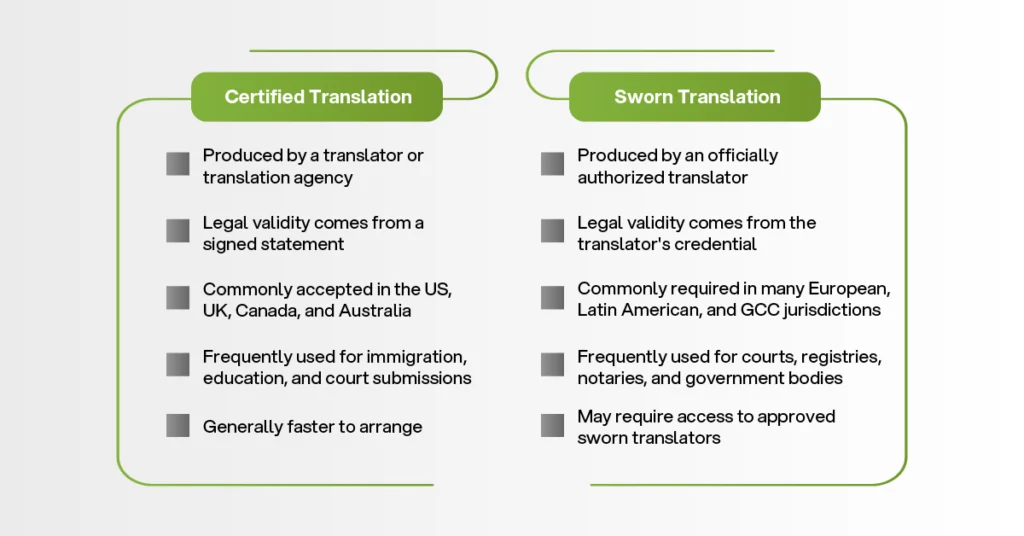
The most practical rule for buyers is jurisdiction.
Common law jurisdictions generally accept certified translations. Civil law jurisdictions often require sworn translations.
This means the decision is not based on document type alone. Instead, it depends on where the document is being submitted.
Understanding this rule allows procurement teams to specify the correct type of translation from the beginning rather than discovering the requirement after a rejection notice arrives.
How the Requirements of the Receiving Authority Determine the Translation Type You Need
One of the most common mistakes organizations make is assuming the translation provider determines which translation type is appropriate.
In reality, the receiving authority makes that decision.
A court, ministry, immigration authority, regulatory agency, university, or notary body establishes the requirements that must be met before documents can be accepted.
That is why the same document may require different treatment depending on where it is being submitted.
For example:
- A birth certificate submitted to USCIS may require a certified translation.
- The same birth certificate submitted to a Spanish civil registry may require a sworn translation.
- In another jurisdiction, the translation may require both sworn status and an apostille.
This makes the pre-commission stage critical.
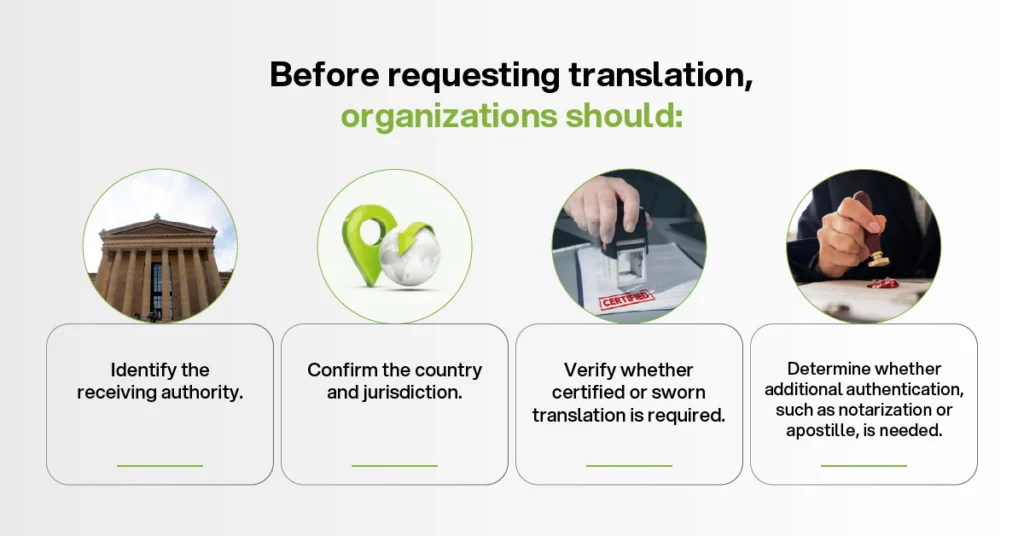
A translation provider can offer guidance, but the authority receiving the document ultimately sets the rules.
Taking these steps before commissioning a project can dramatically reduce rejection risk and eliminate avoidable delays.
Which Translation Type Common Legal Document Types Actually Require
Although requirements vary by jurisdiction, the following reference guide can help procurement and legal teams understand common patterns.
| Document Type | Typical Requirement |
| Birth Certificates | Certified in the US; sworn in Spain; sworn plus apostille in some jurisdictions |
| Immigration Documents | Certified translations typically required for US immigration submissions |
| Academic Diplomas | Often certified for US institutions; sworn for certain European equivalency procedures |
| Court Documents | Sworn in many civil law countries; certified in many common law jurisdictions |
| Commercial Contracts | Depends entirely on the receiving authority |
| Regulatory Submissions | Determined by the relevant regulator and jurisdiction |
| Board Resolutions | Certified for many US filings; sworn for certain UAE government submissions |
This illustrates an important principle: document type alone does not determine the required translation.
Instead, intended use and receiving authority determine what is necessary.
For example, organizations operating in the Gulf frequently encounter specific requirements for Board Resolution Translation UAE projects. When board resolutions are submitted to certain government entities, translation by a Ministry of Justice-approved translator may be mandatory.
Establishing a jurisdiction-specific reference matrix for recurring document categories can save procurement teams significant time while reducing compliance risk.
What Businesses Should Confirm Before Commissioning Professional Translation of Legal Documents
Organizations often focus on language pairs, turnaround times, and pricing when requesting quotes.
However, legal document translation requires a more structured briefing process.
Before commissioning a project, confirm the following:
1. Receiving Authority and Jurisdiction
Identify exactly who will receive the document and where the submission will occur.
2. Certified or Sworn Translation Requirement
Never assume. Request written confirmation whenever possible.
3. Additional Authentication Requirements
Determine whether notarization, legalization, or apostille is required alongside the translation.
4. Submission Deadline
Include the final filing deadline, not simply the desired delivery date.
These four details provide the foundation for a compliant translation workflow.
They also help avoid situations where the provider delivers a translation that is accurate but unusable because it does not meet procedural requirements.
For organizations evaluating a long-term language partner, reviewing About Us / Our Story can provide useful insight into experience with regulatory, legal, and cross-border documentation projects across GCC, European, and North American markets.
Certified vs Sworn Translation Decision Checklist — Before You Commission Any Legal Document Translation
Before approving any legal documents translation project, use this checklist:
- Identify the receiving authority.
- Confirm the submission jurisdiction.
- Determine whether the jurisdiction follows common law or civil law requirements.
- Verify whether certified translations or sworn translations are required.
- Check whether apostille or notarization is needed.
- Confirm that the translator holds any required official credentials.
- Include the submission deadline in the project brief.
- Create a reusable reference guide for recurring document categories.
- Obtain written confirmation of requirements whenever possible.
- Match the translation type to the authority—not to assumptions based on previous projects.
Following these steps significantly reduces rejection risk and helps ensure documents remain legally valid throughout the submission process.
Get the Right Type of Legal Translation with bayantech
Choosing between certified and sworn translations is not about selecting a higher-quality service. It is about selecting the translation format required by the authority reviewing your documents.
At bayantech, our legal translation specialists help businesses confirm the right translation type based on the receiving authority, jurisdiction, document type, and authentication requirements.
Whether your documents require certified translation, sworn translation, notarization, or apostille support, our team can help you reduce rejection risks, avoid unnecessary delays, and keep your cross-border submissions moving forward.
Request a quote today or speak with our team to make sure your legal documents are translated the right way from the start.