

Relying on an outdated market-size figure, a statistic from a vendor’s sales pitch, and your intuition can make it difficult to secure permission for a localization budget. That simply isn’t sufficient to support your spending plan or effectively compare services.
Your ultimate choice becomes a guess when you lack reliable, current localization statistics. When localization directly affects your revenue, compliance, and customer experience, this is particularly dangerous.
With information on market size, conversion rates, AI usage, and particular statistics for the GCC, Arabic, healthcare, and SaaS industries, this resource compiles the localization market data you truly need to make an informed choice. Everything on this page is dated, referenced, and operational.
Localization Statistics: Global Market Size and Growth Trends
What is the size of the localization market in 2026? Since multiple research organizations measure different aspects of the sector, there isn’t a single figure.
According to Nimdzi Insights, the language sector is expected to grow from $72.6 billion in 2025 to roughly $73.4 billion in 2026. The market for language services is estimated by Mordor Intelligence to be worth $75.53 billion in 2026. By 2031, it projects a 5.12% CAGR to reach $96.97 billion.
Although those numbers are close, they are not the same. Nimdzi’s industry definition encompasses a wide range of language services and technologies. Translation, interpreting, localization, subtitling, DTP, and transcreation are among the commercial services that Mordor uses to define its market.
This is why localization market data can look inconsistent across reports. A report on language services, translation services, localization technology, or AI localization may use a different base and scope.
Quality requirements also belong in that discussion. ISO 17100:2015 remains the current published translation-services standard, although ISO is developing a second edition.
Buyers can use ISO-Certified Translation Services as one signal of documented processes and quality controls. Professional credentials from bodies such as the American Translators Association can support supplier qualification where relevant.

What Localization Actually Does to Conversion and Revenue
It’s one thing to understand the size of the market, but it’s another to demonstrate how localization truly increases sales in order to get budgets approved. You may demonstrate that localization is a profitable investment rather than merely a cost by presenting actual multilingual website conversion numbers.
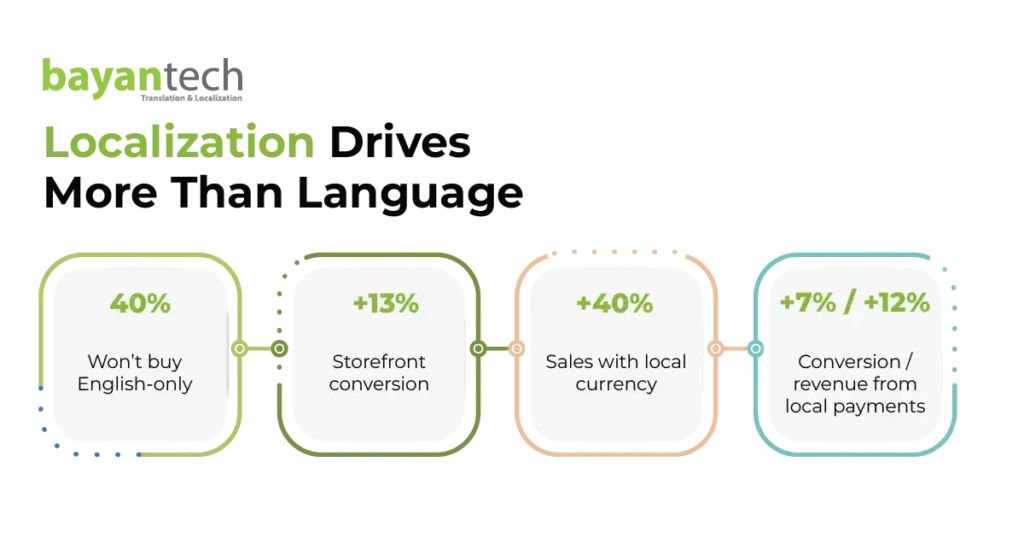
According to the well-known “Can’t Read, Won’t Buy” poll by CSA Research, 40% of respondents claim they will never make a purchase from an English-only website, and the majority prefer to shop on websites in their native tongue. However, the checkout step is where the true magic happens.
You may be thinking, “Vendor blogs always exaggerate their conversion numbers.” Use only data from reliable research companies to prevent this.
For example, Shopify discovered that displaying prices in local currency can increase sales by up to 40%, while translating a storefront increases conversions by an average of 13%. According to Stripe’s analytics, introducing local payment options at checkout boosts revenue by 12% and conversions by more than 7%.
The influence of localization on sales extends far beyond just translating your marketing material, as demonstrated by these global eCommerce translation data. It’s equally crucial to get the checkout process perfect, including address formats, payment methods, and currencies.
Your translated content ROI statistics are significantly more difficult to argue when you use figures from reputable research firms rather than random blog posts.
Localization Statistics on AI and Machine Translation Adoption
If you know the current AI in translation statistics and how fast machine translation is being adopted, you can easily see if your team’s workflow is falling behind or keeping up with the industry. It turns localization automation trends from a buzzword into a real, measurable goal.
The data shows that most localization teams are already using machine translation, but it’s not a simple “humans vs. machines” story. Nimdzi’s recent report found that over 80% of language providers offer machine translation post-editing (MTPE). Another survey showed that while 16% of teams use fully automated workflows, most rely on a mix of automation and human review, and 45% still do everything manually.
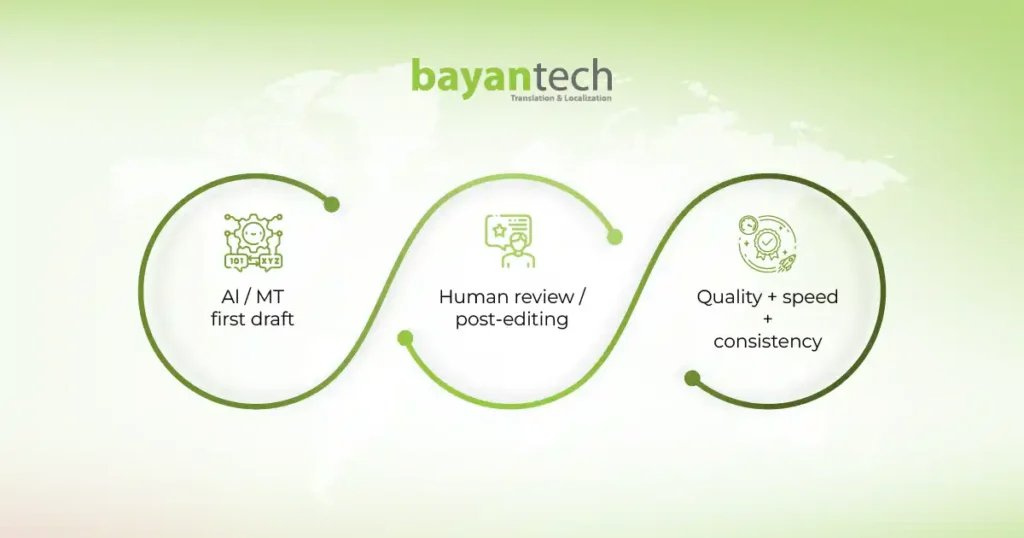
This brings up the big question: “Is AI just going to replace human translators completely?” The current AI localization market data says no. AI paired with human review is the standard right now.
Almost all professional translators use translation memory and CAT tools. The sweet spot is using AI for a first pass and having humans review it. This gives you the speed of automation without sacrificing the quality checks that regulated or brand-sensitive content demands.
Localization Statistics for GCC, Arabic, Healthcare, and SaaS
Global localization statistics give us the big picture, but the numbers become harder to find when we look at a specific region or industry. GCC, Arabic, healthcare, and SaaS are good examples because research companies often measure these markets differently.
GCC and Arabic Localization
The GCC and wider Middle East are becoming important markets for language and localization services.
According to Nimdzi, the Middle East generated around $1.1 billion in language-industry demand in 2025, representing 1.5% of the global market.
BlueWeave Consulting gives a different estimate, placing the GCC translation-services market at $2.1 billion in 2024, with expected annual growth of 7.1% through 2031.
Why are the numbers different? Simply because the two reports are not measuring exactly the same thing. They use different market definitions, countries, and research methods. This is why GCC localization statistics should always be read in context rather than compared directly.
Arabic-specific market data is even harder to find. One useful indicator comes from W3Techs, which reported that Arabic was used on only 0.6% of websites with an identifiable content language.
This does not tell us how large the Arabic localization market is. However, it does show that Arabic still represents a relatively small share of online website content.
Healthcare and Life Sciences
Healthcare is easier to track because many language-industry reports include life sciences as a separate category.
Mordor Intelligence estimated that life sciences represented 18.36% of language-services spending in 2025.
The demand comes from content such as clinical documents, regulatory submissions, medical information, and patient communications.
In healthcare localization, the priority is not simply translating content quickly. Accuracy, consistent terminology, proper review, and clear quality checks are essential because mistakes can carry serious consequences.
SaaS and Software Localization
Finding SaaS-only localization statistics is more difficult because research reports usually include SaaS within larger categories such as software, IT, and telecom.
Phrase’s 2025 global survey (Censuswide) found that 96% of businesses are already translating or localizing their software, and 80% expect localization to play a growing strategic role as they expand internationally.
These figures do not measure SaaS localization alone, but they still show an important trend: software companies increasingly need localized products and content when entering new markets.
For SaaS businesses, this can include everything from websites and apps to user interfaces, help centers, onboarding flows, and customer communications.
For more context on working across Middle Eastern markets and specialized industries, explore bayantech’s About Us page.
From Data to Decision: How to Use Localization Statistics
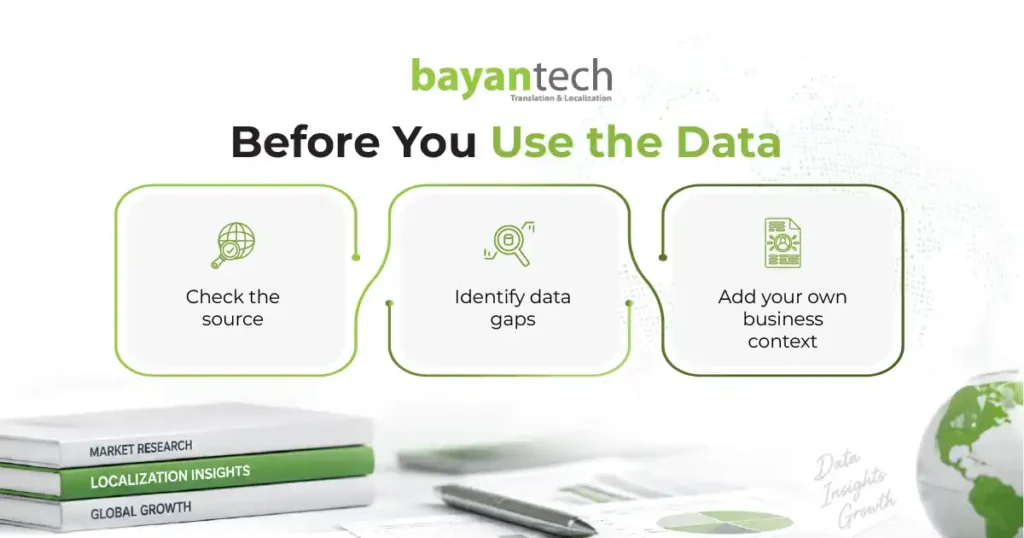
A page full of numbers is not a business case. Each statistic needs a job. Start by mapping every number to one of three questions, so the evidence stays tied to a decision.
- Is the opportunity large enough? Use market-size and growth data to show that language services support active international demand.
- Can localization affect revenue or conversion? Use consumer-language preferences and ecommerce conversion data to connect localization with buyer behavior.
- What operating model makes sense? Use AI, MTPE, and automation statistics to compare manual, hybrid, and automated workflows.
Then check the source behind each number. Record the publisher, study date, sample or market definition, geography, and whether the figure is measured, surveyed, or forecast. A forecast should never be presented as if it were recorded revenue.
Finally, identify the gaps. If public GCC, Arabic, healthcare, or SaaS data is too broad, do not fill the slide with a weak statistic. Use internal project data, a provider benchmark, a market-specific case study, or a paid research source instead.
A solid localization industry report can explain the market. A procurement decision still needs your content volume, languages, quality requirements, turnaround expectations, technology stack, and risk level.
Get Localization Data Specific to Your Market
Localization statistics are most useful when they match the decision you need to make. bayantech can help connect market data with your languages, content types, quality requirements, and workflow.
Tell us your target markets and industry. A bayantech specialist can return a scoped quote with market-specific context within two business hours.