

A product feature appears in the UI with one name, in the help center with another, and in a sales deck with a third. At first, that may seem like a small issue. But over time, it slows teams down, creates rework, and makes the brand feel less consistent across markets.
That problem is called terminology drift.
Terminology Management is the process of defining approved terms, storing them in a shared resource, and using them consistently across languages and content types.
Done well, it improves terminology consistency in translation, supports multilingual content consistency, and makes localization program management much easier. Let’s learn more about terminology management!
The Problem With Terminology Drift
Most teams begin with translation glossary management in a spreadsheet. That works when the number of terms is small and only a few people are involved. The problem starts when multiple regions, agencies, or internal teams begin working in parallel.
Then terms start to split.
A support article may use one phrase, the UI another, and marketing a third. Acronyms get translated differently. Product names, feature labels, and regulated wording lose alignment.
Without terminology standardization and ongoing termbase management, teams stop using one shared language and start making decisions on the fly.
That is where confusion starts. And once confusion enters the workflow, every release becomes harder to manage.
Why It Gets Worse in Fast-Moving Teams
The issue becomes more serious in SaaS, enterprise environments, and any business with fast release cycles.
In SaaS localization terminology, product updates happen constantly. UI strings change, onboarding flows evolve, documentation gets revised, and campaigns launch in parallel.
If approved terms live across emails, spreadsheets, and old files, inconsistency becomes almost unavoidable.
That is why a multilingual terminology database matters. It gives product, marketing, support, and localization one shared place to align on meaning. Instead of each team working from its own version, everyone works from one source of truth.
Without that structure, teams do not just move fast. They move apart.
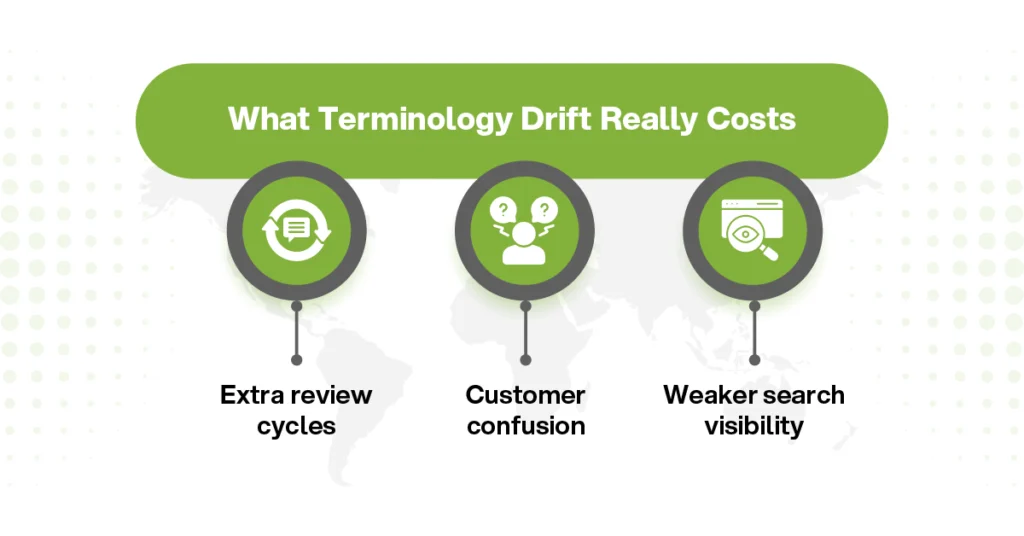
The Real Cost: Rework, Confusion, and SEO Problems
Terminology drift is not only a style issue. It creates practical business problems.
First, it adds rework. When terminology is not controlled, the terminology QA process keeps catching the same issues late in the workflow. Reviewers flag term mismatches after translation is complete, which means extra fixes, extra approvals, and slower delivery.
Terminology accounts for 15% to 30% of translation/writing work. Effective terminology management can increase productivity in translation and revision by about 20%.
Second, it creates a weaker customer experience. If the product says one thing and the documentation says another, users start second-guessing what they are reading. Even if both terms are technically correct, the inconsistency makes the content feel less reliable.
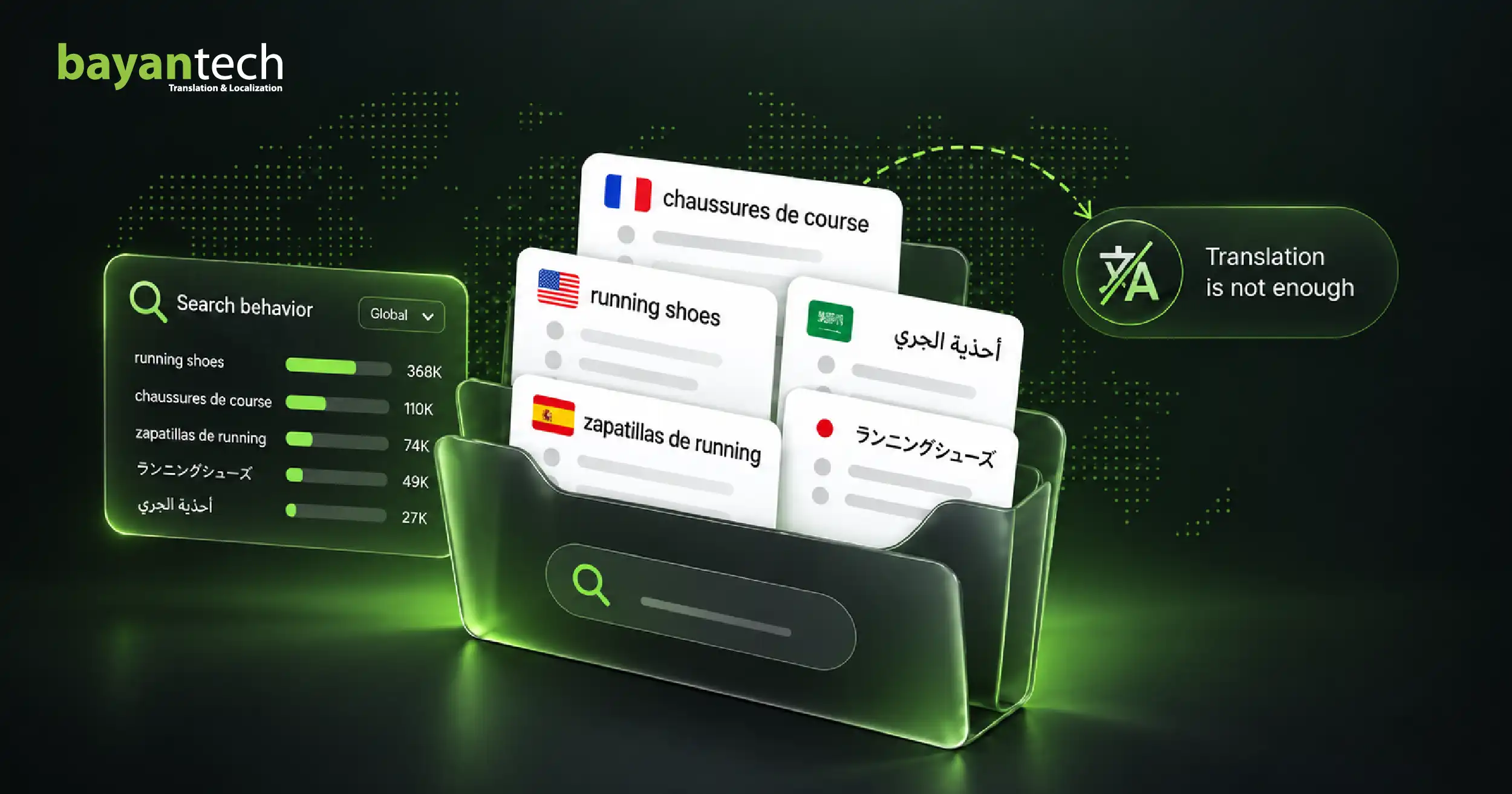
Third, it can hurt search visibility. Terminology management for SEO localization helps teams align translated terms with how people actually search in each market. When different pages use different variations of the same idea, relevance gets split and multilingual content consistency suffers.
So the cost is not only internal inefficiency. It is also lost clarity in the market.
Why It Matters Even More in Regulated Industries
In regulated sectors, terminology mistakes can carry much higher risk.
Regulated industry terminology management matters in fields such as life sciences, medical devices, legal services, and finance. In these environments, terms often appear in safety information, instructions for use, claims, contracts, and compliance content. Here, approximation is risky.
That is why enterprise terminology governance matters. Teams need to know which term was approved, who approved it, and why that choice was made. This creates consistency, but it also creates traceability.
Many organizations also align their terminology practices with ISO terminology management standards to support more structured and reliable terminology work. In practical terms, that means decisions are documented, review paths are clear, and approved language is easier to defend and maintain.
Why Translation Memory Is Not Enough
A common mistake is assuming that Translation Memory solves terminology problems.
It does not.
Translation Memory helps reuse previously translated sentences or segments. It is useful for consistency and efficiency, but it does not decide which term is correct in every context. It only shows what was used before.
A termbase does something different. It stores approved terms, definitions, usage notes, forbidden variants, and context. That is what protects terminology consistency in translation across different teams, content types, and markets.
So Translation Memory supports reuse. Terminology management supports control. Both matter, but they are not the same thing.
What a Practical Terminology Strategy Looks Like
A good localization terminology strategy does not need to be complex. It just needs to be usable.
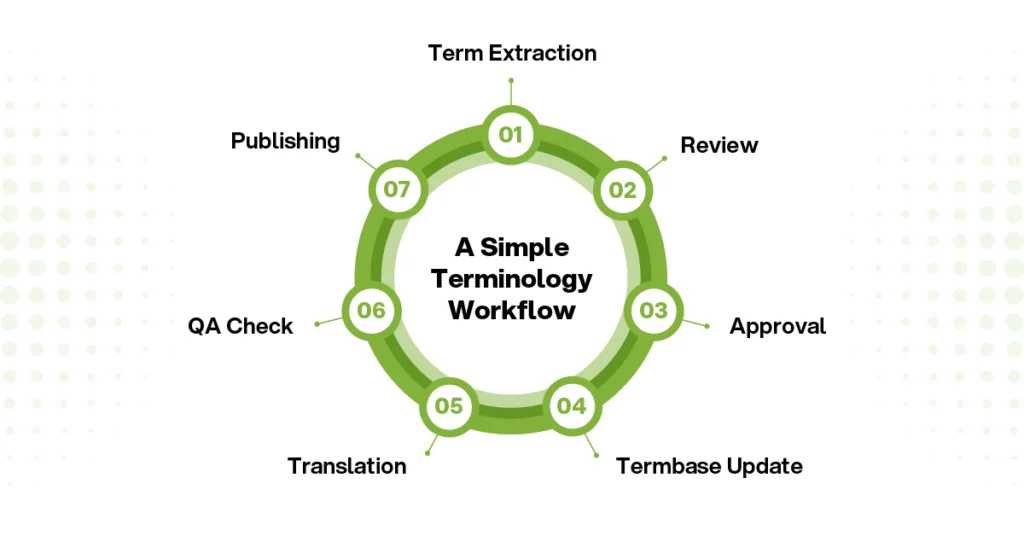
At a basic level, it should include a shared termbase, a clear approval workflow, and a QA step that checks whether approved terms are actually being used.
This is where terminology management best practices make a real difference. Instead of treating terminology as a side task, strong teams build it into their normal workflow.
The result is fewer corrections, faster production, and more predictable quality.
- Start With a Termbase People Will Actually Use
A termbase is a multilingual terminology database that stores approved terms in one searchable place.
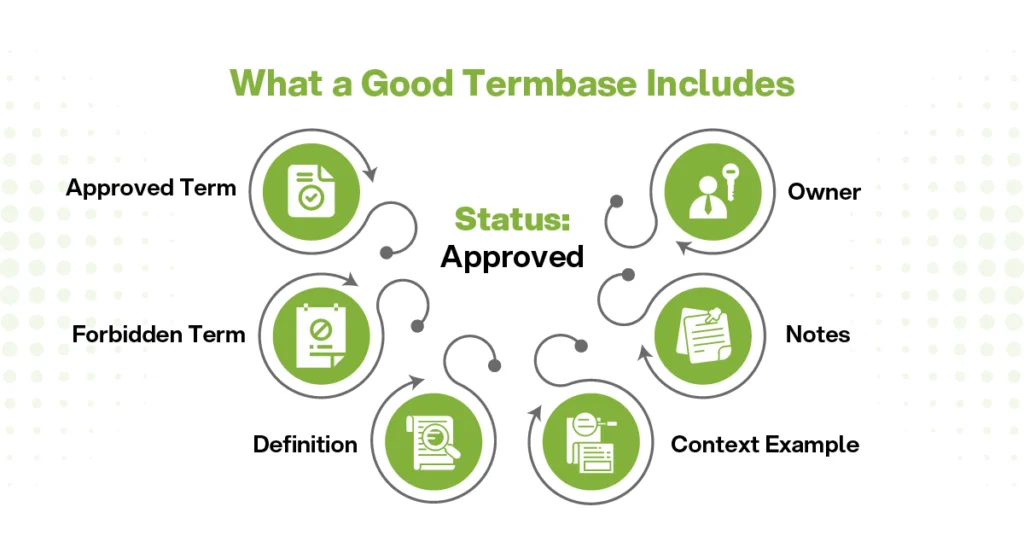
Each entry should include the approved term, any forbidden term, a short definition, a context example, notes, and an owner. That structure makes translation glossary management much more useful because it tells people not only what term to use, but also how and when to use it.
Just as important, the termbase must be easy to access and easy to update. If it is hard to use, people will ignore it. Many teams get better results when the termbase is connected to CAT Tools, so approved terms appear directly inside the translation environment.
A termbase only works when people actually trust it enough to use it.
- Add the Right System and Workflow
As terminology grows, spreadsheets become harder to manage. At that point, a terminology management system becomes useful.
A good system helps teams search terms, manage approvals, track changes, control permissions, and keep history clear. That matters because terminology changes over time, and teams need to know what changed and why.
This is also where people often confuse a terminology system with a Translation Management System. They can connect, and sometimes they overlap, but they serve different purposes. One manages the broader localization process. The other focuses on controlling approved language.
Both can support terminology management services, but terminology still needs its own structure and ownership.
- Extract, Govern, and Check
Strong terminology work usually starts before translation begins.
Teams can use terminology extraction tools, or structured review, to pull candidate terms from product strings, documentation, high-value pages, support content, and other key assets. Then they apply terminology standardization by choosing the approved term, defining it clearly, and documenting where consistency matters most.
From there, governance keeps the process moving. Enterprise terminology governance should answer three simple questions: who can propose a term, who approves it, and how quickly decisions are made. Some teams use terminology workflow automation or AI-powered terminology management to speed up routing and suggestions, but the goal stays the same: move faster without losing control.
Finally, terminology needs a QA gate. A strong terminology QA process checks for forbidden terms, inconsistent variants, wrong-context usage, and simple formatting issues. This is where Localization Quality Assurance becomes much more effective, because it catches problems before they reach the final content.
How It Supports SEO Localization
Terminology management also strengthens SEO localization.
When every page in a locale uses different wording for the same concept, search relevance becomes fragmented. A stronger localization terminology strategy helps teams align approved terms with page titles, headings, metadata, and core on-page content.
That creates clearer search targeting and better multilingual content consistency across markets.
In simple terms, when terminology is aligned, both users and search engines get a clearer signal.
A Smarter Way to Get Started
To begin, focus on one product area, market, or content type. Identify key terms, create a termbase, assign owners, and integrate terminology checks into the Translation Workflow. This approach reduces review comments, improves consistency, and eases future scaling.
For teams working across languages, effective terminology management is essential to avoid rework. bayantech offers expert translation and localization services that ensure clarity and consistency in multilingual content.
From terminology management to ongoing language support, we prioritize accurate messaging across markets. With ISO-certified quality processes, bayantech helps organizations maintain clear terminology and high-quality content at scale.