

You’ve built a strong English keyword list, translated it into French, German, Arabic, and Spanish, and launched your localized pages. Now, you wait for the traffic.
But the results don’t match the success of your English site.
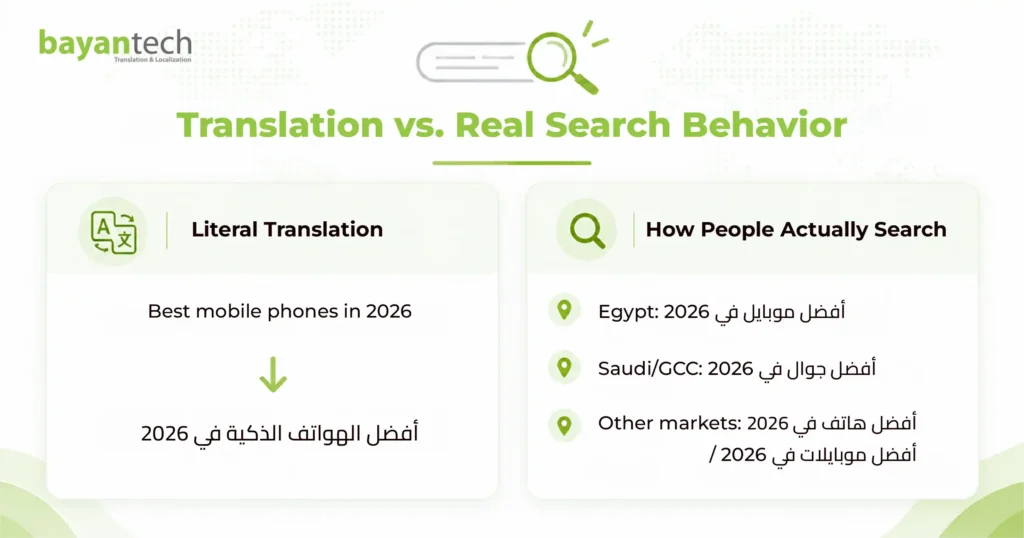
The problem likely isn’t your content. The failure started much earlier, with the keywords themselves. A translated keyword list is not multilingual keyword research. Translation tells you how to say a term in another language; keyword research tells you what people in a specific market actually search for.
Those two answers are often vastly different. This gap affects search volume, user intent, rankings, content planning, and ultimately, the traffic each market generates. Let’s explore why this happens and how to fix it.
Keyword Localization vs. Translation: The Difference Costing You Rankings
Translation starts with an existing word and asks: “How do we say this in another language?”
Keyword localization, however, asks a fundamentally different question: “How would someone in this market search for this product, service, or problem?”
That subtle shift in perspective completely changes your keyword list. A translator might give you a perfectly accurate French version of an English product term. But French users might actually use a shorter phrase, a local product name, an English loanword, or a completely different colloquial expression when searching.
The translated term is linguistically correct, but it isn’t necessarily the best search term. This is why having a translator review your keywords cannot replace cross-language keyword analysis. Linguistic review confirms that a phrase sounds natural, but it cannot tell you how many people search for it, what results Google shows, or whether another phrase has stronger local demand.
Effective multilingual keyword mapping requires both language expertise and search data. This is exactly why keyword research should happen at the beginning of a Multilingual SEO strategy, long before the content is translated.
Why Search Intent Changes by Language (Even for the Same Product)
Matching keywords across markets does not mean matching search intent.
Imagine a software category that has been established in the US for years but is still relatively new in another market.
American users may search for:
- best [software] platforms
- [software] pricing
- [software] provider
Users in the newer market, however, might be searching for:
- what is [software]?
- how does [software] work?
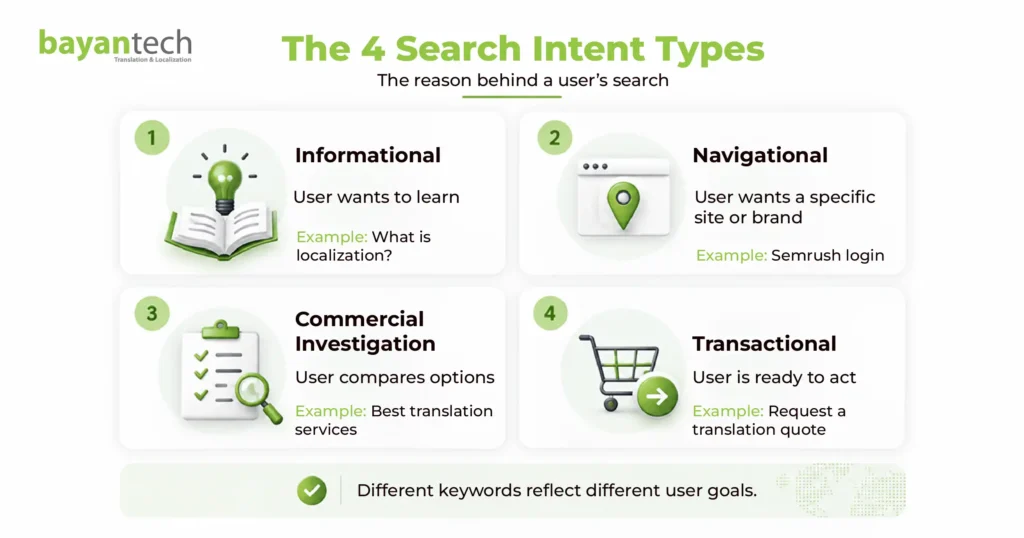
The topic is identical, but the intent is entirely different. This matters because Google interprets queries through four broad intent categories: Informational, Navigational, Commercial Investigation, and Transactional. A page designed to sell a product will fail to satisfy a user who is still trying to understand what the product actually does.
Search volume alone won’t solve this problem. Before assigning a keyword to a page, always check the local SERP. Are the top results guides? Product pages? Comparison articles? Videos? Those results will tell you much more about local search intent by language and market than a translated keyword list ever could.
This is why proper keyword research by market looks at what people mean, not only what they type.
What Arabic and GCC Keyword Research Gets Wrong Most Often
Arabic makes the translation trap even more visible.
A common approach is to research keywords in English, translate them into Modern Standard Arabic (MSA), check the search volume, and apply that single list across Saudi Arabia, the UAE, Qatar, Kuwait, Bahrain, and Oman.
That gives you Arabic keywords. It does not give you a GCC keyword strategy.
While MSA is vital for formal communication and broad readability, real search behavior is far more complex. Users in the Gulf frequently move between MSA, local dialects, English terms, transliterated words, and mixed-language queries depending on the topic.
Consider a technology product. A potential customer could search using:
- The formal Arabic product name
- A familiar local dialect expression
- The English product name
- An English term written in Arabic characters (transliteration)
- A hybrid mix of Arabic and English terms
If your research only checks formal MSA translations, you can miss valuable search opportunities before you even analyze the numbers. Furthermore, a keyword with strong demand in Saudi Arabia doesn’t automatically deserve the same priority in the UAE. Search volume, wording, and commercial intent can vary by country.
This is why GCC keyword research should not rely on one Arabic keyword list. The goal is not to replace MSA with dialect keywords, but to compare MSA, local wording, English alternatives, and mixed-language variations to understand which terms reflect real search behavior in each market.
For brands targeting the region, dialect-aware, market-level research must be a core component of your Arabic SEO Services, especially for transactional searches where everyday language can influence conversions.
Why Multilingual Keyword Research for PPC Isn’t the Same as SEO
Another common shortcut is using the exact same multilingual keyword list for both organic and paid campaigns. While there will be overlap, the decision-making process is entirely different.
For SEO, you prioritize:
- Search volume and keyword difficulty
- Search intent and SERP competition
- Existing rankings and content opportunities
For PPC, you must also factor in:
- Cost per click (CPC) and competitive density
- Commercial value of the query
- Whether the CPC makes sense for the expected conversion rate
These metrics can vary significantly by country. A keyword might be highly attractive for SEO but too expensive for paid acquisition in a specific market.
Good multilingual keyword research uses the same market understanding for both channels but makes distinct, channel-specific decisions.

Where Multilingual Keyword Research Tools Can Mislead You
Tools like Semrush and KWFinder make international research faster, but no tool should make the final decision for you. Watch out for two major pitfalls:
1. The Location Trap
Search volume depends entirely on the database or location you select. A “global” number can make a keyword look attractive even when demand in your priority country is tiny. Always drill down to the national or local level.
2. The “Missing Data” Illusion
“No data” does not automatically mean “nobody searches for this.” Tools often lack enough information to calculate volume for highly specific local phrases. If a locally relevant phrase shows zero data, don’t delete it immediately. Instead, check alternative spellings, singular/plural forms, dialect variants, Google Autocomplete, and the actual SERP.
Multilingual keyword research tools provide evidence. They do not replace market judgment.
Multilingual Keyword Research Roadmap: An 8-Step Process
So what should the process look like when you are targeting several languages and countries?
Here is a practical roadmap.
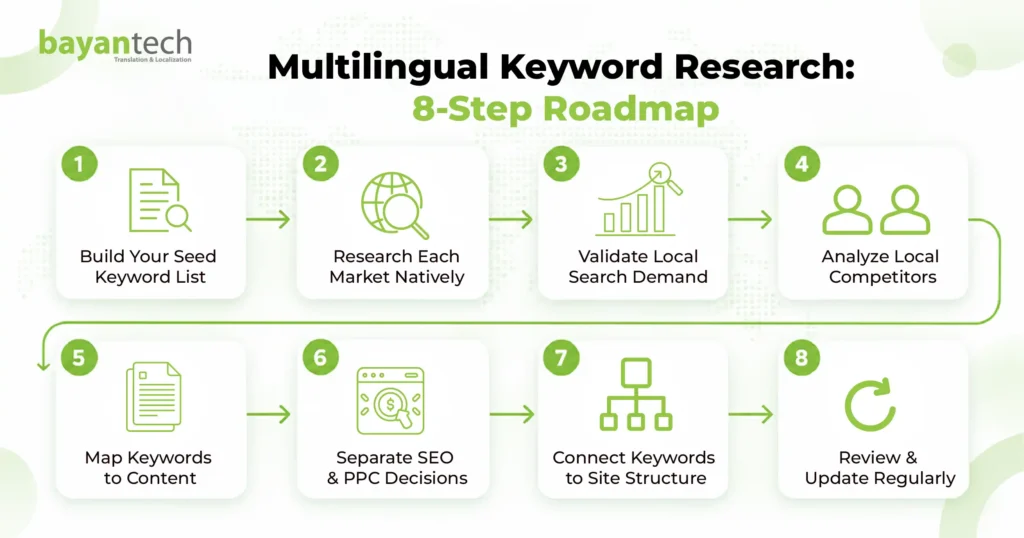
1. Build Your Source-Market Seed List
Start with your core products, services, customer problems, and main topics. You aren’t building the final international list yet; you are building a map of what needs to be researched.
For example, a SaaS company might begin with:
- Product category
- Key features
- Customer problems
- Integrations
- Industry use cases
- Pricing-related terms
- Comparison terms
Keep the list connected to actual business priorities rather than generating hundreds of variations immediately.
2. Research Each Target Market Natively
Use your seed topics to start fresh research in each target language. Do not just translate and validate. Work with native-language autocomplete, local forums, customer language, and native SEO specialists.
For Arabic markets, explicitly include MSA, dialect variations, and mixed-language searches. The source keyword tells you what topic to investigate; it does not dictate the final keyword.
3. Validate Search Demand in the Correct Country
A French keyword in France and the same keyword in Canada represent different opportunities. Set the correct country in your tool and compare volume, trends, intent, and difficulty.
Lower volume than your English source market isn’t necessarily a problem. Markets differ in population, category maturity, language preference, competition, and search behavior.
Your goal is not to replicate the source market’s numbers. It is to identify the strongest realistic opportunities within each target market.
4. Analyze Local Competitors, Not Just Global Competitors
Your biggest English competitor might be invisible in another country. Identify the websites actually ranking for your topics in each target market and run a keyword gap analysis.
Look for patterns: Are they winning informational searches you ignored? Do they have local landing pages you missed? Are they using terminology or topic clusters that do not appear in your translated keyword list? These differences can reveal opportunities that keyword translation alone would never uncover.
5. Map Keywords to Search Intent and Content
Don’t just hand a spreadsheet to a writer. Build a multilingual keyword mapping document. For every cluster, define the target market, language, primary/secondary keywords, search intent, and recommended content type (e.g., service page vs. blog post). This prevents multiple pages from cannibalizing each other.
6. Separate SEO and PPC Decisions
Once your core set is ready, route opportunities to organic, paid, or both. Evaluate SEO terms based on ranking opportunity and content fit. Evaluate PPC terms based on CPC and conversion potential. Do this separately for every major market.
7. Connect Keywords to International Site Structure
Keyword research should influence your site architecture. It will reveal if you need separate landing pages, different navigation priorities, or localized URL structures. Once those pages exist, ensure proper Hreflang Implementation so search engines know exactly which regional version to show to which user.
8. Review the Keyword Set Regularly
Keyword research is never truly finished. Markets evolve, terminology changes, and new competitors emerge. Regularly review your priority keyword sets using:
- Search Console
- Analytics
- Ranking data
- PPC data
- Local SERPs
- Keyword research tools
Look for:
- New queries generating impressions
- Keywords losing demand
- Changing search intent
- New competitor rankings
- Content gaps
- New dialect or product terminology
- Pages ranking for unexpected keywords
This turns your initial research into a living multilingual search strategy.
Quick Recap: Before You Trust Your Multilingual Keyword List
Before building content around your new list, ask yourself:
- Was it researched separately for each market, or just translated from English?
- Was search volume checked in the correct, specific country?
- Was local search intent verified via the SERP?
- Were local competitors included in the gap analysis?
- (For Arabic) Did the research include MSA, local dialects, and relevant English terms?
- Were SEO and PPC evaluated as separate channels?
- Has every keyword been mapped to a specific page and user intent?
If the answer to several of these is “no,” your problem isn’t your rankings yet. It’s your research.
Get Multilingual Keyword Research Built Around Your Markets
Expanding into another language should not mean copying your English keyword strategy into another spreadsheet.
At bayantech, we combine market-specific search research with linguistic and localization expertise to build multilingual keyword research around how audiences actually search in each target market.
Tell us which languages and markets you are targeting and how you currently handle keyword research. We can scope the research needed for your international SEO strategy and provide a tailored quote.
Already have multilingual keyword lists? Let our team review how they were generated, whether search intent matches each market, and where translation-based or market-specific gaps may be limiting performance.
Need to handle the work internally? Use this 8-step multilingual keyword research roadmap to brief your SEO, content, localization, and PPC teams around one market-by-market process.