

Your business expanding into a new target market usually sounds simple until language delivery becomes a reality.
Suddenly, product content, marketing, legal docs, and customer support all need to stay accurate and consistent across a wide range of languages.
Internal teams often can’t absorb the volume, review cycles, and ongoing changes, so work gets split across vendors and freelancers.
That’s when a language service provider (LSP) steps in to save the day.
A good LSP translates your content and helps you manage multilingual delivery so launches stay on schedule and language support is provided for every market.
In this guide, learn about what a language service provider does and how you can choose the right LSP for your business.
What Is a Language Service Provider (LSP)?
A language service provider (LSP) is a partner that helps businesses communicate across languages by delivering multilingual work end-to-end.
Instead of relying on one person, an LSP typically runs organized teams, defined workflows, and quality checks to deliver high-quality results consistently, even when volume and deadlines increase.
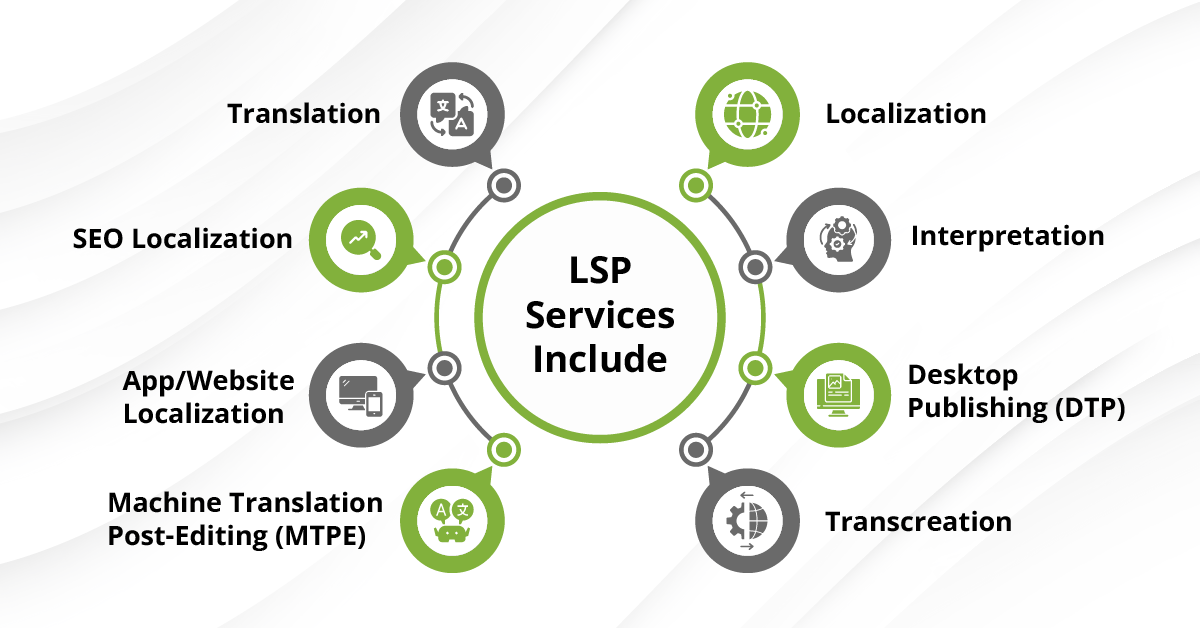
What makes an LSP valuable is the range of services they can deliver and manage under one process. Depending on what they offer, that can include translation and localization, interpreting, multilingual desktop publishing, QA, and ongoing content updates.
One important point: not all LSPs provide the same range, and not all operate with the same standards. The right fit depends on your content types, risk level, and how fast you need to scale.
Why In-House Translation Is Not for Every Project
In-house translation can work when volumes are low and updates are rare. But at scale, the lack of project management would be the real issue.
Without a translation management system to centralize requests, track versions, and control review, teams lose predictability fast.
That’s when quality starts to drift. Different internal reviewers apply different tone and terminology, so content stops feeling linguistically and culturally consistent across markets.
Conversion drops because messaging reads “off,” launches slow down because rework increases, and risk rises because safety-critical content isn’t managed through a controlled process.
A true partner typically offers a range of services—from translation and localization to interpreting—so language delivery doesn’t break the moment a customer needs real-time help.
LSPs Enable Language Access in All Forms
If customers need help in real time, translation alone won’t carry the experience.
Onboarding, troubleshooting, and sensitive conversations often require immediate two-way communication.
That’s where interpretation services—especially phone interpretation—become the minimum viable layer of language access when you can’t staff every language internally.
In many service-heavy businesses, interpretation is what keeps multilingual support usable while written content catches up.
The Core Services an LSP Can Deliver
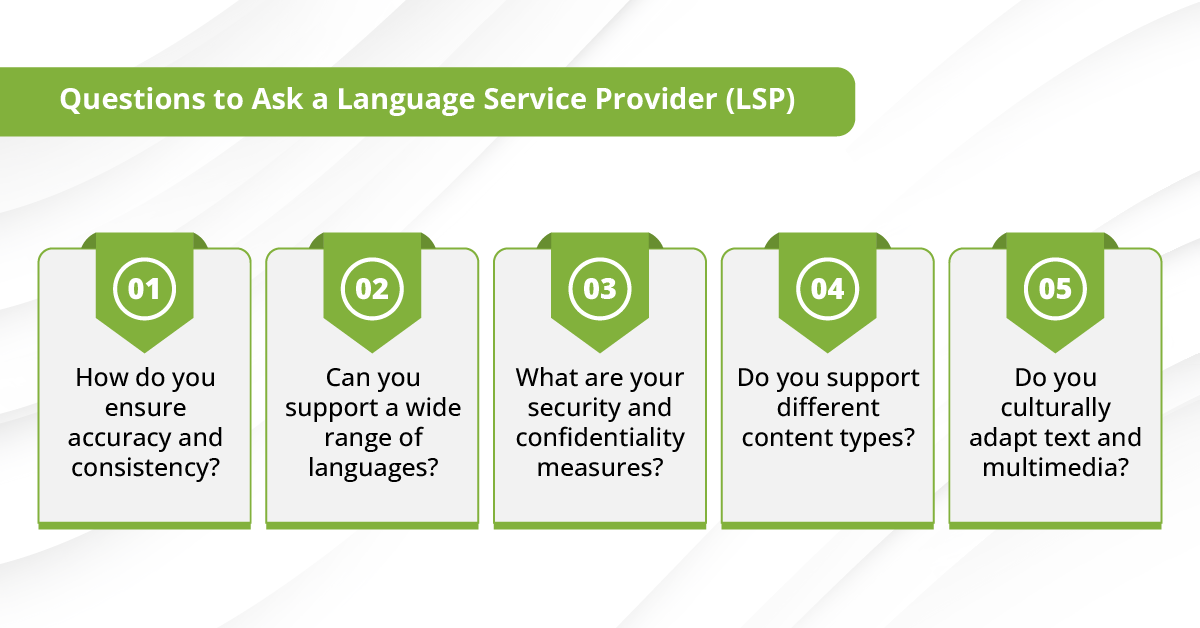
An LSP is good when its high-quality output is repeatable across multiple languages, across updates, and across teams operating in international markets.
Use this short checklist to evaluate them:
- Quality approach: Can they explain, step by step, how they ensure accuracy and consistency (translator + independent review + QA)?
- Cultural fit: Can they adapt content linguistically and culturally for local audiences (tone, terminology, conventions), not just translate it correctly?
- Coverage at scale: Can they support a wide range of languages and scale when you add new markets, products, or content types?
- Domain fit: Do they match your needs by content type (marketing vs technical vs support)?
- Responsiveness: Who owns issues when something is wrong—named PM/account lead or a shared inbox? What’s the escalation path?
- Delivery consistency: Do they handle timelines, version control, and updates without “starting over” each time?
- Security/process maturity: Do they offer basic governance for sensitive files (NDAs, controlled access, secure transfer)?
If a provider can’t show you how quality is produced and protected, you’re buying hope not a process.
Technology in Plain Language: TMS, Machine Translation, and When They Help
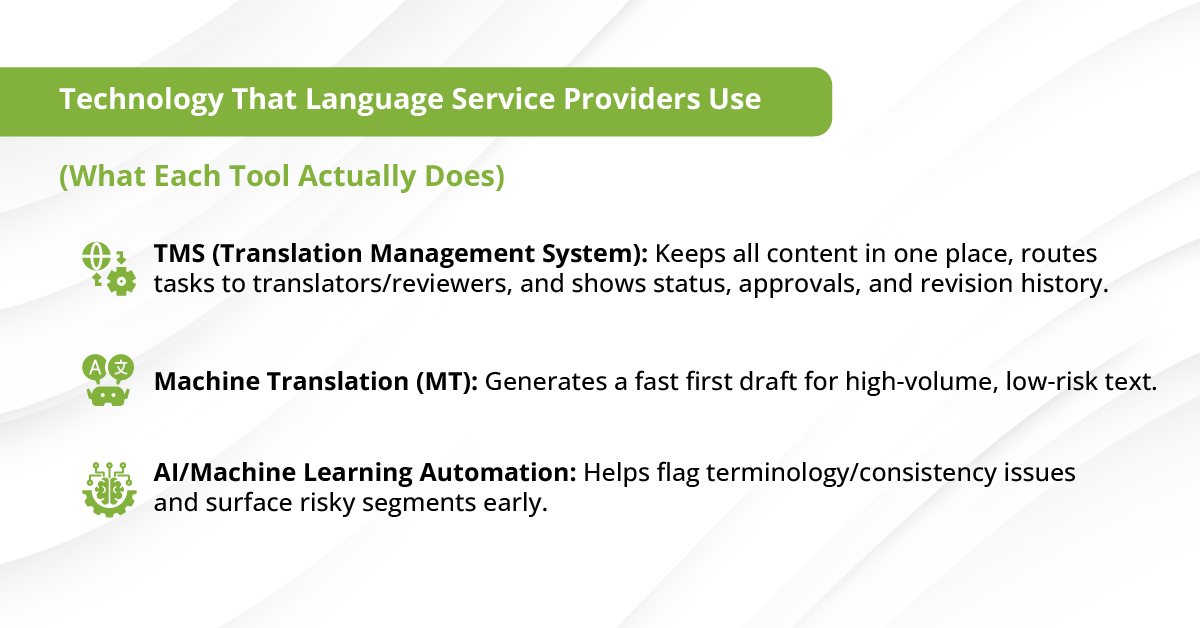
Technology should remove friction, not add complexity. Translation management systems centralize your content, route work to translators and reviewers, and keep status, approvals, and revision history visible, so nothing gets lost in email threads.
Machine translation can speed up first drafts for low-risk, high-volume text, but it only works when human review is built in. The workflow matters more than the engine: drafts still need terminology control, QA checks, and a reviewer who can approve what’s ready to publish.
Behind the scenes, machine learning powers a lot of automation (like suggestions and quality checks), but the goal isn’t “more tech.” The goal is fewer delays and less rework—so teams update what changed instead of redoing everything. For brand, legal, or safety content, machine translation can still help as a starting point, but only with strict review and sign-off.
Real-Life Application of Translation Services by an LSP
A recent B2B SaaS client expanded in several new countries and saw early signals that keeping key touchpoints in English was slowing adoption.
So the first wave of translation and localization focused on what actually moves revenue: high-traffic landing pages, the onboarding sequence, and the support macros customers hit most.
Outcome: quicker launches, fewer late-stage fixes, and a consistent experience across markets.
Partner with bayantech: A Leading LSP in the MENA Region and the US
Ready to expand with the right language service provider?
Request a Language Operations Assessment to get bayantech’s market-by-market plan for what to translate first, how to manage updates, and where quality controls matter most.
Or talk to a Localization Specialist to align scope, timelines, and ownership. Our Professional Translation Services and Localization Services help you communicate easily and confidently with your audience.
Explore Industries We Serve to see how we support multilingual operations.
FAQs about Language Service Providers
- What’s the difference between a freelancer and a language service provider?
A freelancer is one linguist handling specific tasks. An LSP manages teams, workflows, QA, and scaling across multiple languages for ongoing, high-volume work.
- When do you need localization services instead of translation?
When content is customer-facing or UX-driven (websites, apps, onboarding, marketing).
- Can an LSP handle phone interpretation and customer support needs?
Yes. Ask if they offer interpretation services, including phone interpretation, plus availability, escalation handling, and terminology prep.
- What’s the safest way to use machine translation in business workflows?
Use it only for low-risk content as a draft, then require human review and QA before publishing. Avoid MT-only for legal, safety, or brand-critical content.
Want to know how we work and who’s behind the process? Learn more About Us!