
“How much will it cost?” is often the very first question that a company asks when seeking professional translation services for the first time. However, it should be acknowledged that translation rates cannot be easily compared across vendors.
While one vendor might give you a better price per word, another might require a higher rate for the same file. This could be perfectly valid based on the language combination, industry expertise, deadlines, and proofreading requirements.
This guide reveals the principles behind professional translation pricing and offers tips on project planning. So, let’s see!
Translation Pricing Has No Universal Standard
A non-negotiable fact: there is no regulated standard for translating costs. This is why two translation companies can offer widely differing rates for the same job, and yet both rates can be perfectly reasonable.
The main reasons behind this confusion include two key points.
Firstly, there are several translation pricing methods – per word, per page, hourly rate, and translation of whole projects.
Secondly, even the same pricing model will generate completely different rates of translation, depending on a number of factors, such as language, topic, speed, and the type of translation.
However, cost per word is still the popular method that professional translators use. But, this rate alone cannot provide you with a complete picture. Translating a contract, technical guide, and marketing content will require different efforts. So, what are other translation rate models?
The Four Pricing Structures For Translation
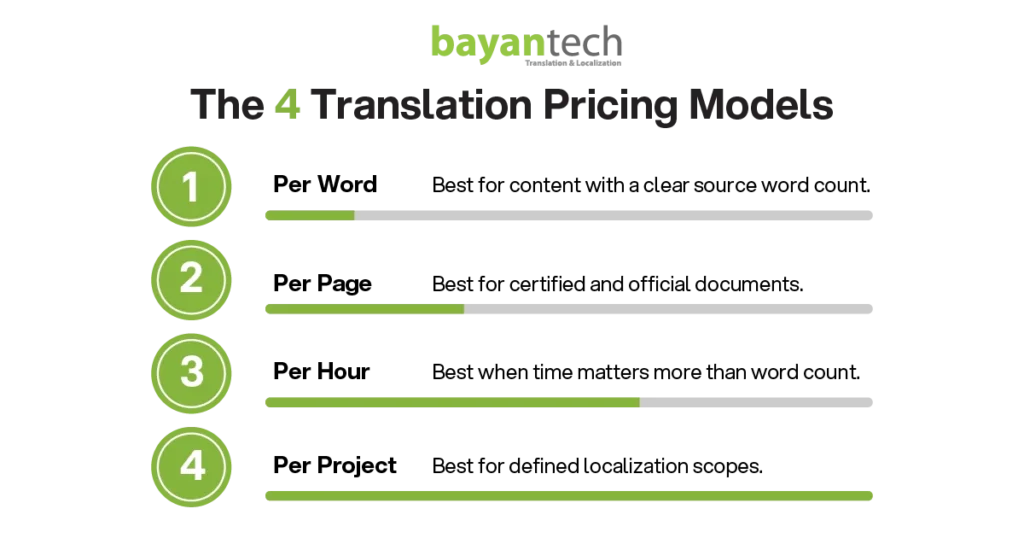
There are four main translation pricing models for most translation services.
- Per-word pricing applies a fixed rate to the source word count. This is typical of business writing, website, software strings, and advertising copy. Document Translation Services are usually priced per word when the source word count is clear and the file does not require certification.
- Per-page pricing can be useful for any document that must have an official certification. The page is usually considered to be 250 words, but each company defines what counts as a page.
- Per-hour pricing comes into effect when the word count doesn’t accurately show how much time was required for a job. These include proofreading, editing, formatting, consultation, or any specialized work. Hourly pricing is suggested by the ATA if research or complicated review is required.
- Per-project pricing is set based on the whole scope of a defined translation project. It is typically used in localization pricing.
What Actually Drives Translation Rates Up?
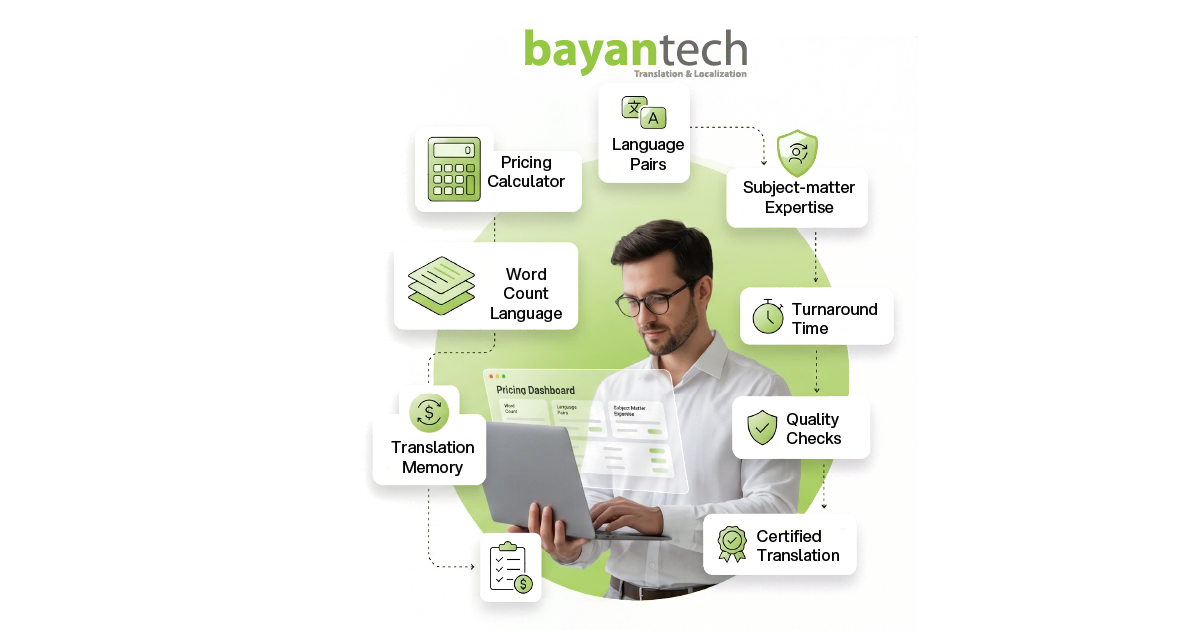
Translation rates increase when a project needs more than language fluency.
The first factor is the language pair. Spanish to English is the second most requested pair, with 18% of projects. Common pairs, such as English to Spanish or English to French, usually cost less because more qualified translators are available. On the other hand, less common pairs, such as English to Finnish, Norwegian, or Swahili, often cost more because the talent pool is smaller.
Target language complexity also affects the final price. Some languages expand after translation, which can add review time and increase formatting or desktop publishing work.
Subject matter expertise is another major cost driver. Patent filings, clinical trial protocols, KYC screens, and engineering specifications need professional translators with field knowledge, not only language skills.
Turnaround Time Pricing: What Urgency Really Adds to Your Invoice
Timeline is another factor that changes translation rates. Even when the language pair and content type stay the same, a shorter deadline can raise the final cost.
The cost of an urgent project with a deadline of two days would be higher than the cost of the exact translation project completed in five days.
One translator normally schedules between 2,000 and 2,500 source words per day for most projects. When the deadline is too short, the service provider will have to work extra hours, on weekends, or involve other translators to complete the project in time.
For this reason, some services offer rush fees from 25% to 50% higher than their regular rates.
In 2026, professional translation rates commonly range from $0.09 to $0.35 per source word, depending on the language pair, subject matter, deadline, and review workflow.
AI-Powered Translation and MTPE: When It Saves Money and When It Does Not
After deadline, technology is another area where buyers often expect lower costs. MTPE can reduce translation pricing, but only when the content is suitable for machine translation and human review.
In machine translation post-editing (MTPE), machine translation creates a draft, then a human linguist edits it for accuracy, fluency, and terminology.
ISO 18587 defines requirements for full human post-editing of machine translation output, which reinforces that MTPE still needs qualified human review.
If the machine output is weak, the post-editor may spend almost the same effort as translating from scratch. That is why MTPE works best for high-volume, lower-risk content, not certified, legal, or regulated medical documents.
Translation memory (TM) savings work differently. TM reuses previously approved human translations through exact matches and fuzzy matches. This makes it a safer cost-saving method for repeated product copy, manuals, website updates, and content where consistency matters.
Certified Translation Rates: Why Regulated Content Is Priced Differently
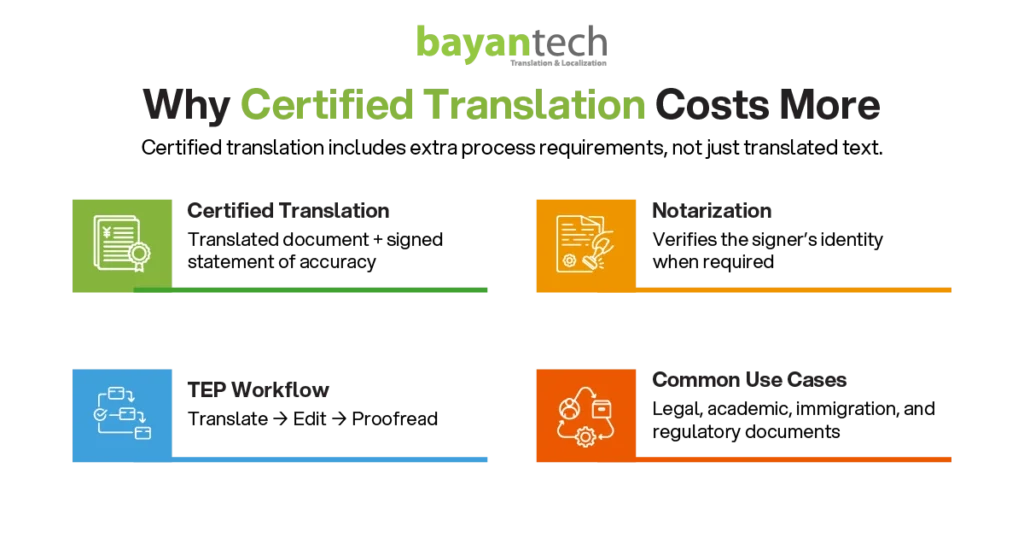
Some projects cost more because the risk is higher. Certified translation is one example, because the client needs proof of accuracy, not only translated text.
ATA explains that a certification statement should confirm the translator’s qualifications, document identity, language pair, completeness, accuracy, signature, and date.
Some clients also ask for notarization. Notarization verifies the identity of the person signing the statement, not the translation itself.
Certified projects also use stricter quality assurance workflows. For legal filings, academic transcripts, immigration documents, and regulatory submissions, the work usually follows Translate-Edit-Proofread (TEP).
The best 2 ISO standards that you need to ask for:
ISO 17100 — Translation service requirements
ISO 9001 — Quality management systems
A Step-by-Step Approach to Accurate Translation Budgeting
To properly decide which translation rate and model to choose, these steps should be recognized earlier for an informed decision.
Step 1 — Define Your Translation Project Scope Before Requesting a Quote
A clear understanding of the translation project, from what needs to be translated, how it should be delivered, and what quality level the content requires, is what makes the translation rate logical.
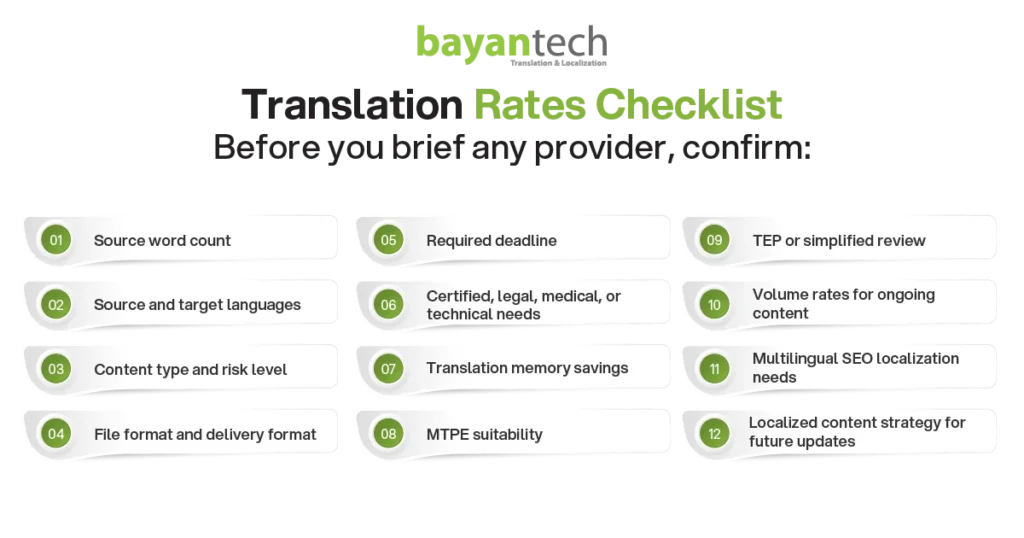
So, be clear with:
- Source word count
- Source language
- Target language
- Content type
- File format
- Deadline
- Delivery format
For multilingual projects, list all target languages initially, as adding them later may alter the quote, timeline, and localization costs.
Step 2 — Match the Pricing Model to Your Content Type
The ideal pricing model varies with content type.
- Cost per word is suitable for documents, websites, app strings, and marketing copy.
- Per-page pricing is typical for certified translations like birth certificates and legal documents.
- Per-hour pricing works for proofreading, editing, desktop publishing, and consulting.
For large multilingual projects, bundled localization solutions simplify budgeting by organizing costs by language, market, or content package.
Step 3 — Use Translation Memory and Automation to Reduce Repeat Costs
Ask whether translation memory (TM) will be created and updated for your projects.
Also, ask which content is suitable for MTPE and which content needs full human translation. Certified, legal, and regulated medical content should follow stricter human-led review.
Step 4 — Confirm Specialist Review
Specialist content costs more because it needs specialist translators. For contracts, filings, and compliance documents, Legal Translation Services require translators who understand legal terminology in both markets.
Inquire whether your project will require a specialist translator or an additional review.
That is why technical translation rates are higher than general business content. The added cost covers expert handling, terminology accuracy, and stronger quality assurance workflows such as Translate-Edit-Proofread (TEP).
Step 5 — Plan for Ongoing Content
Inquire if the provider offers Enterprise localization services for managing content in multiple languages and markets. Larger projects often require more than translation, including localization project management, translation memory updates, quality control, and clear timelines.
Website Localization Services assist with ongoing updates, ensuring translation aligns with keyword adaptation, UX review, and market-specific content. This simplifies multilingual content management, especially for teams needing regular updates across various languages.
Get an Accurate Translation Quote in 2 Business Hours
Share your language pair, word count, content type, and deadline, and our team at bayantech will provide you with a detailed translation price quote in 2 business hours. Your project will be reviewed by professional translators, not estimated through a generic rate table.
In case you have a complex project or require enterprise localization services, you may schedule a brief consultation to define the right workflow before work begins.