

Some teams request translation projects frequently, yet the costs still feel too high.
They wonder, “Is the language service provider pricing fairly?”
Other teams need to set accurate budgets for translation and localization ahead of the year, but feel lost when trying to get a reliable estimate.
When teams budget for localization, they often start with a per-word rate and stop there.
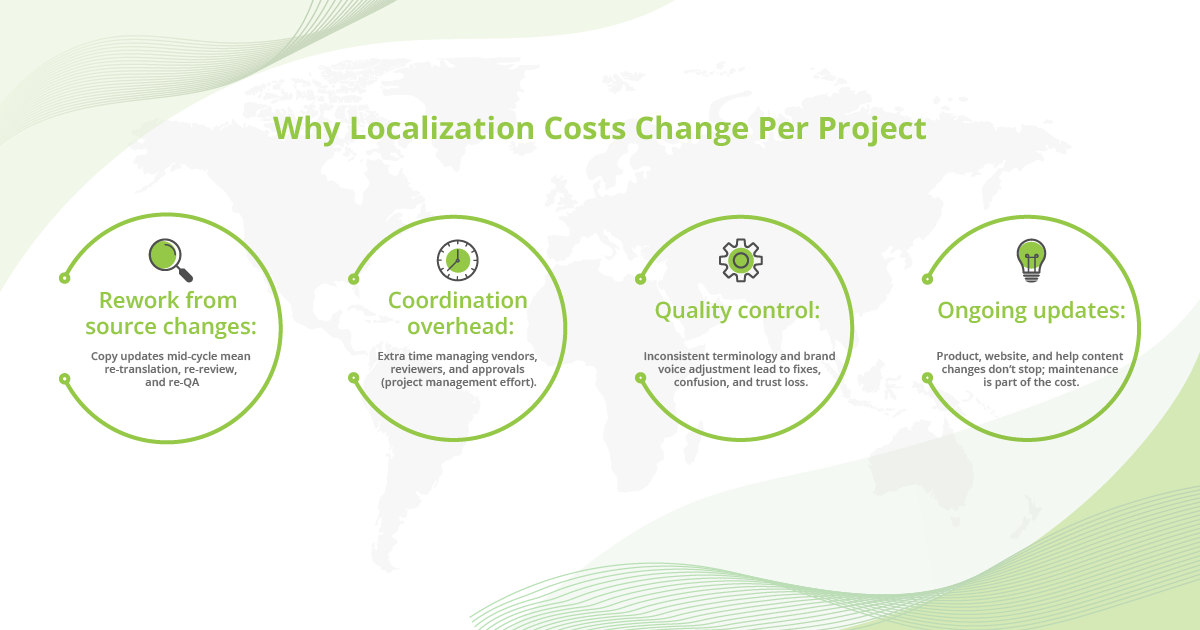
But real localization costs also include project management, quality assurance, and the work needed to launch consistent content across markets.
This guide breaks down localization costs—so you know what you’re paying for and how to control your localization budget without sacrificing quality.
The Budget Blind Spots That Most Teams Don’t Plan For
You’re not only paying for “translation.” So, what else belongs in a localization project budget?
How to Understand and Control Localization Costs
Let’s take a deep dive to understand localization projects from start to finish and how they are priced.
What You’re Paying For in a Localization Process
- Translation, editing, and proofreading: Text is translated into one or multiple target languages by native, experienced linguists, then reviewed for accuracy and readability.
- Formatting, design, and layout: Web pages, PDFs, product pages, and other designed content are adjusted so the localized version works visually and functionally—not just linguistically.
- Quality assurance (QA): Linguistic review plus terminology, consistency, and style checks to reduce errors and avoid “mixed voice” across content.
- Technical production work: File preparation, exports, imports, and workflows for CMS/platform delivery (so content ships in the right format).
- Project management: Coordination across linguists, reviewers, and stakeholders, answering queries, managing approvals, and scheduling delivery to hit deadlines.
Translation technology: Tools that reduce rework and improve consistency—like translation memory, machine translation (when appropriate), and translation management systems.
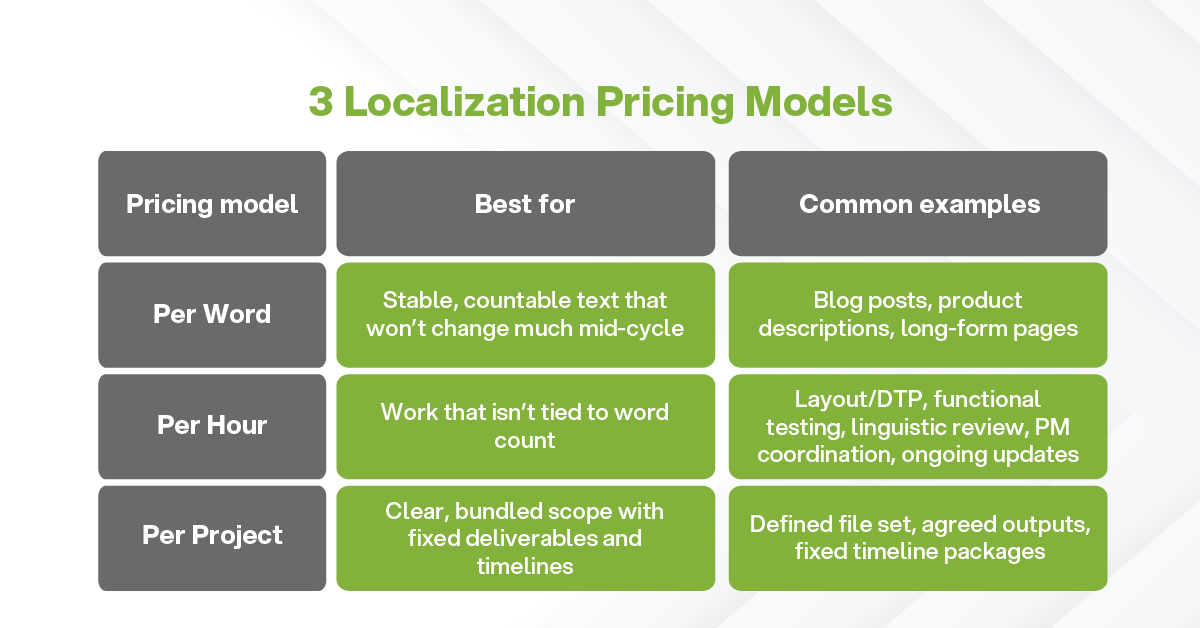
Factors You Must Estimate before Requesting Quotes
Before you request quotes, define the inputs below:
- Target languages and language-pair complexity: Some language pairs take more time to translate and review accurately.
- Volume and repetition: Total word count matters, but so does how much repeats. High repetition can be reused through translation memory, reducing rework.
- Content type: Marketing content needs tone and persuasion. Regulated content needs stricter terminology control. Support docs need clarity and consistency at scale.
- Quality level: Decide if you need publish-ready, high-quality output (multi-step review and QA) or a basic internal-use level.
- Domain expertise and SME needs: Technical or regulated topics may require subject matter expertise, which increases effort.
- Turnaround urgency: Tight deadlines often trigger rush effort and compressed review cycles.
- Stakeholders and review loops: More reviewers and approval rounds increase project management time and extend timelines.
- Updates and long-term maintenance: If content changes regularly, budget for ongoing cycles—not a one-time project.
How to Reduce Localization Costs Without Compromising Quality
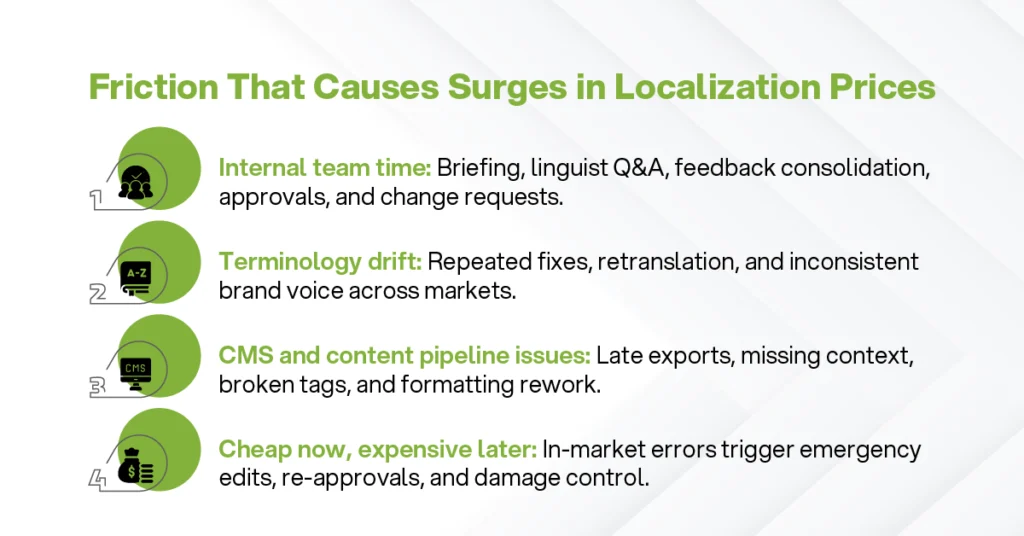
The fastest way to cut localization costs is to reduce rework. Start by building translation memory early, so repeated phrases and approved wording can be reused across pages, campaigns, and future updates.
Use machine translation selectively—paired with Machine Translation Post-Editing for high-volume, lower-risk content where speed matters but review control stays in place.
Tighten the source content too. Short sentences, fewer rewrites, and consistent terminology make translation faster, QA easier, and approvals smoother across all target languages.
Instead of localizing everything at once, phase the rollout. Start with the pages that influence revenue—pricing, onboarding, and core product flows—then expand. This reduces waste and improves return on investment.
Centralize delivery in translation management systems to cut manual steps and keep versions, reviewers, and updates organized. And define quality up front: clear acceptance criteria for QA and sign-off prevents endless review loops.
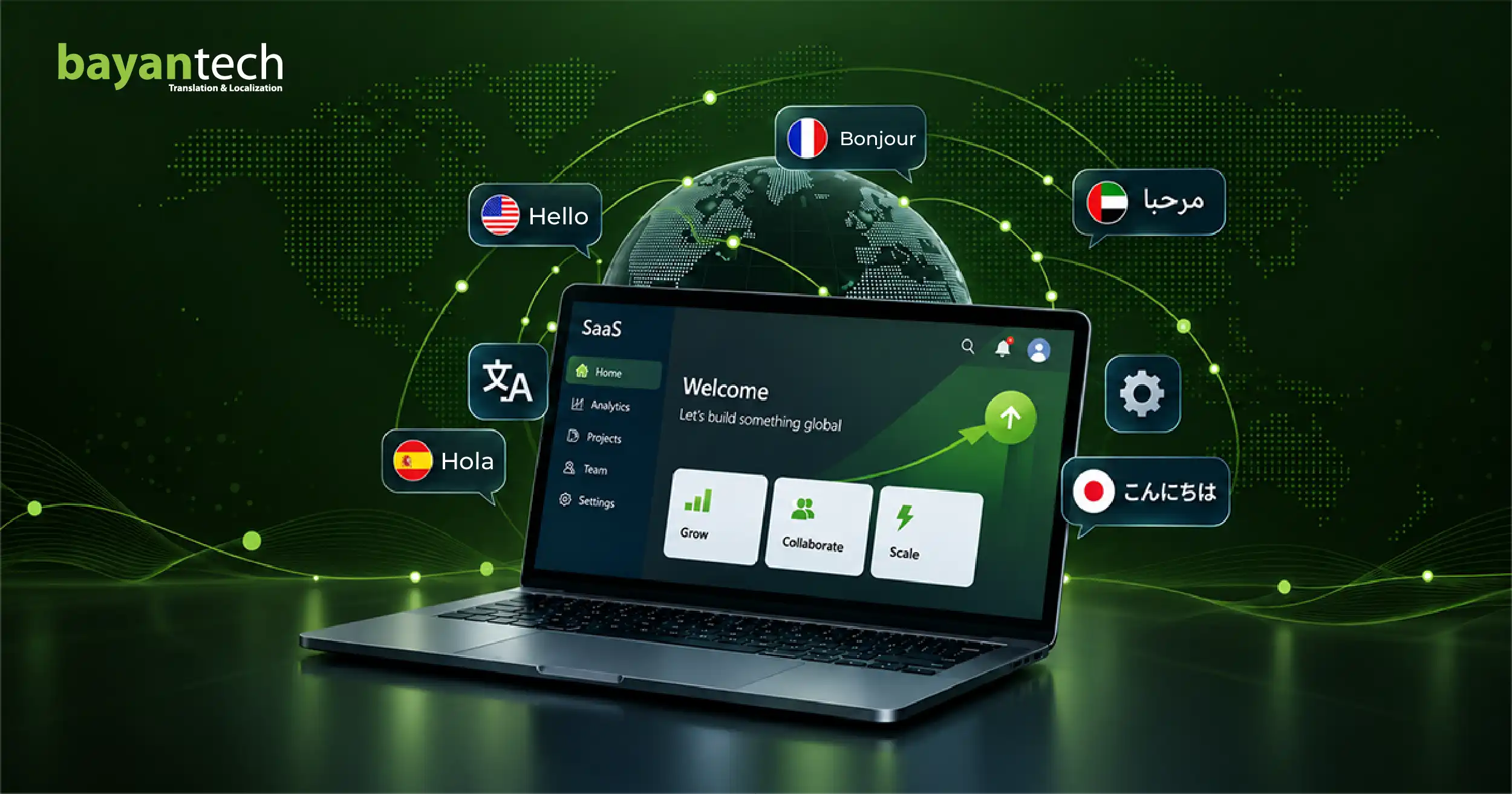
Example: A SaaS team launches into four markets and doesn’t translate the full site immediately. They localize the highest-impact pages first, reuse translation memory across product and support content, and use Machine Translation Post-Editing for lower-risk volume.
The result is fewer revisions, faster releases, and easier long-term updates—without sacrificing quality.
A Simple Localization Budget Framework
Step 1: Inventory what you’re localizing
List content types by market: marketing pages, support content, UI strings, PDFs/designed files.
Step 2: Estimate effort by content type
Break costs into the real work: translation, formatting/DTP, quality assurance, and project management.
Step 3: Add a buffer for change and review
Plan for copy updates, stakeholder feedback loops, and extra QA—this is where budgets usually break.
Step 4: Track outcomes to prove ROI
Measure what localization improves: conversions, fewer support tickets, and market growth.
Key takeaway: A good budget doesn’t aim for perfect prediction—it aims for fewer surprises. When you measure outcomes (leads, sign-ups, reduced churn), localization becomes an investment with a clear return on investment.
Get a Clear Localization Cost Estimate for Your Market Plan
If you’re planning a global rollout, bayantech helps turn “rough guesses” into a clear, market-ready estimate—based on scope, timelines, and real production steps.
Start with our Localization Services team to map what’s needed, what can be reused, and what will impact budget before it becomes a surprise.
For high-volume content, Machine Translation Post-Editing can cut turnaround while keeping review control in place.
And when content updates are frequent, a Translation Management System keeps versions, approvals, and terminology consistent across markets.
If you’re comparing vendors, check what to ask a provider of Professional Translation Services before signing—then request a quote with confidence.
FAQ
How does translation memory reduce cost?
Translation memory reuses previously approved translations for repeated sentences. This cuts rework, speeds up delivery, and improves consistency across updates.
Is machine translation suitable for customer-facing pages?
Sometimes, but only with post-editing and strict QA. For high-impact pages (home, pricing, legal, brand campaigns), human review is usually required to avoid tone and accuracy issues.
How do I estimate costs for multiple target languages?
Start with per-language word count, then add costs for QA, formatting, and review time per language.
What should be included in translation quality assurance?
Linguistic review for accuracy and readability, terminology and style checks, and final checks for numbers, links, layout, and locale formats (dates, currencies, units).