

If your company translates product content, legal documents, medical materials, or marketing pages across multiple languages, you already know how quickly things can go wrong without a shared reference point.
Translation glossaries solve that problem. The translation glossary starts off as a simple list of terms and their approved translations; however, it becomes a very important tool once the glossary expands itself and turns into a multilingual or localization glossary.
In this guide, we talk about what translation glossaries are, why you need them, and how to create an effective one.
Quick Self-Check: Do You Actually Need a Translation Glossary?
Here’s a fast way to find out.
- Do multiple translators or vendors work on your content?
- Do the same terms appear across your website, app, documents, and support pages?
- Have reviewers flagged the same terminology issue more than once?
- Do you translate product names, legal clauses, medical terms, or technical instructions?
If you answered yes to any two of those questions, then you absolutely require controlled terminology. Glossaries help ensure translation consistency by guaranteeing that the correct terms are consistently used in all translations.
The Real Problem: Inconsistent Terms Cost More Than You Think
Inconsistent terminology isn’t just a minor problem. It’s a process failure that grows over time.
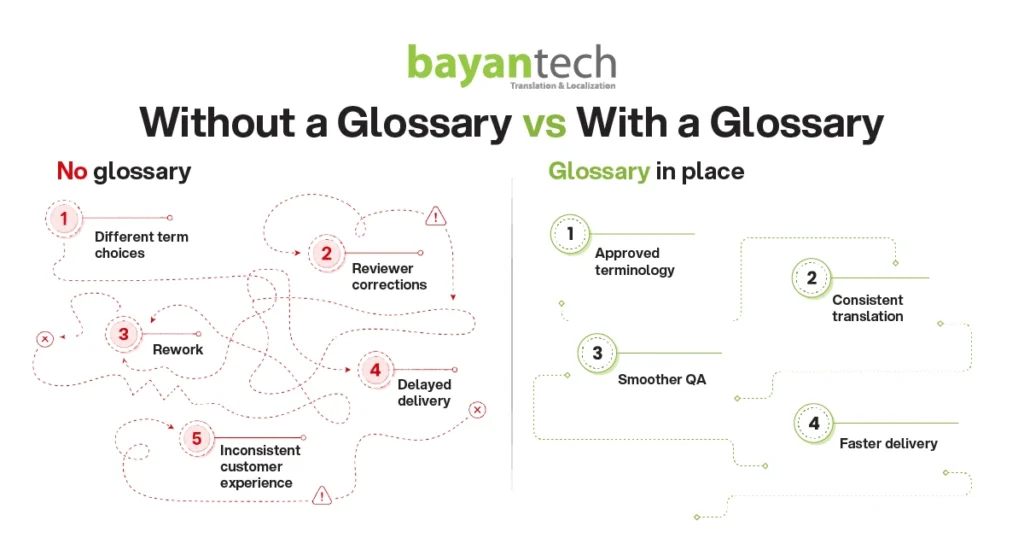
Without solid terminology management, the same issues keep showing up: a product name translated differently on the website and in the app, a legal clause phrased differently across contracts, a medical device term that varies between the instructions and the package insert. Reviewers catch it, flag it, and fix it, then the same thing happens on the next project.
That is why localization quality assurance is so challenging without a glossary. There is no definitive source of information; thus, linguistic quality assurance becomes a reactionary activity instead of a preventative one. Translators do their best, but they do not coincide in their choices, and when this is realized, it is too late, the deadline is missed.
Translation glossaries change all of this, giving translators, reviewers, and other parties involved a common point of reference beforehand.
Why Glossaries Matter More as Localization Scales
The more content you produce and the more languages you translate into, the more critical a shared glossary becomes.
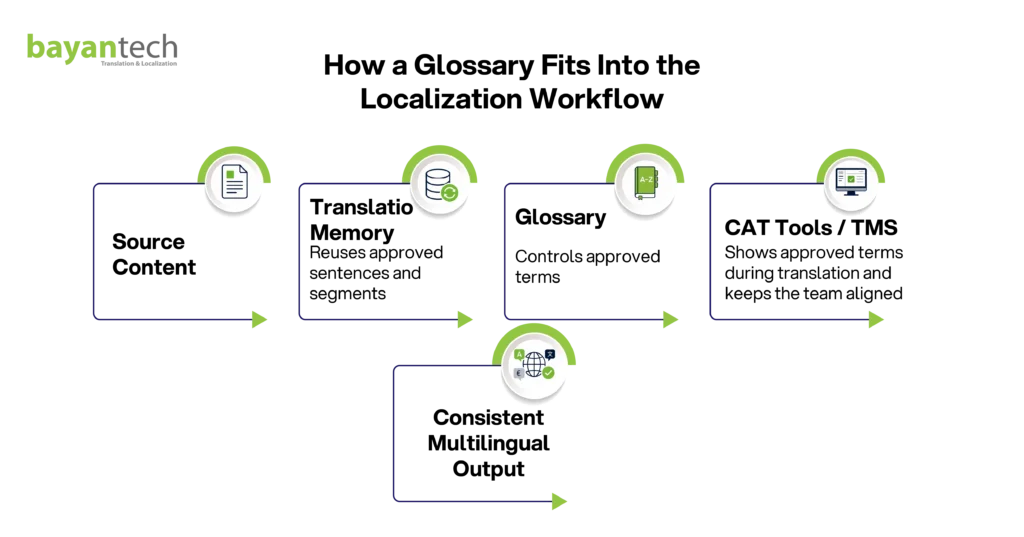
Here’s how it connects to your broader translation technology stack:
Translation memory stores previously approved translations at the sentence or segment level. It helps translators reuse approved content faster. But it doesn’t control individual terms; that’s the glossary’s job.
CAT tools help translators work more efficiently. When a glossary is connected to a CAT tool, approved terms surface automatically during translation, so linguists don’t have to guess or ask.
A translation management system can centralize your workflows, assets, and terminology in one place. When translation memories and glossaries are both connected, the whole team works from the same foundation.
Translation glossaries don’t replace any of these tools. They make them more effective.
What Is a Translation Glossary, Really?
A translation glossary is a structured list of important terms and their approved translations. In more mature localization programs, it expands into a full terminology database, one that consists of definitions, usage notes, forbidden variants, subject areas, and context examples.
A strong glossary entry includes:
- Source term: the original term in the source language
- Approved translation: the validated equivalent in the target language
- Definition: what the term means in context
- Context sentence: how it’s used in a real sentence
- Do-not-use variant: rejected translations that should be avoided
- Notes: any special instructions (keep in English, capitalize, etc.)
- Owner/reviewer: who approved and maintains this entry
A localization glossary can also flag brand names, slogans, or product names that should not be translated at all, which is just as important as knowing the approved translation.
Glossary vs. Termbase: What’s the Difference?
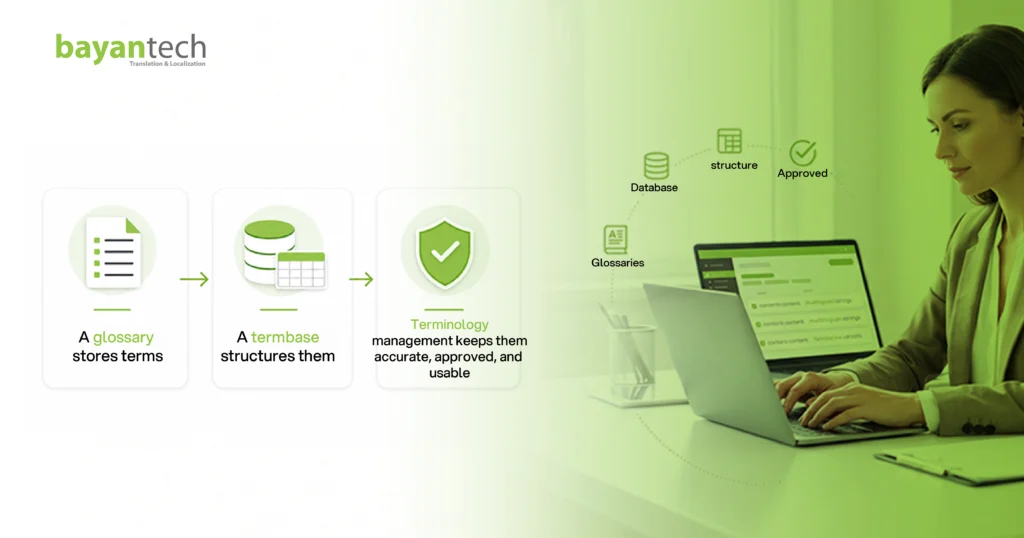
A glossary is where most teams start. It’s a working list of approved terms that translators can reference.
Termbase management takes that a step further. A termbase is a more structured resource; it captures multilingual concept relationships, term status, metadata, and approval workflows. Think of it as a governed terminology database rather than a shared spreadsheet.
Terminology management is the broader process: creating terms, approving them with subject matter experts, updating them after product changes, and making sure controlled terminology actually flows into your translation workflow, not just sitting in a document no one checks.
The distinction matters because a glossary that no one maintains becomes a liability. Terms go out of date. New products launch. Markets change. A managed termbase with a clear update cycle stays accurate.
What Terms Should Go Into a Multilingual Glossary?
Start with the terms that directly affect clarity, brand perception, and user trust:
- Product and feature names
- UI labels and button text
- Service names and taglines
- Acronyms and abbreviations
- Regulated or compliance-specific terms
- Industry-specific vocabulary
- High-frequency words that appear across multiple content types
- SEO terms (more on those below)
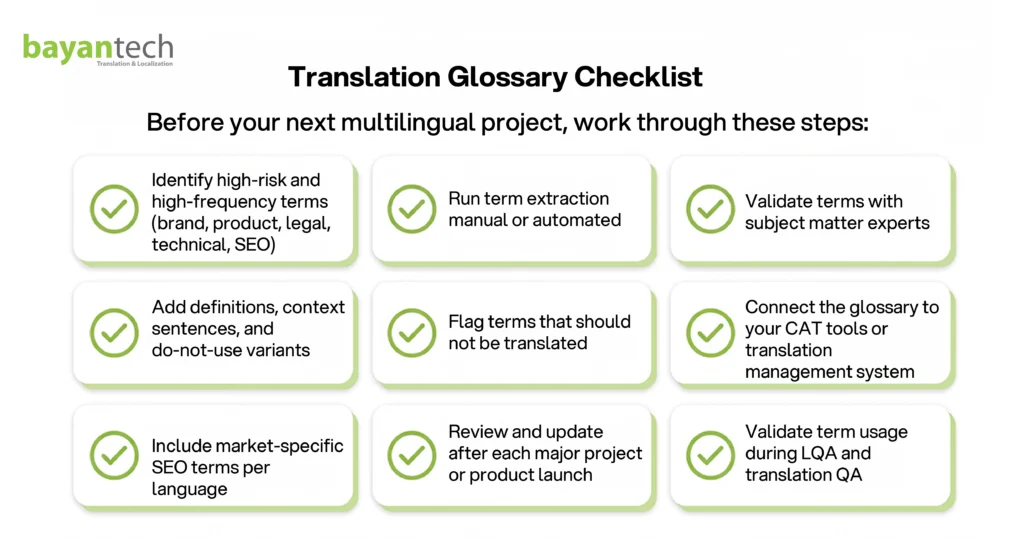
To identify candidates, teams can use manual term extraction by reviewing source content and pulling high-priority terms by hand. For larger content volumes, automatic term extraction tools can generate a first draft faster. Some platforms now offer AI terminology extraction to accelerate that process. Either way, human review and expert approval are non-negotiable before any term goes live.
Industry Glossaries: Medical, Legal, and Technical Translation
Some content simply cannot afford terminology errors.
A medical translation glossary covers clinical terms, dosage language, device names, symptom descriptions, and pharmaceutical instructions. In patient-facing materials or regulatory submissions, one inconsistent term can create serious risk.
A legal translation glossary keeps contract clauses, party names, jurisdiction-specific terms, and compliance phrases aligned across documents. Legal language is precise by design and that precision has to survive translation.
A technical translation glossary is essential for product manuals, software strings, engineering documents, and safety instructions. Technical terms often have no direct equivalent in the target language, so approved translations have to be established before translation begins not discovered during review.
In all three industries, the pattern is the same: define the terms before translation starts, validate them with subject matter experts, and apply them consistently through QA.
Glossaries for Keyword Localization and Multilingual SEO
This is an area most localization teams underestimate and where a glossary creates real competitive advantage.
SEO terms are not generic words. They reflect how real people in a specific market search for specific things. Translating English keywords directly into another language often produces technically correct but search-invisible results.
A glossary built for keyword localization documents approved SEO terms for each market based on localized keyword research, not literal translation. Those approved terms then flow into page titles, headings, metadata, and internal links consistently across your site.
This is how multilingual SEO actually works in practice: approved, researched terms reused accurately across every content type, rather than each translator or content manager making independent keyword choices.
What a Good Glossary Entry Looks Like
Here’s a simple example of the difference between a weak and a strong entry:
Weak entry: onboarding → تأهيل
Strong entry:
- Source: onboarding
- Approved translation: تأهيل
- Definition: The process of introducing a new user to a product or service
- Context: “Complete the onboarding steps to set up your account.”
- Do not use: إعداد (reserved for technical setup)
- Notes: Use consistently across help center, UI, and email
- Owner: Product Localization Team
Over time, entries like this build a terminology database that protects terminology consistency across teams, vendors, and content types and makes translation consistency something you manage proactively, not fix retroactively.
Build Your Translation Glossary Before the Next Project Starts
Getting translation right at scale starts with terminology. A glossary built before translation begins reduces reviewer corrections, vendor confusion, and QA delays and it compounds in value with every project.
At BayanTech, we help businesses extract high-risk terms, build translation glossaries aligned to their industry and markets, and integrate terminology management into a full translation quality assurance workflow.
Request a translation glossary audit to identify the terms that need approval, build a multilingual glossary for your next localization project, and connect it to your QA process before content goes live.